Picto Diary - 20 to 24 October 2026 - Hoover Retreat
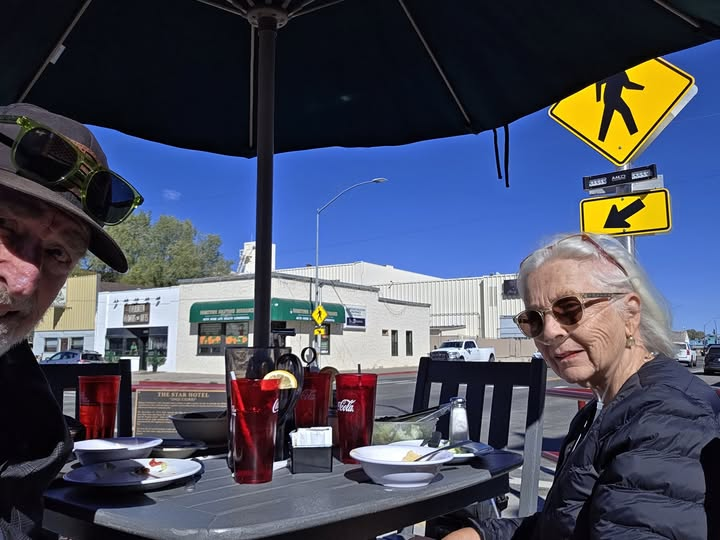
Above: Mwah (sic) and TIMDT, mid-feast at the Star Hotel, Elko, NV, 20 October 2026.
We left Park City bound for Palo Alto driving the Rubicon 392 via I-80, destination, a Hoover Institution donors’ retreat beginning early AM, 22 October 2026.
Elko is the obligatory Basque pause along the way: the Star Hotel, opened in 1910 by Pete and Matilda Jauregui as a winter boarding house for sheepherders, still serves the classic family-style spread that once anchored the Great Basin diaspora. (Wool Growers in Bakersfield remains the other non-negotiable.)
Basques from both sides of the Pyrenees arrived here in the late nineteenth century as ranchers and, later, the preferred sheepherders; the Euzkaldunak Club (1959) and its National Basque Festival each Fourth of July weekend keep the woodchopping, dancing, and Picon Punch tradition alive as one of the country’s oldest and largest such gatherings.
The usual two-day motorcycle or driving cadence broke when Winnemucca’s Gold Country Best Western sold out, depositing us one hundred twenty miles further down the road at Reno’s Atlantis. The hotel’s steakhouse had the reputation; we chose the Manhattan Deli instead. Nothing says “successful day on the road” quite like matzo-ball soup after a long stretch of sagebrush.
On the drive I finished (listening on Audible) the first two chapters of Victor Davis Hanson’s new The Counterrevolution: The Fall and Rise of Donald Trump and the MAGA Movement (sequel to The Case for Trump). Hanson frames the 2025 return as an actual counterrevolution against the progressive capture of universities, media, the administrative state, and cultural norms—not a cautious slowdown. Chapter 2’s account of the post–January 6 wilderness years of lawfare and institutional opposition, which he argues hardened the agenda and broadened the coalition, seemed the useful bit of homework before sitting in on VDH's sessions at the Hoover retreat.

Above: Stanford Park Hotel, Menlo Park, CA. 21 October 2026.
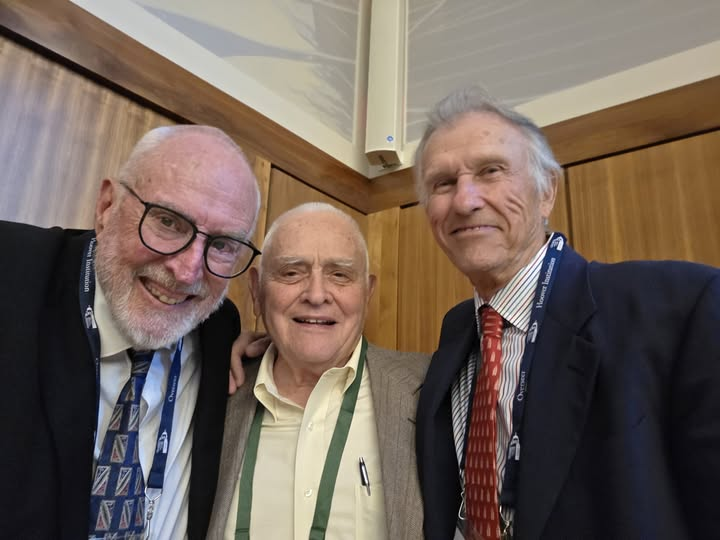
Above: Bishop, The Monk, and RMK.
William Blount Hall, David and Joan Traitel Building, Hoover Institution, Stanford University. 22 October 2026. Citibank Overseas alumni "reunion" at a Hoover Institution donor retreat.
SDT Selected Takeaways Hoover Retreat, Stanford University | 22 October 2026
Economic and Security Commons
Presenters: Condoleezza Rice, Philip Zelikow, and Steven J. Davis
The Economic and Security Commons (also called the Commons Initiative) is the Hoover Institution’s most ambitious multi-year effort in decades, launched in April 2026. Drawing on a phrase favored by the late George P. Shultz, it asks how the United States and other free societies can respond to accelerating geopolitical shifts, rapid technological change, and eroding confidence in democratic institutions. At its core is a framework of voluntary cooperation among free peoples—one that addresses shared problems while reaffirming opportunity, the social contract, and American leadership.
A steering committee chaired by Hoover Director Condoleezza Rice, with senior fellows Steven J. Davis, Stephen Kotkin, and Philip Zelikow, guides the work. It is organized around five broad goals:
- Show that democracy still works
- Create opportunity in the digital age
- Sustain the foundations of the American Dream
- Adapt American power for a different world
- Engage the ideas of friends and rivals
Nearly 30 research teams—drawing from Hoover, Stanford, and outside experts—examine specific topics under these headings. The initiative includes conferences (including a major plenary in September 2026), outreach through the Freedom Frequency Substack and other channels, and engagement with policymakers, business leaders, and international partners. It is framed as both scholarly and civic, aimed at a “hinge point” of history as America approaches its 250th anniversary.
One point raised by the panel was the slowdown in American manufacturing and the lag in US infrastructure investment. The Economic and Security Commons initiative would address this concern, among many others.
Apropos, obtaining the mike at the Q&A, I noted that I had recently read Hoover Research Fellow Dan Wang’s book "Breakneck," which argues that China’s advances in manufacturing and infrastructure have been aided by an engineering-focused leadership class. "Breakneck" by Dan Wang | Stephen DeWitt Taylor
Wang observes that Chinese political leaders, including Xi Jinping, have overwhelmingly been engineers, while American ones have mostly been lawyers. Engineers, he suggests, are wired to make things happen; lawyers are more inclined to dwell on the risks of making them happen. Would this US lawyer mindset, I wondered, hinder a revival manufacturing/infrastructure in the US sought by Hoover's Economic and Security Commons effort?
The panel replied that Dan Wang would play a key role as a subcommittee lead on the project. Condoleezza Rice observed that China’s engineering advantages coexist with serious structural vulnerabilities, including the demographic contraction set in motion by the one-child policy. I should note that Wang’s book itself offers a balanced account of China’s successes, opportunities, and risks.
Economic Fault Lines
Presenters: Eric Bettenger, Valerie Ramey, Paola Sapienza
Presenters listed five areas of economic woes for the average American:
Wage growth isn't keeping up with inflation.
It's hard to get ahead without a college degree.
High prices of food, energy and housing.
Job worries from tariffs and AI.
High mortgage interest rates.
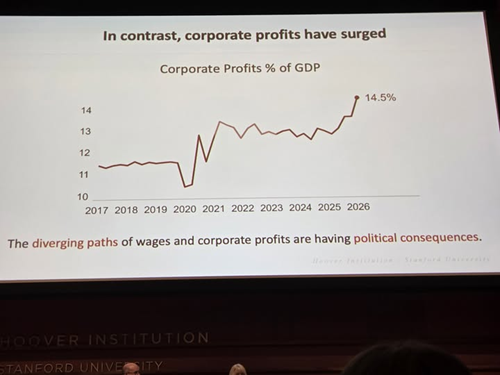
Above: Par Contra...
Presenters noted some troubling trends:
The less educated are being left behind.
Fewer children are doing better than their parents.
Troubling Education Trends... including:
- The Male Problem
- Declining Test Scores
- College Affordability and Debt
- Chronic Absenteeism
- Disruption on the Horizon: AI + Workforce + Tax Credit
Foreign Born Share of US Population at 1919 Levels
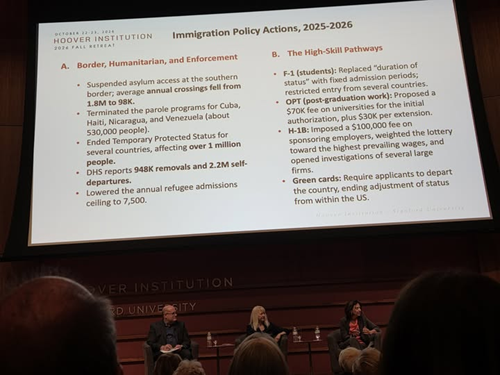
Above: Slide from "Economic Fault Lines" presentation.
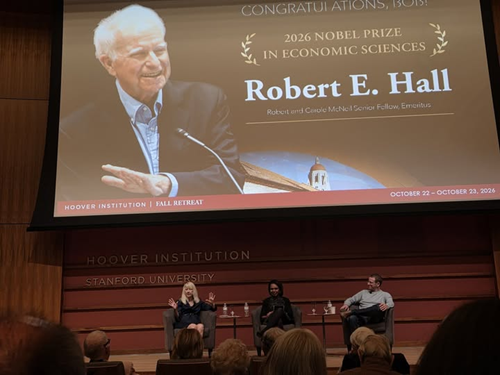
Above: Valery Ramey, Condi Rice, and Andy Hall. Hoover Institution, 21 October 2026. Celebration of Robert E. Hall Nobel Prize.
Valery Ramey, Hoover Senior Fellow is a former student of Robert E. Hall. Andy Hall, Hoover Research Fellow on loan to Anthropic, is Robert E. Hall's son. Here is a reference to Andy Hall presentation at Hoover's 08 August 2026 Jackson Hole event. Hoover and the Motorcycle - 08 August 2026 | Stephen DeWitt Taylor
Robert E. Hall, the Robert and Carole McNeil Endowed Professor of Economics and Senior Fellow Emeritus at Stanford University’s Hoover Institution, shared the 2026 Nobel Memorial Prize in Economic Sciences with Michael Woodford for their contributions to the “microeconomic foundations of macroeconomic stabilization.”
Their work rebuilt macroeconomic models from the ground up by focusing on how the decisions of individual households and firms shape overall outcomes, rather than relying mainly on statistical relationships among aggregates like inflation, output, and consumption. Hall’s influential research, notably a 1978 paper testing and extending Milton Friedman’s permanent-income hypothesis of consumption, showed how expectations about future income affect spending and helped undermine purely Keynesian approaches to fiscal stimulus. These insights became cornerstones of the New Keynesian models now used by central banks and governments worldwide to respond to economic shocks and smooth business-cycle fluctuations.
250 Years On and 25 Years On: American Power in Historical Perspective
Presenter: Sir Niall Ferguson
Two hundred fifty years on, the imperial scenario seems to be closer than ever. UCF at the White House.
Trump channels Nixon? Believe it or not, yes. At home, enemies list. Abroad, the national interest over idealism.
November 2019: Kissinger told me the US and China were "in the foothills of a cold war. November 2020: We are in the "mountain passes" of a cold war.
Late 2022: "The second cold war will be more dangerous than the first."
We have ended up in Zbig Brzezinski's "worst-case scenario:
The accurate wording from Zbigniew Brzezinski’s The Grand Chessboard: American Primacy and Its Geostrategic Imperatives (1997) is:
"Potentially, the most dangerous scenario would be a grand coalition of China, Russia, and perhaps Iran, an “antihegemonic” coalition united not by ideology but by complementary grievances. It would be reminiscent in scale and scope of the challenge once posed by the Sino-Soviet bloc, though this time China would likely be the leader and Russia the follower."
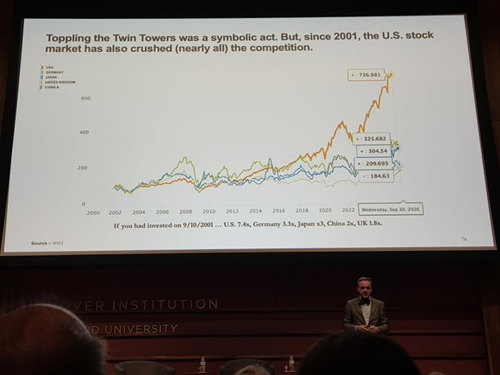
"Yet what I didn't anticipate was that the US would economically outperform both adversaries and allies."
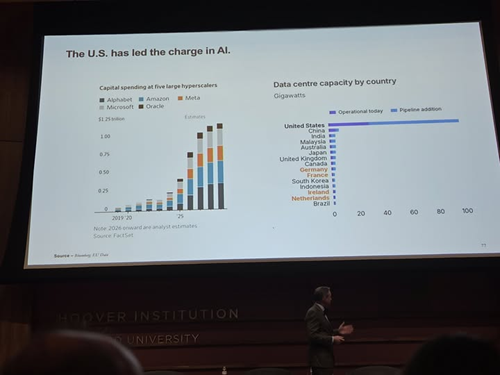
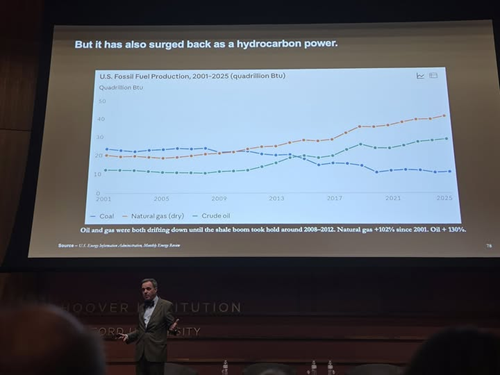
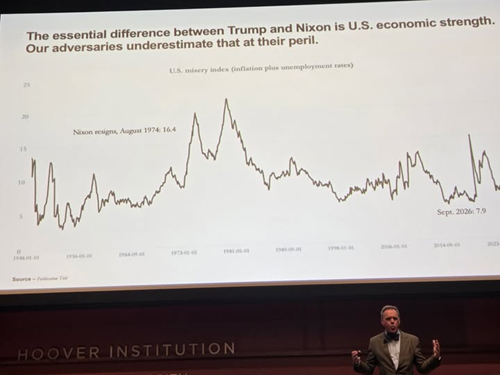
I got a question in to Sir Niall in Q and A.
First some background.
I have considered US involvement in the Ukraine War to be a fool's errand from the outset.
IMHO there was some validity in Putin's concern about NATO encroachment in areas outside of Russia's borders he deemed more "Russian" than the countries in which they were located.
The absence of a formal, binding non-enlargement commitment after 1990 left a political opening that the West used and Russia later framed as betrayal.
Rapid enlargement into Central and Eastern Europe, combined with partnership mechanisms in Ukraine, occurred while Russia was in a period of profound weakness; great powers have historically treated such zones as sensitive.
Ukraine’s own agency matters: it sought these partnerships as an independent state wary of Russian influence, consistent with the right of states to choose alliances.
Apart from giving Putin the benefit of the doubt after Russia's attack on Ukraine, there was little chance of the West/Ukraine prevailing in the war in the first place. Three reasons:
Russian Resolve. The West had little appreciation of the depth of Russia's commitment, including her historic ability to suffer, to accomplish an economic and cultural restoration of the motherland after eighty years of misery under Bolshevism. And significant progress has been made since the end of the communist era.
European flaccidity. Europe, with weak leadership, was suffering economic and cultural decline all exacerbated by a misguided energy policy.
Real Politic. Russia and the US are energy exporters. Europe is a net energy consumer. Both cultures share deep, Christian cultural underpinnings that are still alive today. Russia and the US were once allies in two world wars. They should be allies again.
So, my question to Ferguson was about Russian Resolve. I asked if the US hadn't underestimated the Russian ability to suffer (economically, casualties etc.) in the Ukraine conflict. I cited the historical example of the Battle of Stalingrad in WWII where Russia's will to prevail against Hitler included positioning fifteen thousand NKVD troops in back of the Russian line with orders to shoot Russian deserters.
Sir Niell answered to the effect that we should be more appreciative of Ukraine resolve in the face of Russian aggression. I can only presume he didn't like my question.
Russian Response to Islamic Terror
A Lunch Conversation Spurs a Thought
During lunch with someone steeped in Russian affairs, I mentioned that in 2014 I had ridden a motorcycle through northern Turkey, Georgia, Dagestan, Armenia, Ingushetia, and North Ossetia. I stopped in Derbent and then in Grozny. Both cities are roughly 90 percent Muslim. 2014 - Caucasus by Motorcycle | Stephen DeWitt Taylor
Fourteen years earlier, Russian federal forces under Vladimir Putin had flattened Grozny with artillery, air strikes, and missiles. The UN later called it the most destroyed city on Earth. Civilian deaths in the siege are estimated at 5,000–8,000. Putin declared the city liberated in early February 2000; the Russian flag went up over the center on the 6th.
When I arrived in 2014 Grozny looked brand new. Fresh boulevards, new buildings set among vacant lots where older structures had stood, a striking new mosque, a five-star hotel. The scars were still visible, but the surface had been poured over.
My lunch companion had been in Grozny in the late 1980s. He described the political climate that preceded the assault: local Islamic groups willing to deal with Moscow, and a radical Salafi-Wahhabi contingent of warlords and foreign fighters pushing stricter Sharia, a broader Caucasus jihad, and global ambitions. That faction, he said, had made the status quo untenable.
On the same trip I visited the City of Angels cemetery on the northeastern edge of Beslan, North Ossetia. It commemorates the school siege of 1–3 September 2004, when Chechen-led militants seized School No. 1 on the first day of the school year and took more than 1,100 hostages, mostly children and parents. The three-day standoff ended in chaos and a botched rescue that killed 334 people, including 186 children. Roughly 266 individual graves sit there—about 186 of them children’s—each with a uniform headstone and portrait. The complex also preserves the ruins of the school gymnasium and a central monument known as the Tree of Sorrow. It remains one of the main sites of annual remembrance.
After our conversation I kept turning over a contrast. Russia, faced with radical Islamist challenge, levels Grozny. France’s response to recent unrest has been narrower and more transactional.
In 2000 a friend and I had breakfast at Jo Goldenberg’s deli in the Marais. Goldenberg himself sat with us and told the story of the 1982 attack on his restaurant—an early, explicit case of Middle East-linked terrorism aimed at Jews in France. Jihadist violence later intensified with the GIA in the 1990s and then accelerated sharply after 2012: Merah, Charlie Hebdo, the Bataclan, Nice, and others. Many of the perpetrators were French-born or raised, of North African Muslim background, acting on Salafi-jihadist ideology. Official counts record dozens of such attacks and hundreds of deaths. The ideologies are not identical in every case, but the pattern of Islamist or related Middle East extremism is documented from the 1980s forward.
France and Russia face overlapping difficulties yet handle them in nearly opposite ways. One wonders whether they might gain more from practical collaboration on the problem than from treating each other as adversaries. If Marine LePen is elected French President in April 2027 a Russia/France rapprochement seems eminently possible if not altogether probable.
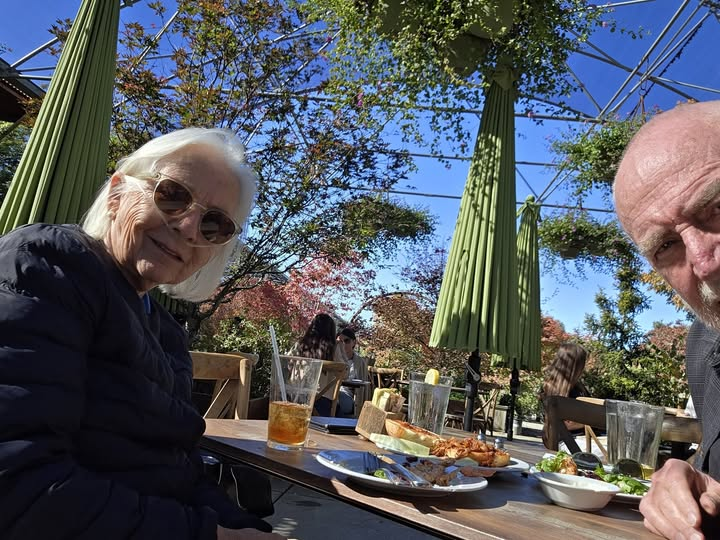
Above: High Hand Restaurant, Loomis, California. 23 October 2026.
One of our favorites in 49er territory.
This time we share:
Shrimp salad.
Pulled pork sandwich.
Carrot cake.
24 September 2026
Following, highlighted, are the five college football teams I have been following this year. I listened to two of the five games listed while driving the Rubican 392 across basin and range on I-80, from Reno to Park City. The two games that I listened to were thrilling games, but both of my teams lost. The three that I didn't watch or listen to, all my favorites came out on top.
- BYU (No. 2): Lost to UCF 31–39 in double overtime.
- University of Miami (No. 1): Beat Pittsburgh 52–23.
- Texas (No. 19): Beat Ole Miss (No. 7) 34–27.
- Michigan: Lost to Indiana (No. 6) 6–13 in overtime.
- Utah (No. 10): Beat Houston (No. 14) 21–13.