"Breakneck" by Dan Wang
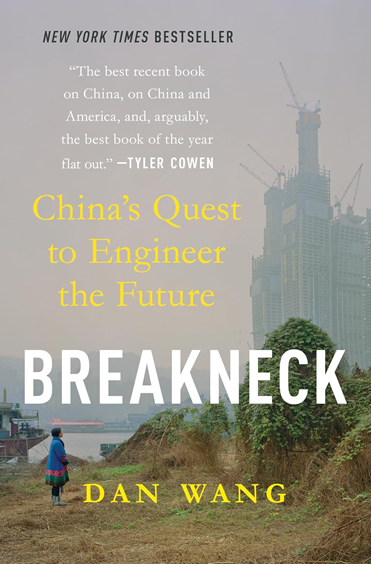
Above: Breakneck: China’s Quest to Engineer the FutureDan Wang (W. W. Norton, August 26, 2025; ~288 pages)
I completed reading this book today.
New York Times bestseller; shortlisted for the Financial Times/Schroders Business Book of the Year; widely praised as one of the strongest recent books on China.
AI assisted review followed by SDT personal observations.
Core Thesis:
Dan Wang (a Canadian Chinese technology analyst who lived in Hong Kong, Beijing, and Shanghai from 2017–2023 while at Gavekal Dragonomics, now a Hoover Institution research fellow) argues that the United States and China are better understood through professional culture and governance style than through Cold War labels such as “socialist,” “democratic,” or “neoliberal.”
China is an engineering state: its top leadership has long been dominated by engineers (by 2002 all nine members of the Politburo Standing Committee had engineering backgrounds; Xi Jinping studied chemical engineering). It brings a sledgehammer to problems—physical and social—building at breakneck speed.
The United States is a lawyerly society: dominated by lawyers (roughly half of Congress typically holds law degrees; five of the last ten presidents attended law school), it brings a gavel and prioritizes procedure, litigation, and blocking.
Both peoples, Wang contends, are strikingly similar—restless, materialistic, pragmatic, competitive, and awed by the technological sublime. The framework is not presented as a total theory but as a practical lens rooted in the author’s experience and reportage.
China’s Engineering Strengths
Wang opens with a 2021 bicycle ride from Guiyang to Chongqing through Guizhou, China’s fourth-poorest province. Even there, infrastructure (high-speed rail, bridges, highways) surpassed that of far richer U.S. states such as California or New York. Key evidence includes:
-
High-speed rail network roughly 20 times more extensive than Japan’s; a highway system twice the length of the U.S. interstate network.
-
Manufacturing scale: China produces one-third to one-half of most manufactured goods globally; capacity for ~60 million cars per year (out of a global market of ~90 million); in 2022, ~1,800 ships under construction versus five in the United States; projections of ~45% of world industrial capacity by 2030.
-
Shenzhen’s transformation from a fishing village into the world’s premier electronics hub. Wang emphasizes process knowledge—tacit, hands-on expertise accumulated in dense supplier and worker ecosystems (illustrated by the iPhone supply chain). This knowledge is not easily captured in blueprints and was largely transferred when Western firms offshored production. Chinese value-added in iPhones rose dramatically; the same ecosystems later underpinned dominance in solar panels, batteries, EVs, and drones.
-
Local incentives: officials advance via demonstrated construction and land-sale-driven growth, producing rapid physical transformation even in remote areas.
Social Engineering and Its Costs
The engineering mindset does not stop at bridges and factories. Wang treats the population as another material to be molded:
-
One-child policy (1980–2015): Driven in part by missile scientist Song Jian’s cybernetic projections. Enforcement involved mass sterilizations and forced abortions (tens of millions in peak years). It produced severe sex imbalances (~40 million “missing” women), international adoptions, and demographic consequences now being reversed. Fertility was already declining; the policy was both brutal and unnecessary.
-
Zero-COVID: Initially relatively successful, then catastrophic in Shanghai’s 2022 lockdown of 25 million people—food shortages, forced separations, pet killings, and abrupt policy reversal with little transition. Wang estimates nearly two million excess deaths (far above official figures). The episode highlighted both state capacity and rigidity.
-
Broader downsides: surveillance and repression of minorities, debt-fueled vanity projects, environmental damage, and a sense of precarity that has driven emigration (“rùn”) among the educated and wealthy.
Wang describes the Communist Party as a “Leninist Technocracy with Grand Opera Characteristics”—practical until it collapses into the preposterous. Growth and repression are not a paradox but linked features of the same mindset.
The American Contrast and Implications
The United States once built at scale (interstates, railroads, the works of Robert Moses and Hyman Rickover) but has shifted toward a litigious “vetocracy.”
High construction costs, endless permitting, and lawsuits stall projects (California’s high-speed rail versus China’s Beijing–Shanghai line is a recurring comparison).
Offshoring hollowed out manufacturing process knowledge, leaving firms such as Boeing, Intel, and Detroit automakers weaker. Recent federal efforts (rural broadband, EV chargers) have often delivered little relative to spending.
Wang’s closing reflections draw on his parents’ emigration to Canada/the U.S.: they forwent China’s property boom but gained greater personal freedom and security. He argues both countries are imperfect and can learn from each other. America needs to recover a sense of restless ambition and the ability to build (it need not copy China’s model; French, Japanese, or Spanish cost levels would suffice). China would benefit from greater respect for individual liberties. The ultimate contest, he suggests, is which system better serves its people. Mutual curiosity is preferable to inevitable conflict.
Reception and Limitations
The book has been widely acclaimed for its lucid prose, blend of reportage and analysis, and timely framework (praised by Tyler Cowen and others as among the year’s best on China). Critics note that the engineer/lawyer distinction, while illuminating, can be oversimplified: Japan’s law-trained bureaucracy still built intensively; America’s mid-20th-century building boom occurred under lawyer-led governments; development stage and Leninist incentives also matter. Some find the U.S. side thinner than the China portrait.
Overall, Breakneck offers a vivid, firsthand account of China’s physical and industrial ascent alongside its human costs, paired with a clear diagnosis of American institutional sclerosis. It is less a call for imitation than a provocation for both societies to address their characteristic excesses.
SDT Observations
During 2026 I encountered Dan Wang on two Hoover Institution related occasions, hence my interest in reading his book.
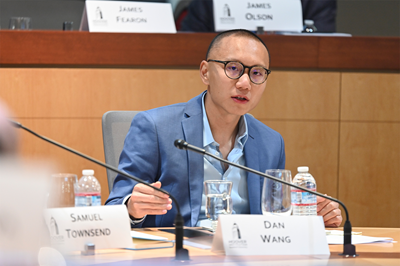
Above: Dan Wang. Dan Wang is a research fellow at the Hoover Institution, Stanford University, in its Hoover History Lab and is one of the most-cited experts on China’s technological capabilities. He is the author of Breakneck: China’s Quest to Engineer the Future (W. W. Norton [US] and Penguin [UK], Fall 2025).
Today (10 March 2026) I attended a virtual (zoom) Insider's Policy Briefing for donors to, and invited guests of, The Hoover Institution.
Dan Wang said a lot... but here are my main takeaways:
China has no ideological ken with Iran or Venezuela. China's interests are purely transactional.
China's dependency on Iran oil is less than might be perceived in today's exaggerated "headline" media climate. China has four months of oil reserves on hand. In her mission to be the world's preeminent manufacturing power she is growing electrical output at double the rate of the US. Here is my Grok search (not Wangs) to illustrate the energy growth point:
For a clearer year-by-year view (select key years from available tables, 2009–2024):
-
2009: China 3,715 TWh | US 3,940 TWh
-
2010: China 4,207 TWh | US 4,114 TWh
-
2023: China 9,456 TWh | US 4,254 TWh
-
2024: China 10,073–10,087 TWh | US 4,387 TWh
Significant "green energy" projects are afoot in the empty western deserts of China. Most people live on the coasts. Over 50% of China's energy comes from coal and that percentage will stay the same, or even grow, in coming years... meaning new coal fired plants year after year. China pays no fealty to the idea of designing her economy according to the demands of the climate lobby. China's energy push is to have diversified sources to secure a domestic energy independence.
China will lead in manufacturing and manufacturing technology for the foreseeable future... except for aviation and high-end chips.
China's domestic economy is anemic with a property overhang and bad debts in her banking system. This will not however, impede her push to dominate world manufacturing and manufacturing tech.
SDT
10 Mar 2026
The Vertex Forum, Scottsdale, AZ. 23 to 25 April 2026.
|
China's Edge and Ambitions
|
 |
|
In examining the global security and economic commons, China’s role on the world stage cannot be overlooked. At Vertex, Research Fellow Dan Wang discussed his bestselling book, Breakneck, which argues that China’s massive manufacturing capacity, rapid electrification, and relentless infrastructure building are giving China a globally leading competitive edge—as Western democracies grapple with burdensome regulation, excessive litigation, and political gridlock.
|
Fogbank
One of the worries that has stayed with me after reading the book is the risk of the United States losing its manufacturing process knowledge. Wang’s clearest public example is the Fogbank case.
Fogbank is a highly classified material used in several U.S. thermonuclear warheads, including the W76, W78, and W88. Experts widely believe it is an aerogel that functions as an interstage material: after the fission primary detonates, it becomes a superheated plasma that helps trigger the fusion secondary.
Fogbank was produced at the Y-12 National Security Complex in Oak Ridge, Tennessee, from 1975 to 1989. After the final W76 production run, the facility was shut down and later decommissioned. When the National Nuclear Security Administration needed the material again in the early 2000s for the W76 life-extension program, almost no one who knew how to make it remained and the records were incomplete. The NNSA first spent about $23 million searching for alternatives; none worked. It then spent roughly $69 million reverse-engineering the original process. Production resumed around 2008, years behind schedule.
Restoring the lost process knowledge proved both expensive and slow.
I believe that DJT's initiatives to resurrect US manufacturing capability are critical to US progress in its competition with China. Wang could have but did not, note this point.
Conclusion
This book is an easy, page-turning read with a strong narrative. I listened to the audiobook in two roughly three-hour sessions while driving from Park City, UT to Ivins, UT and back a few days later. The contrast between the “engineer state” and the “lawyer state”—rather than the usual socialist-versus-democratic framing—really resonated. Wang goes a bit too hard on Trump, in my view. Trump deserves real credit for putting a manufacturing revival back on the national agenda. Wang could have but did not, note this point. Finally, Wang's warning that the US is in danger of forgetting its long held "process knowledge" (Fogbank) thereby raising the cost and slowing the pace of its own needed manufacturing recovery should be a wake-up call.