"Artemis" by Andy Weir
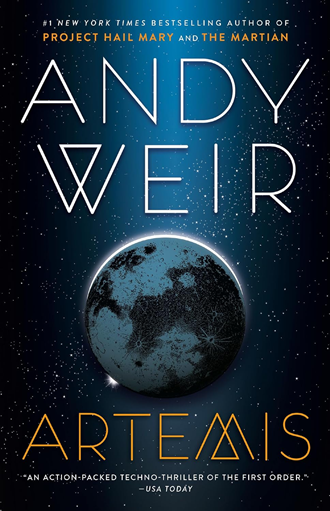
Above: "Artemis." Andy Weir. 303 Pages.
I completed reading this book today. 10 October 2026.
I had read two other books by Weir, "The Martian," and "Project Hail Mary." I enjoyed them enough that I decided to read a third book.
Here is a Grok summary of "Artemis" followed by SDT Comments.
Overview
The story follows Jasmine “Jazz” Bashara, a sharp-tongued, resourceful but flawed porter and small-time smuggler living in a cramped “coffin” apartment. When a wealthy client offers her a fortune to sabotage industrial equipment, the job escalates into a dangerous conspiracy involving control of the city’s oxygen supply, a powerful crime syndicate, and a revolutionary technology. Written in Jazz’s first-person voice, the novel blends heist plotting, lunar engineering and physics problem-solving, humor, and survival stakes in the style of Weir’s earlier work The Martian.
Plot Summary (Spoilers)
Jazz, who moved to Artemis from Saudi Arabia as a child with her devout Muslim welder father Ammar, scrapes by delivering packages and smuggling goods (often with help from her Earth-based pen pal and partner Kelvin). She has a strained relationship with her father stemming from a teenage incident that destroyed his workshop, and she carries related debts and guilt. She also fails an EVA Guild exam due to equipment issues, limiting higher-paying surface work.
Wealthy Norwegian businessman Trond Landvik (who lives on the Moon with his teenage daughter Lene, who benefits from the low gravity) hires Jazz for a million “slugs” (local currency) to destroy four automated anorthite harvesters belonging to Sanchez Aluminum. Sanchez has a near-monopoly: it produces aluminum from lunar rock and supplies the city’s oxygen as a byproduct in exchange for free energy. Trond wants to force a contract breach so he can take over oxygen production.
Jazz accepts for the money that would clear her debts and improve her life. Using welding gear borrowed from her father, a hull-inspection bot, and gadgets from her scientist friend Martin Svoboda, Jazz sabotages most of the harvesters on the lunar surface. She is spotted, forced to flee, and later helped back inside by former friend Dale Shapiro (an EVA guild trainer with whom she has a grudge).
She discovers Trond and his bodyguard murdered. Jazz recovers a case labeled “ZAFO” from Trond’s associate Jin Chu, survives an attack by assassin Marcelo Alvarez, and learns Sanchez Aluminum is a front for O Palácio, Brazil’s powerful organized crime syndicate. Svoboda determines ZAFO is Zero Attenuation Fiber Optic—a virtually lossless cable that can transmit data over arbitrary distances without repeaters, with enormous commercial potential. It can only be manufactured in low gravity, making Artemis ideal.
City administrator Fidelis Ngugi has been using Jazz as bait to flush out the syndicate, which threatens to seize control of the city. Jazz assembles a team (including her father, Dale, Svoboda, and Lene, who inherits Trond’s resources) to destroy Sanchez’s smelter so the oxygen contract can be canceled and Lene can take over under local control.
The sabotage succeeds but produces deadly chloroform that is pumped into Artemis’s air supply. With residents unconscious and dying, Jazz races to access Trond’s stockpile of clean oxygen. She nearly sacrifices herself but is saved by Dale. The city is saved; Lene pays Jazz; and Jazz uses some of the money to buy her father a new workshop. Ngugi nearly deports her but is convinced that Jazz’s controlled smuggling operation keeps worse criminals and dangerous goods out. Jazz ends up with limited remaining funds but arranges an investment tip via Kelvin related to the ZAFO opportunity, and she partially reconciles with Dale.
SDT Comments
The setting for the book is a 2000 population city on the moon in 2080. The plot flows and characters are interesting and well developed. But the plot is of ancillary significance given the extensive descriptions of the how's and what's of a city on the moon. "Artemis" is really science fiction for engineers.
The city exists primarily for tourism once commercial spaceflight has driven costs down enough that a one-way trip is roughly $33,000 (or a short vacation around $70,000 in the book’s framing). It sits near the Apollo 11 site (Tranquility Base) so visitors can take a pressurized train to a visitors’ center, about 40 km away to preserve the historic landing area. The precise site is a compromise near the Moltke Foothills: lowland terrain for the tourist draw, but close enough to highland terrain for easy access to the key resource mineral.
The core engineering insight is that the lunar highlands are largely made of anorthite (a calcium-aluminum-silicate mineral, roughly CaAl₂Si₂O₈). About 85% of surface rocks there are anorthite, which can simply be collected rather than deep mined. Smelting separates it into:
- Aluminum (primary structural metal),
- Silicon (for glass),
- Calcium (low-value byproduct, often sold cheaply),
- Oxygen (abundant byproduct—roughly eight oxygen atoms per two aluminum atoms).
This produces far more oxygen than the city needs for breathing; excess is used for rocket fuel or vented. The process is extremely energy-intensive, far beyond what practical solar arrays could supply without shipping prohibitive mass from Earth. Therefore, the city runs on nuclear reactors (compact designs analogous to those used in submarines). The principle is summarized as “the Moon is made of moon bases—some assembly required.” Sanchez Aluminum holds the long-term contract to supply the city’s oxygen in exchange for free power.
The city consists of five interconnected spherical “bubbles” (the most efficient pressure vessels), named after Apollo astronauts and specialized by function/class:
- Central Armstrong (first built, ~100 m diameter; more industrial),
- Aldrin (tourist zone with hotels, casinos, etc.),
- Conrad (lower income/blue-collar housing),
- Bean (middle-class),
- Shepard (wealthy residences).
The larger bubbles are ~200 m across. Each is roughly half-buried, so the visible domes sit above the surface while maximizing usable volume. They use a double-hull design: outer aluminum skin (~6 cm), a ~1-meter layer of crushed lunar regolith (radiation shielding + structural mass), and an inner aluminum skin. The rock layer also dampens the extreme lunar temperature swings (daytime >100 °C, nighttime ~–180 °C). Bubbles connect via tunnels with pressurized doors so a single hull breach can be isolated without depressurizing the whole city.
Life Support, Power, and Daily Engineering
- Atmosphere: Primarily oxygen from the aluminum smelter (plus any imported or recycled gases as needed). Airlocks and cycling systems are routine.
- Food: Full-scale farming is impractical given space and mass constraints. Residents (especially workers) eat “gunk”—nutrient-tuned chlorella algae grown in tanks, flavored to mimic various Earth dishes. Imported food is a luxury.
- Power and heat: Nuclear reactors dominate. Waste heat is rejected during the long lunar night.
- Gravity: Natural lunar gravity throughout most of the city (residents adapt to a characteristic “long-step” gait). Some hotels use centrifuges for short artificial-gravity experiences.
- Other: Silicon from smelting enables local glass; the overall design minimizes Earth-launched mass by maximizing local materials.
Weir has stated that nearly all the required technology already exists; the hard parts are the economics of launch costs, the energy demand of smelting, and the operational discipline of living in a sealed pressure vessel (fire, for example, is treated with extreme seriousness, similar to a submarine).
In short, Artemis is an aluminum city built from local rock, oxygenated by the same industrial process that produces its metal, powered by nuclear reactors, and shaped as double-hulled, half-buried spheres optimized for pressure, radiation, and minimal imported mass—all in service of a tourism economy near the Apollo landing site.