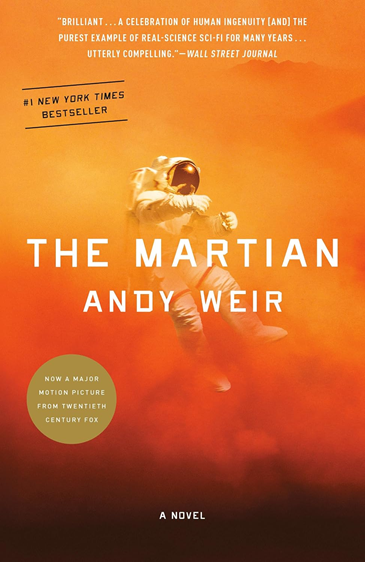
Above: "The Martian." Andy Weir - 369 pages. I completed (re) reading his book today.
The book was published in 2011. I first read it in 2015. I wasn't writing book reviews at that time... but I was keeping lists of books that I had read.
Here's a bare-bones chronology of Andy Weir’s "The Martian" (mission days are sols; a sol is about 24 hours 40 minutes):
-
Sol 6: A severe dust storm hits the Ares 3 site in Acidalia Planitia. An antenna strikes Mark Watney; his suit tears and bio monitor fails. The crew aborts and launches, believing him dead.
-
Shortly after: Watney regains consciousness, treats the wound with the Hab’s medical kit, and inventories supplies. He calculates he has food for roughly a year if he rations, but the next crew (Ares 4) is not due for about four years.
-
Following weeks: He farms potatoes in the Hab using Martian soil, Earth bacteria from waste, and water made by burning hydrazine. He modifies the rover for longer trips and begins logging video entries.
-
About sol 30–60: He recovers the 1997 Pathfinder lander and Sojourner rover from a site he can reach, restores them, and establishes limited communication with Earth. NASA and JPL confirm he is alive.
-
Ongoing: Ground teams devise resupply and rescue options. Watney’s potato crop is later destroyed by a Hab airlock failure and decompression; he salvages what he can.
-
Mid-story: NASA launches a rushed supply probe (it fails). An alternate trajectory (the Rich Purnell maneuver) is calculated so the Ares 3 ship Hermes, already en route to Earth, can swing back to Mars for a flyby rescue. The crew mutinies against orders and executes it.
-
Later sols: Watney drives the rover ~3,200 km to Schiaparelli crater, the Ares 4 landing site, living on remaining rations and solar power, and preps the Ares 4 Mars Ascent Vehicle (MAV).
-
Rescue window: JPL has him strip the MAV of weight (nose cone, life support, seats, etc.). He launches on a steep, underpowered trajectory. Hermes matches velocity; Beck spacewalks to intercept him after Watney breaches his suit to use the escaping air as thrust. He is brought aboard.
-
Aftermath: Hermes returns to Earth with the full crew. Watney survives.
The movie version of "The Martain also came out in 2015. Because I liked the book, I immediately saw the movie.
The next year, 2016, I sat in a San Francisco investor conference where the air was thick with talk of returns, margins, and five-year plans. Elon Musk was the dinner guest. When I got hold of a microphone, I asked what he thought of Andy Weir’s The Martian and the film. The question felt almost frivolous in that room—until Musk leaned into it as if the rest of the agenda had been a sideshow. He lit up. The book and the movie, he said, were not entertainment so much as rehearsal: the kind of story that lets ordinary people feel, in their bones, that Mars is no longer a myth but a destination. Earth’s lease is not eternal. One bad century, one unlucky asteroid, one cascade of failures, and the only known flame of consciousness in the universe could go out. Stories like "The Martian" do the quiet work of making multiplanetary life feel inevitable rather than absurd—so that when the ships are ready, humanity is ready to climb aboard. He spoke as if the hedge were already overdue, and the clock already running.
From that point on, I have become a believer. Mankind needs to go multiplanetary. Elon Musk is the key creative force on earth to make that happen.
Why reread "The Martian" in 2026? The SpaceX IPO lit the fuse. After years of private bets and patient waiting, the largest offering in market history put a public price on the idea that Mars is not a poster on a wall but a destination with a balance sheet. As someone who has long treated that mission as more than a slogan, I had skin in the outcome. I wanted the old voltage back—the scrape of regolith under boots, the thin air, the daily arithmetic of staying alive—even if only through Weir’s fiction. The stock’s debut did not put a boot on the surface. It did something quieter and, for a believer, almost as necessary: it suggested the wager had not gone stale, and that the long road off Earth was still the right one to be walking.
SpaceX went public on June 12, 2026, under the ticker SPCX on Nasdaq (and Nasdaq Texas), after 24 years as a private company. It priced the offering on June 11 at $135 a share, selling 555.6 million Class A shares and raising about $75 billion—the largest IPO on record, topping Saudi Aramco’s 2019 deal. The implied valuation was roughly $1.77 trillion. Underwriters fully exercised their overallotment option; the deal closed June 15 with total gross proceeds of about $85.7 billion on 638.9 million shares. Shares opened at $150 and finished the first day near $161, briefly pushing the market value past $2 trillion. Elon Musk kept majority voting control (reported around 82%) through super-voting stock. Lead underwriters included Goldman Sachs and Morgan Stanley. The company described the listing as funding its mix of reusable launch, Starlink, and longer-term multiplanetary work; 2025 revenue was reported at about $18.7 billion, driven largely by Starlink.
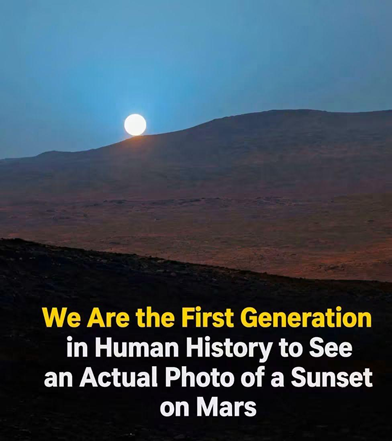
The above image is from NASA’s Curiosity rover in Gale Crater. On sol 5,000 (August 30, 2026, about 9:56 a.m. local Mars time) and again on sol 5,003 (September 2, about 5:39 p.m.), its black-and-white navigation cameras shot panoramas from a sandy ridge nicknamed Chocolatal. On Earth those frames were stitched together and tinted—blue for morning, yellow for afternoon—as an artistic read of the lighting, not a true-color photograph. Curiosity has also taken real color sunsets for years; the famous blue ones (for example from 2015) still recirculate. Fine dust in the thin atmosphere scatters blue light forward around the Sun, so the solar disk and nearby sky look bluish while the rest of the sky goes butterscotch.
I believe mankind's survival depends on the work today being carried out by Elon Musk. Read "The Martian" to help catch a vision of Musk's quest.