"The Song of the Sirens" by Peter Cawdron
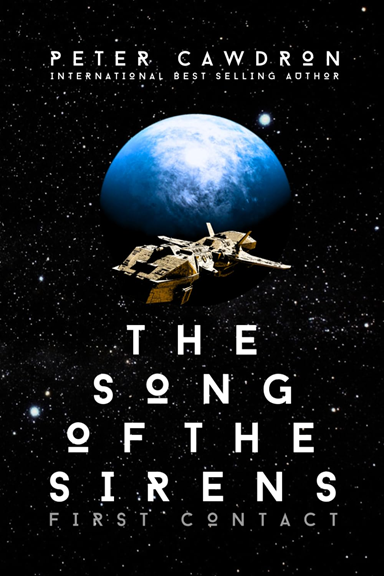
Above: "Song of the Sirens - First Contact," by Peter Cawdron. 297 Pages.
"The Song of the Sirens" is hard science fiction that respects known physics, keeps its pacing tight, and leaves ideas lingering after the final page.
I finished "The Song of the Sirens" today.
I’ve long been fascinated by how science-fiction writers wrestle with the speed-of-light barrier—the single greatest obstacle to any realistic vision of interstellar travel. Peter Cawdron’s novel offers a fresh, grounded wrinkle on the problem.
First, though, the scale of the challenge.
Voyager 1 coasts along at about 10.5 miles per second relative to the Sun. Light travels at 186,000 miles per second, so Voyager is moving at roughly 0.0056 percent of c. At that pace it would take tens of thousands of years to cover a single light-year. Alpha Centauri, our nearest stellar neighbor, sits just over four light-years away. Reaching it in any human lifetime with current technology remains pure fantasy.
Science-fiction writers have invented a colorful catalog of light speed workarounds:
- Star Trek: warp drive.
- Star Wars: hyperdrive.
- Interstellar: a conveniently placed wormhole near Saturn.
- Dune: the Holtzman Effect—space-folding powered by the spice mélange of Arrakis.
- Ender’s Game: ships that crawl along at a fraction of light speed, accompanied by extreme time dilation and instantaneous ansible communication.
- 2001: A Space Odyssey: a ship that limps along at Voyager-like speeds until an alien monolith opens a stargate.
- Project Hail Mary: a “spin drive” fueled by the energy-dense alien microbe Astrophage.
- The Hitchhiker’s Guide to the Galaxy: the Infinite Improbability Drive, a cheerful deus-ex-machina that simply drops the ship wherever the plot requires.
"The Song of the Sirens" takes a different road. By 2200 humanity has settled three or four outposts across the solar system and can push spacecraft to a respectable 5 percent of light speed. In theory that puts Alpha Centauri within range of a ninety-year voyage.
Rather than cryofreeze living adult passengers for nearly a century, Cawdron’s Alpha Centauri bound colonists travel as frozen human embryos in a robot constructed, hollowed out, rocket powered asteroid. Robots fly the rock and raise the first generation on arrival.
The new humans are fitted with AI implants that can be dialed up, dialed down, or switched off entirely—an idea the novel explores with quiet curiosity.
The story centers on Alex, an ordinary high-school student living on a colony asteroid in the Alpha Centauri system. Classes, friends, homework, and a girlfriend named Lux form the texture of daily life—until Lux ventures onto the surface and finds two bodies in charred spacesuits, left to mummify in vacuum. The suits bear the names Xander and Elizabeth. Suddenly every familiar detail begins to feel provisional. Who were they? Why were they abandoned? Accident—or something darker?
The first half of the book unfolds with almost no alarm bells, immersing the reader in the rhythms of adolescent routine before the illusions start to peel away. There are quiet echoes of The Matrix here.
Later the novel widens into humanity’s first encounter with extraterrestrial intelligence: underwater beings whose technology sometimes outstrips Earth’s, yet who have never cracked interstellar travel themselves.
Cawdron examines the social, political, religious, and scientific fallout of First Contact. "The Song of the Sirens" is hard science fiction that respects known physics, keeps its pacing tight, and leaves ideas lingering after the final page. Ideal for readers who like plausible interstellar stories that begin in the small details of daily life and expand into larger questions about truth, society, and what it means to be human four light-years from home. Short enough to finish in a sitting; substantial enough to reward a second thought. Recommended.