"Streetwise" by Lloyd Blankfein
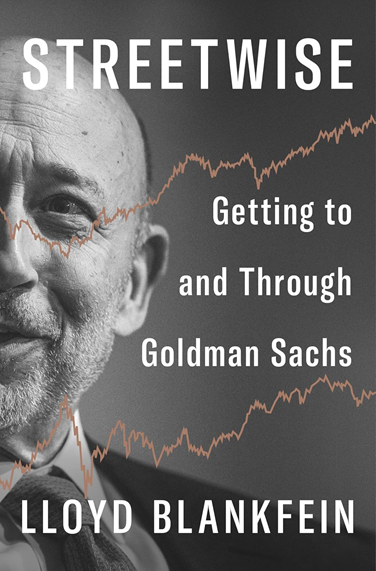
Above: "Streetwise: Getting to and Through Goldman Sachs" by
Lloyd Blankfein. New York: Penguin Press, 2026. ~400 pages.
New York Times bestseller; nominated for the Financial Times Business Book of the Year.
I completed reading this book today.
Here's Grok: Some personal notes at the end.
What the book is. Streetwise is Lloyd Blankfein’s memoir of rising from Brooklyn public housing to chairman and CEO of Goldman Sachs (2006–2018). It is part rags-to-riches story, part defense of the firm’s partnership culture, and part practitioner’s handbook on risk, leadership, and crisis. He says he began writing a private family history and then decided an insider account of Goldman—especially 2008—was worth putting on the public record, with humor, and without much apology.
The firm, the culture, the crisis. Blankfein’s central claim is that culture, not genius or luck alone, is the durable edge. He treats Goldman’s partnership ethos as something that had to be defended after the IPO: iterative argument instead of command, no “eat what you kill” pay that would make a banker unable to walk away from a bad firm-wide deal, risk managers winning arguments with traders, daily mark-to-market so losses could not hide. He is proud of treating promotion as making friends with people who earned it, not promoting friends.
Later chapters and tone. In 2015 he was diagnosed with aggressive lymphoma. Because a CEO’s illness is material information, he told almost no one, did six rounds of chemo, and ran meetings from a hospital room. The cancer receded. By 2018 the job’s costs outweighed its rewards; David Solomon succeeded him. Philanthropy (10,000 Women, 10,000 Small Businesses) and a line about giving with a warm hand rather than a cold one close the personal ledger.
Voice: sharp, funny in the early chapters, dryer and more committee laden as he climbs. Reviewers split along that seam. Bloomberg called it blunt, vulnerable, rarely apologetic; the Wall Street Journal, lively and insightful; Business Standard, a punchy read that explains products well. Kirkus liked the Brooklyn opening and found the C-suite stretch full of jargon and self-exculpation. That split is fair. The book is an education in how one very successful insider remembers risk, status, and luck. It is not a prosecutor’s brief against Goldman, and it does not pretend to be.
Takeaways worth keeping. Outsider eyes as an asset, not a costume. Culture as the thing you rebuild every year, especially after you go public. Risk as scenario planning, not prophecy—“If you were so smart you predicted what happened, tell me what happens next.” Composure as a job: his mantra in the crisis was “No choice, no problem.” Ambition that still notices the cost to family. And the honest limit of the genre: the man who ran the firm writes the history of the firm. Read it as that, and it earns its keep.
SDT personal notes.
Sandy Weill and the NY Jewish Middle Class Stereotype.
During my twenty years working at Citigroup, I worked with several highly capable Jews who grew up middle class in New York City neighborhoods like East New York and Brooklyn. So, I've long been fascinated with the stereotype, if there was one. As I read, I compared Blankfein and his traits with the people I had worked with. Do they play the establishment or the "kid from Brooklyn" as they move up the organization? Working at Citigroup I learned that it could be some combination of the two. And so, it was with Lloyd Blankfein.
I thought of Sandy Weill as an example of the New York City middle class Jewish "stereotype:" the Bensonhurst-born son of Polish Jewish immigrants who built a brokerage from scratch, sold it to American Express, then fused Travelers and Citicorp into Citigroup. He and Blankfein come from the same tribe—scrappy Jewish kids whose parents were in the rag trade or the lower civil service, striving middle class, each ending up running a giant bank.
Circa 2004 I read Monica Langley's book, "Tearing Down the Walls: How Sandy Weill Fought His Way to the Top of the Financial World and Then Nearly Lost it All." I worked at Citigroup from 1971 to 1991 and knew John Reed, who had been Citigroup CEO for four years when I left the bank in 1991. The Travelers/Citicorp merger didn't occur until 1998. Reed was a smart cookie. Who was this guy (Weill) from Travelers who ousted him from a co-CEO position in 2002 and how did he do it?
Reed was the cerebral Citibank technocrat: cool, memo-driven, a systems man who treated the Citi–Travelers merger as a partnership from which both men would eventually step aside. Weill was the opposite. He wanted the company, cultivated the board and treated shared power as temporary. What Reed lacked, on Langley’s telling, was Weill’s appetite for the fight: deal hunger, work on the directors, a need to stay, and a willingness to cut even a co-CEO. Reed had vision and manners. Weill had stamina, an insecurity that never clocked out, and no plan to leave. In 2000 that was enough. Can one say New York middle-class Jewish grit, ambition and hustle outplayed manners and play-by-the-rules in Weill's ouster of Reed?
Weill was the rumpled Bensonhurst kid—short, shy, stickball and a paper route, mother coming out of the house when the street got rough—who never acquired the white-shoe finish. Blankfein had a similar upbringing, though Blankfein was accepted into a white shoe school, Harvard and Harvard Law, where Weill was not. Established houses, both WASP and the older German-Jewish firms, would not take Weill into their training programs. He was like Blankfein in this instance who, despite his Harvard pedigree, would have never been able to start with uppity Goldman. Blankfein, however, fit right in in the rough and tumble atmosphere of J. Aron, Goldman's commodity trading subsidiary. Weill started as a Bear Stearns runner, was happier buried in 10-Ks than working a room, and stayed, in the eyes of the club, a bit crude: blowtorch temper, no MBA polish, the “wrong kind of Jew” in the old Wall Street caste system. The spilled soup-on-the-tie image is the right cartoon for Sandy Weill.
What Weill did have was appetite and a cold eye for the balance sheet. He built a firm by swallowing wounded brokerages nobody else wanted, sold Shearson to American Express, got boxed out by Jim Robinson’s patrician circle, and then came back harder—Commercial Credit, Travelers, Salomon, Citicorp—until he sat on top of the supermarket he had assembled. Loyalty and rage lived in the same man; he could be generous and he could cut a protégé (Jamie Dimon) when power was at stake. The manners never caught up with the empire. That was the point: the Street that once would not train him ended up organized around the deals he was willing to do. In contrast to Weill, as Blankfein moved to the top of Goldman Sachs, he seemed to morph patrician while retaining the skeptical street smarts of his upbringing.
Here's a Grok list that profiles other New York middle class Jewish high achievers:
-
Richard Rabinowitz — grew up in working-class Jewish East New York; later Harvard-trained public historian. His memoir is explicitly about that lower-middle-class ENY world most “Jewish success” stories skip.
-
Jerry Domershick — Thomas Jefferson High School playground-to-college basketball standout from the same East New York pipeline.
-
Ruth Bader Ginsburg — Midwood two-family house, P.S. 238 and James Madison High; immigrant garment-trade family. Not the projects, but not fancy.
-
Sandy Koufax — Bensonhurst; father a lawyer who was not wealthy; public-school kid who became the era’s defining pitcher.
-
Mel Brooks (Melvin Kaminsky) — Williamsburg tenement; garment-worker relatives; USO to comedy to Hollywood.
-
Barbra Streisand — working-class Flatbush / Williamsburg; public housing adjacent, single mother, Erasmus Hall.
-
Larry King (Zeiger) — Brownsville; father died young; radio from a thin wallet.
-
Elliott Gould — Bensonhurst; mother sold artificial flowers, father in textiles.
-
Judge Jack Weinstein — raised and schooled in Brooklyn (Lincoln HS, Brooklyn College); longtime federal judge.
-
Adam Richman — Sheepshead Bay / Midwood day school, then Emory and Yale Drama.
- Same social type, not the same zip code
Chuck Schumer and Bernie Sanders