Reflections on College Sports - 26 December 2025
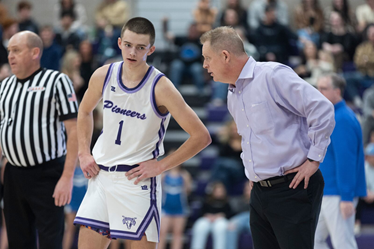
Above: Lehi’s Cooper Lewis, left, listens to his father, coach Quincy Lewis, during a game against Pleasant Grove at Lehi High in Lehi on Friday, Jan. 26, 2024. Lehi won 77-61. Marielle Scott, Deseret News (scroll for Cooper's story).
Recently, I've been following college football and basketball a little more than usual. That's probably because in both sports, BYU and University of Miami are doing pretty well. I'm a graduate of BYU where I played basketball for one year on scholarship. My son Jake graduated from The University of Miami and also went to law school there. For about three years in the late 80's, I served on the Citizens' Board of the University of Miami.
That being said I'm troubled a bit by the way the game has been changed by NIL and the transfer portal. By compensating players large amounts of money and giving them (transfer portal) the freedom to respond to better offers on other teams, we seem to be losing something that has been important to college football in the past.
Now we see rampant roster turnover. Thousands of players enter the transfer portal annually. This disrupts team cohesion and long-term program development. Wealthy programs dominate via massive NIL collectives. Smaller schools are turned into "farm systems." This erodes traditions, prioritizes money over education, and blurs amateurism, making football feel semi-professional. How does the old school spirit survive in such an environment?
My first memories (I was six) of watching college sports come from my dad taking me regularly to watch BYU basketball home games in 1951, the year the Cougars won the NIT. Back then the winner of the NIT championship at Madison Square Garden in New York City, was THE national champion. Today if asked who my favorite BYU basketball stars were, I answer, "Roland Minson, Mel Hutchins, and Jumping Joe Ritchie." I always get a flummoxed look. Questioners expect me to answer Danny Ainge or Jimmer Fredette.
Mel Hutchins was a first team college All American in 1951. He was drafted second overall in 1951 by the Tri-Cities Blackhawks (who became the Milwaukee Hawks that same year) and played his entire seven-season NBA career (1951–1958) with three teams: Milwaukee Hawks (1951–1953), Fort Wayne Pistons (1953–1957), New York Knicks (1957–1958).
Then there's my own stellar college basketball career! I played freshman basketball on scholarship for BYU during the 1965/66 season. Varsity coach Stan Watts, well regarded at the time, called me directly to his office and offered me a full scholarship. The year before I had attended American University in Cairo, Egypt. While in Cairo, I played as sixth man for the Gezira Sporting Club. Three or four members of the Egyptian Olympic Team played for Gezira, including Sammy Shelbaya, who was a national hero. I remember how I was treated as a real friend by the Egyptian players. The Cairo club league games were televised locally in those days and I became a well-recognized person about town... the tall, lanky American kid who played with the Egyptian basketball greats.
Former BYU great, point guard, Gary Earnest was BYU freshman basketball coach. I had a good turnaround jumper at the top of the key. Earnest didn't play me much... maybe five minutes a game, and then, only if we were winning solidly. I make no excuses. Aside from the great turnaround jump shot I was weak on moves; couldn't go left. My friend, Hoops, my age, who played high school basketball at Monsignor Scanlan in the Bronx, says if he had known me at high school age, he could have made me a great player. Hoops played against Lew Alcindor (Jabbar) while in high school. Hoops was a starter at Harvard and played pro-ball in Switzerland after graduation.
One time, while playing for the BYU freshman against Colorado Mesa College in Grand Junction (then a two-year school) I made a beautiful shot, turning to my left, from the top of the key. When I got back to the bench, one of my teammates told me that when I was about to take the shot, Earnest exclaimed, "oh no, Taylor is going to take another one of those dumb shots." When the ball swished, I was told that Earnest said, "but he does it really well." I went on a Mormon mission to France the next year and never returned to the game. I had recurring dreams for years that I was a BYU basketball star, though.
Roger Reid, against whom I had played high school basketball when he was at Springville Highschool, was also on Gary Earnest's BYU freshman team in 1965/66. Roger was a starter and showed great promise to be a varsity standout, which turned out to be true. Roger Reid played minor league baseball as a shortstop over four seasons in the farm systems of the Atlanta Braves and Chicago White Sox organizations, reaching the Triple-A (AAA) level.
Roger Reid served as head coach of the BYU Cougars men's basketball team from 1989 through mid-season in 1996–97. He succeeded LaDell Andersen in 1989 after serving as a BYU assistant coach from 1978 to 1989. During his tenure as head coach, Reid compiled an overall record of 152–77 (.667 winning percentage), which remains one of the highest in program history for coaches with extended service. His teams achieved consistent success, including:
- Six consecutive 20-win seasons to start his head coaching run
- Three Western Athletic Conference (WAC) regular-season championships
- Two WAC tournament championships
- Five NCAA Tournament appearances (with a 2–5 tournament record)
Reid was named WAC Coach of the Year twice and mentored several players who advanced to professional basketball. His time ended abruptly when he was fired on December 17, 1996, during the 1996–97 season after a 1–6 start (complicated by injuries, recruiting controversies, and other factors).
My best friend in high-school, Tim Lewis, like me on Provo High School's basketball team in 1963, didn't have the "moves" shortcomings that I did. Tim played basketball at Southern Utah University and went on to be one of the winningest high school basketball coaches in Utah history. Tim is in the Utah Sports Hall of Fame. Tim's son Quincy played for Wagner University in NYC. Quincy's son Cooper, coached by his dad Quincy at Lehi High School, was named Utah Highschool basketball player of the year in 2024. Cooper, after completing an LDS mission, will play college ball 26/27 season at St. Mary's where he will receive significant NIL money.
Tomorrow, my son Jake is coming up to Park City to watch BYU play Georgia Tech in the Pop-Tarts Bowl played at Camping World Stadium in Orlando Florida. I expect to have a good time, just being with my son. But as for the games of college football and basketball? Something is not right. When I reflect on this question, here is the first thing that comes to mind: "For what shall it profit a man, if he shall gain the whole world, and lose his own soul?" Mark 8:36.