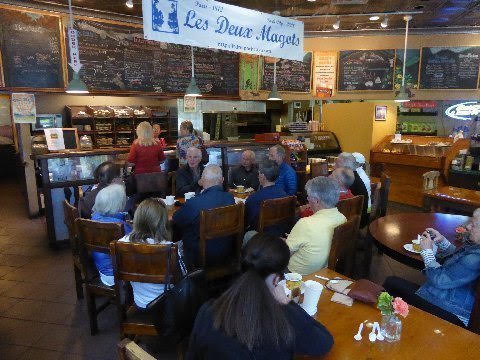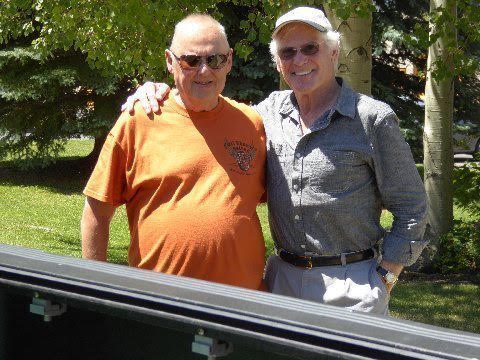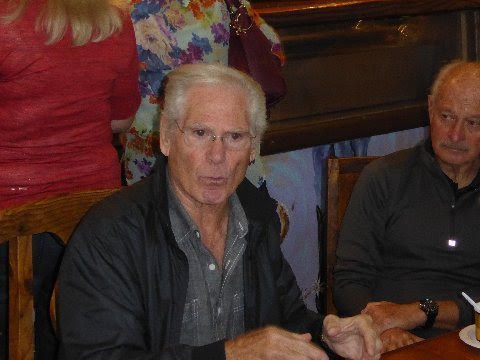
Above: Bob Goodman presses a point to LSDM ROMEOs. Seated at Goodman's left, Montage. La Societe Deux Magots, Wasatch Bagel, Park City, UT. 31 July 2015.
A Tale of Two Systems
Most Americans believe the nation is not in a real recovery regardless of what economists say.
The reason for this disconnect is that the United States is in the middle of a short-term, cyclical economic adjustment superimposed over a long-term economic sea change to a slower growth path. This overlap causes recessions to be exaggerated and prolonged, while recoveries tend to be shorter and less dramatic.
The longer cycles stem from the ongoing conflict between our economic system of free-market capitalism and our democratic political system.
When you allow our type of economic system to operate freely, within the law, and let the markets dictate outcomes, what you tend to get is a very efficient economic system. You get lots of growth, you employ a lot of people, you get low interest rates, low inflation, profits grow very rapidly, and equity markets, which reflect that health, typically do very well.
But with the very positive economic outcome, the social outcome can be problematic. Maximizing profits is an economic, not a social motive. The media tends to lump both the social and the economic together and declares our free-market economic system as unfair. In a social sense there may not be fairness, but, in an economic sense, the system is fair.
In an economic sense it is perfectly fair to expect a superstar baseball player, take Alex Rodriguez, to earn $25 million a year and a public school teacher to earn $60K a year. In terms of the social implications, nobody would doubt that the teacher is worth more than A-Rod, but in an economic sense, given A-Rod provides entertainment value for millions, the free market system declares A-Rod is worth much more.
In a political sense you may be as equal as Donald Trump, but, form an economic standpoint 'the market' says he's more productive.
Because the American people look at the results of a freely functioning capitalistic system as socially unfair, they equate it with being economically unfair, and when we deem something as unfair, we vote to change it. In a democracy, if the majority of American voters want government to redistribute the wealth from those who have produced it to those who will consume it, that is going to happen, but not without consequences. The result will be a less efficient economic system.
You can't blame our free market system for creating inequalities between and among people. Its just the nature of our system. Our system rewards people based upon their contribution to the system. The American people don't seem to understand that we can't ask our type of economic model to do something for which it was not designed; that is, deliver a fair social outcome.
The American people are getting what they say they want. They want a more equal distribution of income and wealth; and our government will try to achieve that result by manipulating our tax system. In so doing, they may remove the very incentives for people to compete, to take risks, and create jobs. That strategy will inhibit long-term growth.
Demand Problem
The US is facing a similar economic situation it faced during the Great Depression. To really put people back to work today, it may be necessary to recreate the WPA, TVA and CCC, and build dams, and roads, and bridges. While I know that means more government spending, in the near term that's what its going to take to restart this economic engine.
Supply side economic solutions, which worked in the late 70's and 80's, during the Reagan era, will not restart the current, clogged economic engine today.
In the short run, we're going to have to run a large budget deficit. In the long run, however, we must eliminate the structural deficit that appears to be baked into the system. This can be done by a combination of slowing the growth of government spending combined with a major overhaul of our tax system, with the objective of making it more efficient.
The challenge is there is an overwhelming majority of the American people that stand to benefit from government giving them something. They don't understand that big government has only what it can get from other people. So these issues wind up being a transfer from those who are producing to those who are consuming. Only the arithmetic is now running against us.
Its going to take a lot more pain before we get any real change, and we haven't reached that threshold. Not yet, anyway.
You could put me in the Oval Office with President Obama and shut the door and I would tell him the same thing that any economist would tell him. He's bright and he'd get it, he might even agree with everything I say. However given political reality, there would be nothing he could do about it because he'd never get re-elected. In a democracy the people get what they ask for, not what they may ultimately need.
The Future
As more an more countries adopt a free-market system, it will be come increasingly difficult for the US to compete as they become more efficient and we become less so.
That means that over the longer run, Americans may have to adjust to slower growth and shrinking opportunities, meaning fewer jobs, which eventually leads to politicians getting thrown out.
Its like a pendulum. A pendulum swings from one extreme to the other, so eventually we will see a turn like in 1979 and 1980, which came about after the American people suffered enough that they threw everybody out and started brand new with Ronald Reagan. That will hnappen again, only we haven't experienced enough pain yet.
The current economic outlook does not appear to be conducive to the kind of investment returns to which we have been accustomed. Advice? Force yourself to step away from the day-to-day discussion of economic events and adopt a more macro view of the world. Adopt an investment plan to fit this macro world view.