Picto Diary - 2nd Ridge - 15 June 2015
.... all tactical authority was handed over to his [Hamilton's] two corps commanders, Hunter -Weston with the British on the Cape Helles front, and Birdwood with the Anzac forces at Gaba Tepe. Since these two officers also remained at sea through the vital hours of the day they too were without accurate information. Signaling arrangements on the shore began to fail as soon as the first contact with the enemy was made, and very soon each separate unit was left to its own devices. Thus no senior commander had any clear picture of the battle, and battalions divided only by a mile or two from the main front might just as well have been fighting on the moon for all the control the commanders exercised on them.
"Gallipoli." Alan Moorehead
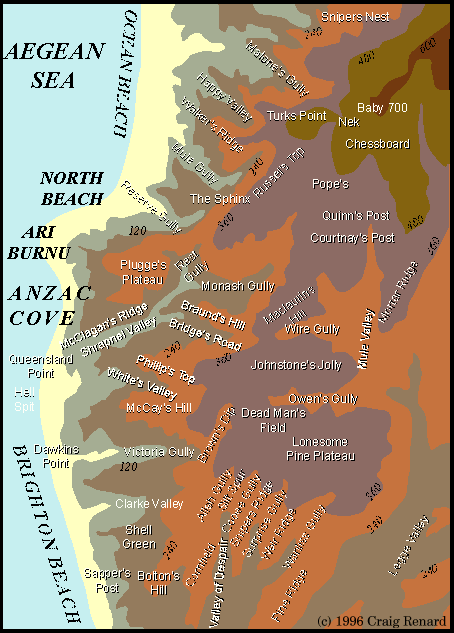
Above: Map showing area of Anzac concentration between beach landing, 25 April 2015 to 06 August 1915, the day of the start of the August Anzac offensive. Gallipoli. Turkey. Sapper Gallipoli Centenary Tour. 15 June 2015.
In the first 24 hours of fighting Anzacs established a front line on 2nd ridge, the purple segment of the map.
Yesterday members of the Sappers Gallipoli Centenary Tour, organized by Boronia Travel Center and led by battlefield tour guide, Rod Margetts, walked up Shrapnel Valley (see map) to Shrapnel Valley Cemetery. Buried there is Major Hugh Quinn, one of Australia's most revered war heroes.
Sharpnel Valley was the main supply line from the beach to the Anzac front line.
Quinn, 27 year old commander of C Company, 15th Battalion, Australian Imperial Force, and his detachment of 226 men took over the position now known as Quinn's post (see map) from troops of the 14th Battalion on 29 April. For the next month some of the bloodiest fighting of the Anzac Gallipoli campaign happened along the front line at Quinn's post. Quinn was killed there on 29 May while reconnoitering for an attack to recapture trenches seized ty the Turks earlier in the day.
From Shrapnel Valley Cemetery we walked, a 1000 meter long 150 meter elevation climb, to Plugge's Plateau (see map). From there we could see the Lone Pine monument on 2nd ridge, just south of where Quinn's Post is located. Plugge's Plateau was held by the Anzacs for the duration of the campaign.
Turkish Army head quarters were located on The Chessboard.
Other segments of the front line (simplifying here) were located near Walker's Ridge separated from the 2nd ridge front line by deep, inaccessible ravines.
Walking these ravines today, as the Anzacs did 100 years ago, gives rise to a vivid, "lump in throat sense" of the Gallipoli ordeal.
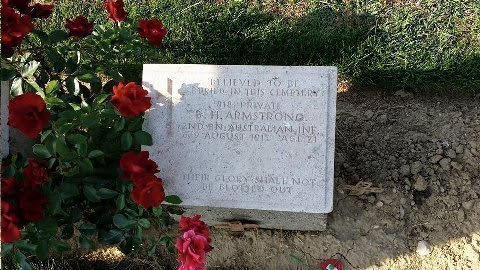
Head stone of Benjamin Harrison Armstrong. Lone Pine Cemetery, Gallipoli Peninsula, Turkey. 15 June 2015.
Armstrong (called Anzac Armstrong in record of American graves in foreign battlefields) was only known American citizen to fight under Australian command at Gallipoli.
On 25 April 1915, Lone Pine, atop Second Ridge, became a forward entrenched ANZAC position.
Original battle plan was for the ANZACs to get one ridge further inland...Gun Ridge (just off the above map to the east). An early command decision (snafu) to divert fighters, having Gun Ridge as an objective, to other areas, strategically less important, compromised the landing's overall objective. Another "woulda, coulda, shouda,"
Two Anzacs did reach the top of Gun Ridge, with a view of the Dardanelles, but having outstripped their supply lines they retreated to find their units.
On the initial landing, troops, expecting a fairly easy beach, found gnarly hills, cliffs and ravines. It was dark. Soldiers got separated from their commands. For the first twenty four hours, unorganized Anzac groups of soldiers fought their way east as best they could.
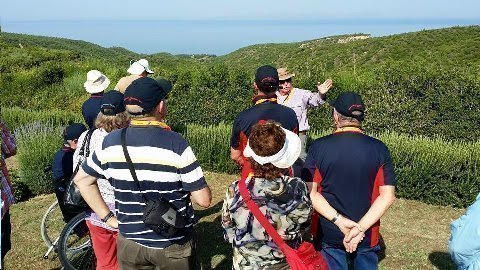
Rod Margetts speaks to the Sapper Tour of Gallipoli. Quinn's Post. 2nd Ridge. 15 June 2015.
Quinn's was on the front line facing 21st regiment and 59th Division Turkish Troops led by Col. Mustafa Kemal...later Ataturk, president of Turkey.
Image looks west to the Aegean Sea. Below the ridgeline is Anzac Cove, where 25K Anzac were landed between 25 April 1915 and 01 May 1915. Objective : Secure the Gallipoli peninsula to allow opening of the Dardenelles for an allied sea assault on Constantinople.
In the distance is Plugge's plateau (right, rock layer visible... where we stood yesterday) and Shrapnel Valley, the main supply route from the beach to the front lines.
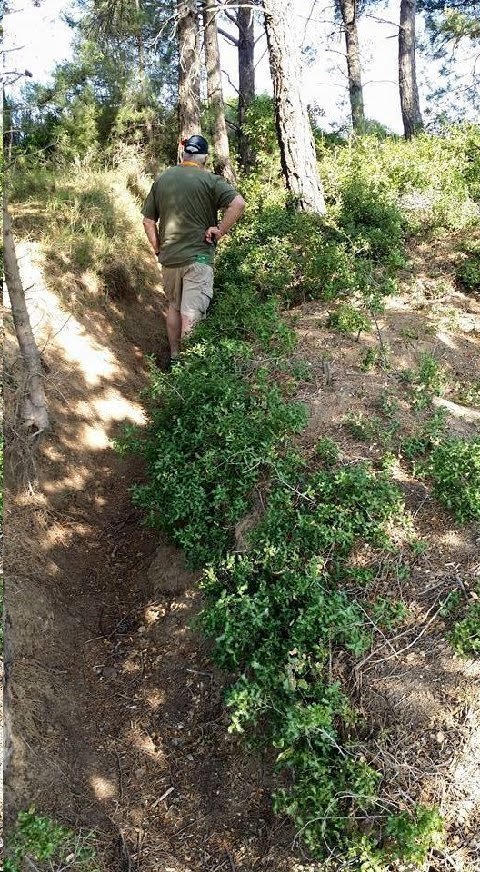
Above: The Bishop standing at forward ANZAC trenches (eroded significantly over 100 years). Quinn's Post. 1 km inland from landing beach atop 2nd Ridge. Gallipoli Battlefield. Turkey. 15 June 2015. Turkish trenches only 10 meters away at this point.
After lines were established in late April 1915, Turks mounted a counter offensive on 19 May 1915. Bloodiest fighting was at Quinn's. 10,000 Turk casualties before Turkish pull back after 2 days fighting. Limited ANZAC casualties as ANZACs well dug in.
Margett's authoritative narrative and supplementary readings ("Anzac Jack," "Gallipoli" by Alan Moorehead, various web searches) go far to give me a sense of "the ground," as Margett's calls it, the fighting resolve of young men on both sides, and the intensity of the fighting. It is sobering to stand in this trench, let the imagination run a bit, and hear in my mind, Hugh Quinn calling out orders to his men. It happened right here 100 years ago.
Also sobering is knowing that these men on both sides died for capricious reasons. There was no ideological reason to fight a war in 1914. Leaders like Tsar Nicholas and Kaiser Wilhem were insecure dilettantes surrounded by scheming advisors. The French and the British, fearful of German naval buildups, sought alliance with with Russia. When teetering, weak Austria Hungary decided to go against the slav Serbs post Sarajevo, the slav Russians had to protect their fellow slav tribe members. Germany, ally of Austria Hungary, backed Austria Hungary's attack on Serbia. And Britain and France were obligated by treaty to support Russia. It all happened in one month. August of 1914.
Turkey's story is equally poignant. As the Ottoman Empire, wearied by the Balkan wars in 1912, and a century long process of decline where its ability to protect the far flung parts of its empire had weakened, the Turks could have remained neutral in WWI or thrown in with the Allies. Another "woulda, coulda, shoulda" intervened to tilt Turkey towards teaming up with the Central Powers when Churchill sequestered two recently constructed battle ships bought and paid for by Turkey and diverted the ships to the British war effort. Germany opportunistically brought two ships up the Dardanelles and gave them to Turkey. Advantage Germany and Central Powers.
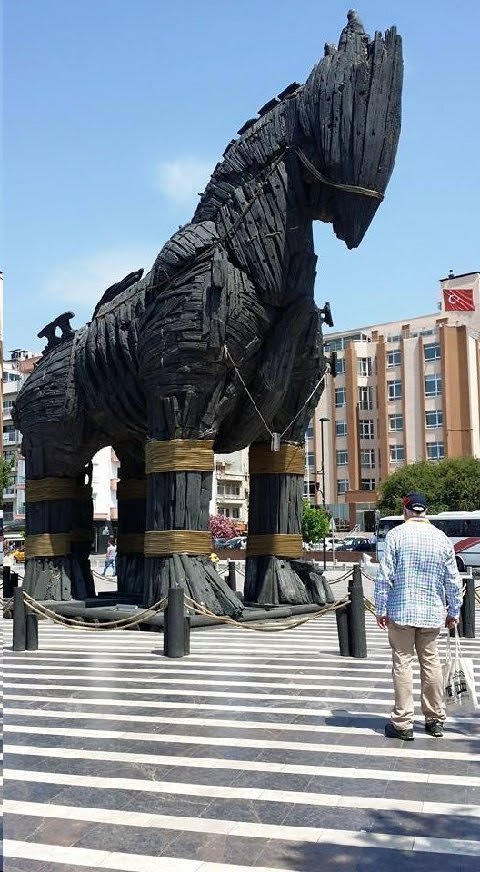
Above: The Bishop and The Trojan Horse. Canakkale, Turkey. 15 June 2015.
Canakkale is 18 miles north of ancient Troy, on the Hellespont (the Dardenelles). Both on the Asian side.
The horse shown was made for the movie "Troy," starring Brad Pitt.
Can the meaning of life be found in this horse? Does Homer have the answer?
Herodotus?
"And now, as he looked and saw the whole Hellespont covered with the vessels of his fleet and all the shore and every plain about Abydis as full as possible of men, Xerxes congratulated himself upon his good fortune; but after a little while he wept."
Herodotus, Book VII, Chapter 45
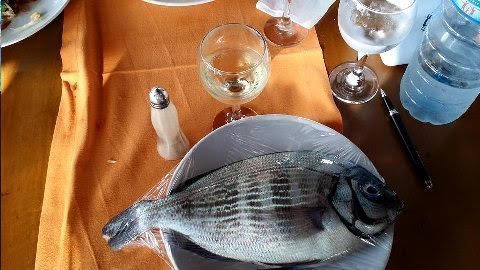
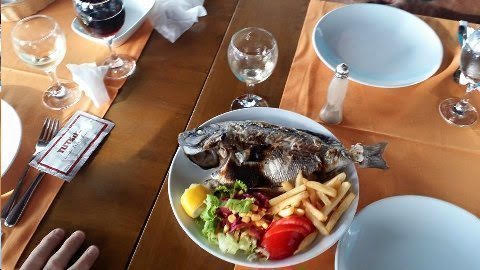
Above: Before and after. Seaside Restaurant. Canakkale, Turkey. 15 June 2015.
Tokyo-ite Malcolm in withdrawal. No seafood for a week. Perfectly remedied here.
PM today was a break from the battlefield with tour members free to wander around Canakkale at their leisure.
Addendum: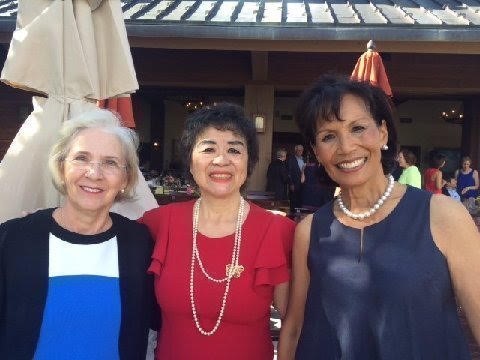
Above: TIMDT, Bridge, and Bali. 1% birthday party. Park City, UT 14 June 2015.
Sorry I missed it!
To get even more insight into incompetent aristocratic military officers from the UK, Austria, Germany & France, I am going to send you Ken Follett’s: Fall of Giants, a 1,000 page tome. Very worth reading about the events that led up to WWI and the ensuing battles, armistice, etc.
Morgan, Chicago, IL
Very grateful!
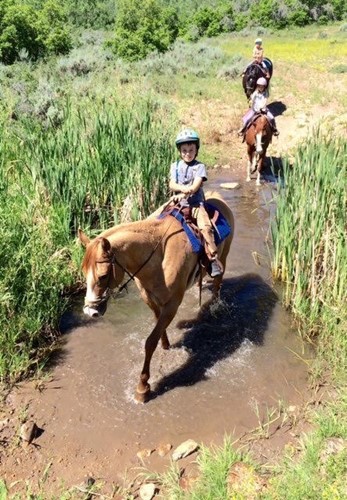
Above: Drums trail ride. Horse camp. Image by FeeBee. 14 June 2015.