Picto Diary - 22 to 30 April 2026 - The Vertex Forum

Above: Beaver Dam, Arizona. Maverick. 23 April 2026.
Out and about on the 'Wing.
Early stop riding to Scottsdale, AZ to attend Hoover Institution Vertex Forum. Ivins to Scottsdale distance: 400 miles.
Typical max riding distance these days is 350 miles... but it wouldn't make sense to take two days to cover the relatively short supplemental distance.

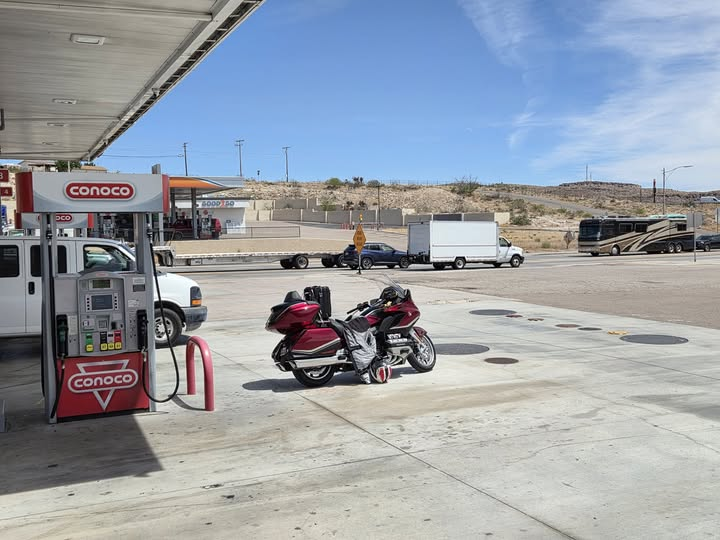
Above: Conoco. Kingman, AZ. 23 April 2026.
Out and about on the 'Wing.
Somewhat unforgettable: The guy at the register weighed over 500 pounds. He asked me if I liked the 'Wing.

Above: Four Seasons Resort at Scottsdale Troon North. 23 April 2026.
Outside my hotel room balcony, my own private hoodoo. I'm here to attend Hoover Institution's Vertex Forum, 23 to 25 April 2026.

Image

Thank you for joining us at the Hoover Institution’s Vertex Forum.


We welcome your feedback about the forum. Please share your thoughts through the 2026 Vertex Forum Survey.

Over the course of the forum, we explored a set of questions that are only becoming more urgent: how technological change is reshaping economic power, national security, and the institutions that underpin free societies. What made the conversations distinctive was not only the range of perspectives, but the rigor, clarity, and intellectual honesty with which Hoover scholars engaged them.

We have gathered a selection of materials to extend those conversations beyond the forum itself. Think of this as a brief study guide, bringing together key ideas, recent work from Hoover fellows and participants, and a preview of the kind of ongoing inquiry that Vertex is designed to foster.

The Launch of a Major Initiative

During the Vertex Forum, the Hoover Institution launched the Economic and Security Commons
, a major initiative to envision how America and free societies can respond to a period of profound global transformation defined by large-scale geopolitical shifts and rapidly accelerating technological change.

Finding the Ideas – and the Confidence – to Weave the World Anew

Read Secretary Rice’s new column in Freedom Frequency, in which she announces the launch of the initiative, reflects on the erosion of the post-World War II international order, and calls for renewed confidence in the power of free people to build and defend liberty. 

The American Example

At Vertex, Senior Fellow Philip Zelikow, who along with Secretary Rice, Steven J. Davis, and Stephen Kotkin, chair the steering committee of the Economic and Security Commons, described a key tenet of the initiative: to examine how the United States can reclaim a compelling vision rooted in the social contract of the republic, its confidence as a nation, its belief in opportunity, and voluntary partnerships throughout the world.

Relying on these foundations, and leading by example, the American republic ascended to global leadership and have helped sustain peace, stability, and prosperity in the world for three quarters of a century.

AI's Economic Reckoning

In this session recorded at Vertex, two of Hoover’s leading economists, John Cochrane and Steven Davis, argued that while artificial intelligence is already emerging as a powerful economic force, its greatest impact is likely to come through higher productivity, lower costs, and a reshaping of the workplace. The conversation also raised a broader concern: that the greater risk may lie not in AI itself, but in policy failure—overregulation, weak education, and rigid labor systems – that could prevent the economy from adapting and capturing the gains of technological change.

  • John Cochrane argues in a recent essay that AI regulation poses a greater threat to democracies and economies than AI itself. In this short and engaging video, Cochrane explains that AI is more likely to free workers from routine activities into higher value work, and make society richer in the long-run.
  • Read Steven Davis’s and colleagues’ March 2026 research on AI adoption in the workplace, which finds that a vast majority of firms use AI, with higher user rates at younger and more productive firms.

China's Edge and Ambitions

In examining the global security and economic commons, China’s role on the world stage cannot be overlooked. At Vertex, Research Fellow Dan Wang discussed his bestselling book, Breakneck, which argues that China’s massive manufacturing capacity, rapid electrification, and relentless infrastructure building are giving China a globally leading competitive edge—as Western democracies grapple with burdensome regulation, excessive litigation, and political gridlock. 

Additionally, Senior Fellow Elizabeth Economy talked about her work leading Hoover’s program on US, China, and the World, her perspectives on the upcoming Trump-Xi summit in Beijing later this month, and China’s strategy and vision for its future

  • Read Dan Wang as he describes China’s “enduring formula for wealth and power” in the September/October issue of Foreign Affairs magazine. Also read Wang’s New York Times essay in which he explains why China’s leadership is “pushing intensely at substituting electricity for oil.” In March, Wang discussed Breakneck on Hoover’s Secrets of Statecraft podcast, with historian Andrew Roberts.
  • Read Elizabeth Economy’s essay in Foreign Affairs earlier this year, in which she discusses Beijing’s strategy to “seize new frontiers of power.” Watch Economy in this short video describe China’s territorial ambitions. 

Strengthening the US-Mexico Partnership

At Vertex, Senior Fellow Stephen Haber unpacked one of North America’s most important relationships. Mexico is now the United States’ top trading partner, with nearly $1 trillion in cross-border trade and shared stakes in security, energy, and regional stability. Drawing on Hoover’s Program on Foundations of Economic Prosperity and dialogues it hosts with US and Mexican leaders and experts, he explored where the partnership is thriving, areas of friction, and why deeper bi-lateral cooperation is needed.

The Future of War and Global Trade

Vertex convened two timely forums on the future of war with Lt. Gen. H.R. McMaster and the future of economic security and global trade with Steven Davis, offering perspective on the strategic and economic pressures shaping today’s Economic and Security Commons.

  • In a recent essay at Freedom Frequency, Davis examines the impacts of the Trump administration’s dizzying array of tariffs and other trade policies, which have caused a rupture in the international trade order that has fostered prosperity and security for than 80 years.
  • Watch H.R. McMaster talk about how the United States must develop specific and strategic plans of action to prevent conflict and restore credible deterrence.

Iran and the Global Order: What Comes Next?

Despite heavy losses to the Islamic Republic’s military and a decapitation of its political leadership, the Strait of Hormuz remains closed and the economic costs of the war in Iran continue to rise. Meanwhile markets are behaving as though the conflict has already passed. In his talk at Vertex, Senior Fellow Niall Ferguson examined whether the America and the free world are witnessing the wisdom of crowds, or a dangerous misreading of reality?
 
In another conversation, Iran scholar Abbas Milani, Admiral Gary Roughead, and Philip Zelikow, spoke in depth about the current military and political situation in the Middle East, prospects for the Islamic Republic’s survival, and a resolution to the conflict.

  • Read Ferguson’s recent article in The Free Press, “The Gap Between Truth (Social) and Reality on Iran.
  • In another article at The Free Press, Ferguson along with Zelikow and the Council on Foreign Relation’s Richard Haass outline a US plan for re-opening the Strait of Hormuz on America’s terms.
  • Watch Milani on a recent episode of GoodFellows with Cochrane, Ferguson, and McMaster discuss life within the beleaguered theocracy. In this episode of Today’s Battlegrounds, released on the heels of the Vertex Forum, Milani discusses with McMaster the war’s effect on the Iranian people and prospects for peace and security in the Middle East.

American Leadership and Renewal in an Era of Global Disorder

How does America lead in a world rife with conflict, instability, and geopolitical risk. These were the topics of a series of conversations featuring Secretary Rice, and Senior Fellows Amy Zegart, Philip Zelikow, and Stephen Kotkin.
 
In the introductory video played at Vertex announcing the Economic and Security Commons initiative Zelikow invokes Dwight D. Eisenhower’s 1953 inaugural address, quoting his line “whatever America hopes to bring to pass in the world must first come to pass in the heart of America,” underscoring that the challenges of our time are solvable—but only if renewal begins at home.
 
In closing that video. Director Rice urged that as the nation approaches its 250th birthday, Americans should look ahead and begin anew—starting fresh conversations about how to renew America as an example to free societies everywhere and reinforce the American leadership on which a stable world still depends.

Closing

We are grateful for your participation and for the seriousness you brought to these discussions.
 
Vertex is intended not as a single convening, but as the beginning of a continuing exchange, one that connects research, policy, and practice in a moment when each depends on the other. We hope the materials shared here are useful to you, and that you will continue the conversation with colleagues and collaborators.
 
We look forward to staying in touch and to welcoming you back for future convenings at Hoover.

Save the Date for the 2027 Vertex Forum:

April 14-16, 2027 in Arizona 

Image


Homepage

The Hoover Institution at Stanford University is a public policy think tank promoting the principles of individu...


Homepage

The Hoover Institution at Stanford University is a public policy think tank promoting the principles of individu...

Hoover's above summary of the Vertex Forum saves me from crafting my own flawed notes. Following, however are selected personal vignettes and thoughts regarding my attendance: 

Just over a month ago, I attended a Hoover Zoom featuring Dan Wang who gave a presentation at Vertex. My report on his talk can be found here: Dan Wang on China Tech - 10 March 2026 | Stephen DeWitt Taylor.

Today, Dan Wang made comparisons between China and US manufacturing, forecasting, as he did in his previously cited Zoom talk, the magnitude of China's manufacturing preeminence compared to the rest of the world.  Wang compared the rickety US commuter rail systems to China's high-speed trains.  I asked Wang in the Q and A about the anticipated demographic cliff China faces.   Wang allowed that the demographic cliff was a problem for China's future.  I remain puzzled about what impact China's demographic cliff will mean in terms of her ability to sustain her ability to remain a power player on the world stage.
On 24 April 2026 Steven Kotkin, preeminent Stalin biographer, joined the breakfast table where I was seated.  During the conversation, I asked Kotkin how he dealt with the risk of students cheating using AI.  He said that students were going to use AI in the real-world post-graduation so don't deny them the use of AI in the classroom.  Rather, teach students the adverse consequences of overreliance on AI e.g. diminished ability to think critically, in their course work.  
Later in the day I waylaid Kotkin in the hotel atrium and told him that I had read the first of two volumes of Simon Sebag Montefiore's biography of Stalin.  What did he think of it?  "He's a novelist," Kotkin said smiling.  Me: "Umm... well, I guess I had better read your Stalin books as soon as possible."  Kotkin smiled and went on his way.  To be fair to me, I read the Sebag Montefiore book in 2013, a year before Kotkin's first Stalin bio was published.  I should have told him that but didn't remember it at the time.  The first two volumes of Kotkin's Stalin biography are on my to-be-read book pile as I write.
A year after reading Simon Sebag Montefiore's Stalin bio, I motorcycled the Caucuses in 2014.  I visited many of the locales of Stalin's early life:  Gori, where he was born; Tbilisi, where he went to clerical school, and Batumi where, as a young agitator, he blew up a refinery.   I referenced Stalin frequently in my trip diary, here:  2014 - Caucasus by Motorcycle | Stephen DeWitt Taylor. While riding in Chechnya, we stopped to see a small village school.  On the wall of the headmaster's office was a portrait of Stalin.  Stalin in Russia... gone but not forgotten.
Steven Davis also joined the breakfast table where a few of us were already seated with Steven Kotkin.  While Davis later gave a formal presentation at the Vertex Forum on Economic Security and Global trade, I knew Davis best for his earlier work on "working at home" (WFH) during the Covid era.   Davis was the speaker at the Sun Valley, ID Hoover luncheon which I attended in 2024.  There I heard his WFH presentation.
The paper for which Davis is most widely known—and the one that best fits as the foundational/key study on WFH during the COVID era—is “Why Working from Home Will Stick” (co-authored with Jose Maria Barrero and Nicholas Bloom). It draws on surveys of more than 30,000+ Americans (later expanded to over 250,000–300,000 responses in updates.  
 
Core findings: COVID-19 caused a “mass social experiment” in WFH. Pre-pandemic, only ~5% of full workdays were from home; post-pandemic, it stabilized much higher (around 20–25% of paid workdays by 2025, or roughly 3.5x pre-2019 levels). The paper explains why it stuck (better-than-expected experiences, new investments in tech/human capital, reduced stigma, lingering health concerns, and tech innovations) and projects benefits like productivity gains, employee welfare improvements (especially for higher earners), and shifts in urban spending.
Davis's study is one of the most cited papers in the field and is frequently referenced in Hoover materials, media, and policy discussions.
I asked Davis, who was seated next to me at breakfast, if he was still working on the WFH subject.  After telling me that WFH wouldn't be his topic today, he said there is new evidence emerging that US fertility rates were being positively impacted in WFH households (!).  More, he said, would be forthcoming in a later to be released publication.  Now that's a find I'll be interested in hearing more about!
Selected Ted Cruz takeaways.
Ted Cruz, US Senator, Texas.  Vertex invitee Ted Cruz and Condi Rice held an armchair conversation at dinner on 24 April 2026.  Cruz:
"Peace through strength" remains most important US mantra as regards international relations.
Our enemies are scared out of their minds of DJT.
Israel is US's strongest, most important ally.
Beware antisemites on the right.
Tucker Carlson is America's most dangerous demagogue.
Antisemitism is a gateway drug for communists.
US universities spur antisemitic chaos.
Israel and America have shared values.
Those who hate Irael hate America.
I am a proud populist from the right.
Two topics seemed to dominate the Vertex event:  Iran War and AI.
One of the benefits of being a Hoover donor is that you can have time to speak directly, usually in cocktail or breakfast setting, with some of the top academics in their fields.  I was able to speak face to face with John Cochrane, H.R. McMaster, Gary Roughead, Seven Kotkin, and Condi Rice.    Most of those with whom I talked were for confronting Iran. But, there were different points of view on tactics and strategy.   I didn't have direct interaction with Niall Ferguson, but l listened attentively to his talk.   Ferguson saw value in confronting Iran but warned of the illusion of quick wins, the importance of naval/air power limits without ground commitment, and the danger of the conflict becoming a wider stalemate that benefits adversaries. He expressed that the war is far from over despite official narratives.

Michael McFaul, a Hoover Senior Fellow who was not present at Vertex, has consistently opposed President Trump's decision to launch the war against Iran (Operation Epic Fury), viewing it as unnecessary since there was no imminent threat to U.S. security and deterrence had been working.
In an after-dinner presentation Q and A I asked Condi Rice about US/Canada relations.  She gave an answer I would have expected... to the effect (e.g. paraphrasing) that Canada and the US are important partners... yes some of those Ontario people are socialists, but in the west of Canada are well grounded productive people.  It is too bad that US/Canada relations suffer at the moment, but we are and will remain strong allies.  
I am not so sanguine about the US/Canada relationship, but then, I wasn't US Secretary of State.

Above: Wickenburg, AZ Maverick. 26 April 2026.
Out and about on the 'Wing. Scottsdale to Ivins. 400 miles.
Briggs and Riley on the back seat. I couldn't go to the Four Seasons Hotel with pedestrian motorcycle luggage, what?

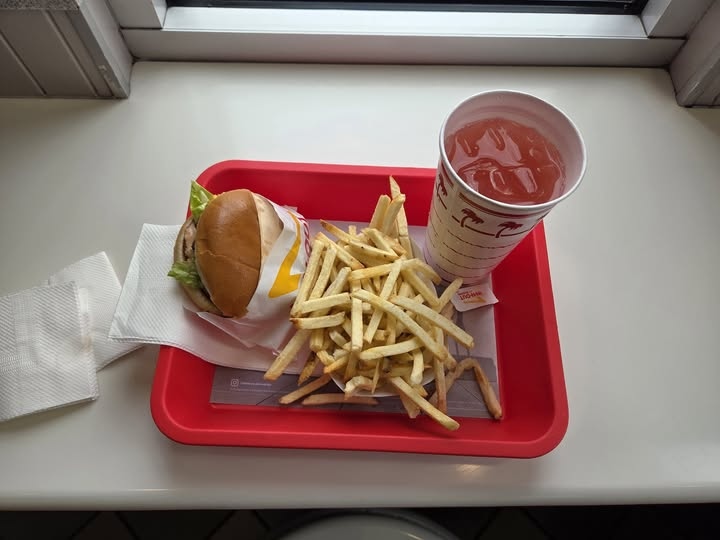
Above: In N Out burger. Kingman, AZ. 26 April 2026.
Out and about on the 'Wing.

It is difficult to conceive how anyone can live a fulfilled life while being out of range of an In N Out burger.

Above: Terribles. North Las Vegas, NV. 2026.
Out and about on the 'Wing.
Stop for electrolytes and gas.
Home stretch. About 100 miles to go.

Above: Park City, UT. 30 April 2026.
LSDM Walkers.
The Engine House at left. Recently completed Park City subsidized housing.

Addendum:

Thanks. Sounds great! Best wishes for a successful [WJT Memoirs] project.
Nathans, Orlando, FL