Picto Diary - 21 June 2026 - Australia Ruminations: Immigration and Covid... and movies
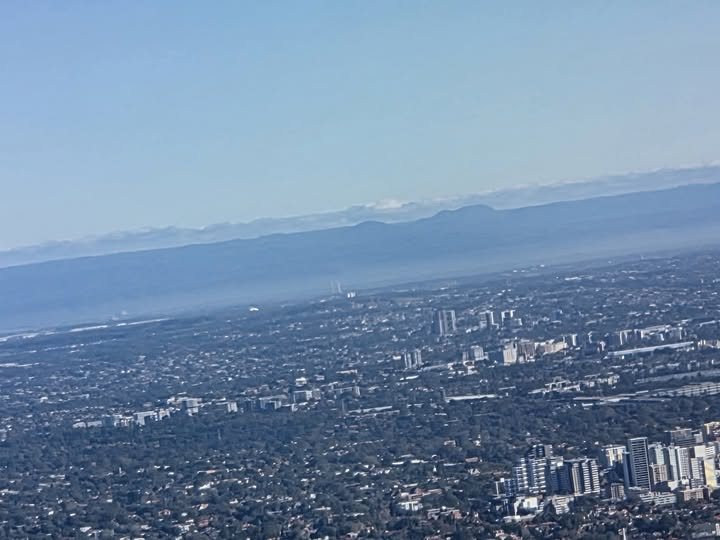
Above: Sydney, Australia. 21 June 2026.
Seeking the Kimberley.
Image: Sydney Western Suburbs and beyond, The Blue Mountains.
As I took this image from the Delta aircraft at the start of our flight to Los Angeles, I recalled a comment our driver, Thomas made yesterday: “Many of Australia’s Asian and African immigrants have settled in ethnic enclaves in Sydney’s western suburbs.” His observation, and this view out of the aircraft window, prompted me to reflect on Australia’s immigration policy. What has changed immigration-wise since I lived in Australia in the 1970s, and what impact have those changes had on the country today?
As Drums and I walked around Sydney the last two days, I was struck by the number of East Asian and South Asian faces—an everyday sight that was almost nonexistent when I lived in Australia fifty years ago.
Three of the five taxi drivers we used during our Australian stay were of Pakistani origin. All were in their twenties, fluent in English and happy to converse about their immigration story. Our hired driver the previous day, Thomas, was a Ghanaian immigrant. He lit up when I mentioned that I had visited Sekondi, Ghana, in 2019. The exceptional concierge at the Sydney Marriott Hotel at Circular Quay, Mohammed, was a Malaysian immigrant. He went above and beyond, seamlessly arranging our meetup with Thomas and his immaculately polished Audi SUV, and securing reservations at two outstanding restaurants in Sydney's Rocks neighborhood. Most of the waitstaff at the Marriott's Sylvester’s Restaurant and Lounge, where we enjoyed breakfast twice, were also East Asian.
Today, Australia operates a points-based skilled migration system alongside family reunion and humanitarian streams. Post-1970s, shortly after we had left Australia, it shifted from the White Australia Policy to official multiculturalism, emphasizing cultural retention alongside civic participation. There is no mention of "assimilation" in Australia's immigration program, unlike in the US where there is robust debate about "assimilation versus multiculturalism." Over 30% of the Australian population is overseas born, with significant intakes from Asia, the Middle East, North Africa, and elsewhere. So far, the policy has delivered economic benefits: skilled workers fill labor gaps, and many immigrant groups show strong educational and employment outcomes. So far, successes include relatively high overall social cohesion, low homicide rates compared to many peers, and better integration metrics than parts of Europe for many cohorts. Australia's selection criteria (skills, English, age) filter for employability better than chain migration or asylum-heavy systems elsewhere. Still, if driver Thomas is right, that is if ethnic neighborhoods are building in Sydney's western suburbs, Australia may come to face some of the same issues as seen in Europe... that is, non-assimilating multicultural residential enclaves.
I found myself wondering whether Australia’s seemingly successful multicultural immigration system was showing any cracks—similar to the immigration-related stresses now straining several European countries. My curiosity had been sparked by a recent shooting incident at Sydney’s Bondi Beach.
On December 14, 2025, father-and-son gunmen Sajid Akram (50, Indian-born Muslim from Hyderabad, arrived in Australia 1998 on a student visa later converted to partner visa and permanent residency) and Naveed Akram (24, Australian-born) attacked a large Jewish Hanukkah celebration ("Chanukah by the Sea") at Archer Park near Bondi Beach in Sydney. They killed 15 people (including a child) and wounded more than 40 in Australia's deadliest mass shooting/terror attack since Port Arthur in 1996.
Authorities classified the Bondi Beach shooting as an antisemitic terrorist attack inspired by Islamic State (ISIS) ideology. Sajid was shot dead by police; Naveed was wounded, arrested, and charged with 15 murders plus terrorism offenses. The pair had legal firearms (Sajid held a license for six), conducted reconnaissance, received tactical training, and traveled to a region in the southern Philippines associated with extremism in November 2025. Sajid had no prior adverse record noted at immigration, but the son drew intelligence attention as early as 2019. This was not random crime or socioeconomic fallout—it was ideologically driven targeting of Jews during a religious festival.
The Bondi attackers fit a recurring profile: a first-generation immigrant from a Muslim background who built a life (fruit shop owner) yet whose household produced a jihadist son raised in Australia. This demonstrates transmission of ideology across generations despite decades in the country.
While most of Australia's Muslim immigrants are hardworking and law abiding, the Bondi Beach attack does open a window: it shows that Australia's multicultural immigration model—while economically beneficial and relatively successful—has not eliminated risks from admitting or retaining non assimilating populations where significant subsets hold ideologies hostile to the host society's foundational principles (tolerance for Jews, rejection of religious violence). Father-son radicalization after long-term presence underscores assimilation failures in pockets, not just "recent arrivals."
Effective policy would prioritize civic integration and value compatibility (assimilation) over open-ended diversity: stricter ideological screening where feasible, accelerated assimilation pressures, reduced chain migration from high-risk sources, and honest data collection on outcomes by origin/religion (avoiding politically correct gaps).
Geography and selection give Australia advantages Europe lacks, but complacency about "it can't happen here" or reflexive defense of multiculturalism as an unqualified good ignores evidence from this and prior incidents. Patterns in terrorism and subgroup crime warrant targeted scrutiny, not blanket denial.
Australia remains safer and more cohesive than many alternatives, but incidents like Bondi are warnings, not aberrations to be explained away.
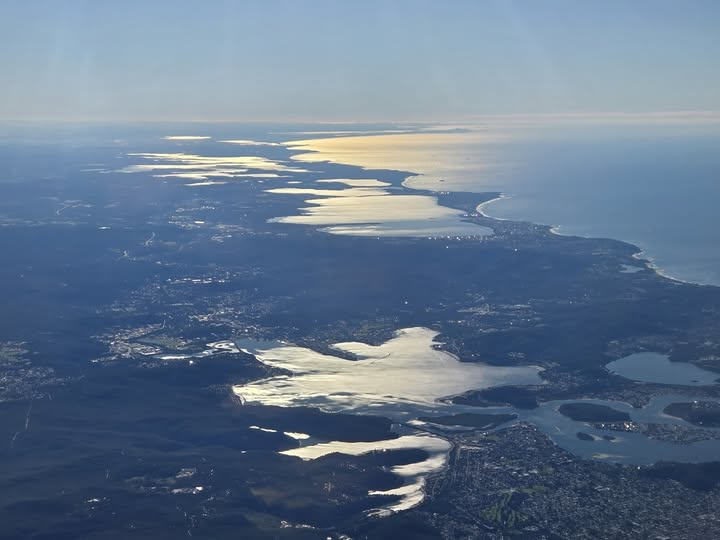
Australia’s “go hard, go early” elimination strategy stood in sharp contrast to the more mitigation-focused approaches taken in places like Sweden, the UK, and the United States. Given the growing body of evidence that even the U.S. mitigation strategy tended toward overkill, I found myself wondering what Australians were saying, in hindsight, about their own uncompromising approach.
Here's a Grok summary about OZ Covid-19 lessons learned in hindsight: OZ's experience offers several takeaways, echoed in official inquiries and analyses:
- Early, decisive action works for containment — "Go hard and go early" (border closures, lockdowns) saved lives when done before widespread community transmission. Slow or inconsistent responses elsewhere led to higher tolls.
- Elimination/zero-COVID is resource-intensive and hard to sustain long-term — It succeeded initially due to geography (island nation) and compliance but became untenable with more transmissible variants. Flexible, adaptable strategies are better than rigid ones.
- Balance health with broader impacts — Lockdowns and restrictions are blunt tools. Future responses need better consideration of mental health, education, economic costs, and equity. Measures should be time-limited and targeted where possible.
- Planning and structures matter — pre-pandemic plans were inadequate or ignored key tools (e.g., border closures). Clear governance, defined roles, and less reliance on informal networks would improve efficiency.
- Communication and public trust — Consistent messaging helped high compliance initially, but prolonged restrictions tested it. Transparent trade-offs (health vs. other harms) build better buy-in.
- Excess mortality as a key metric — Australia's low early excess deaths highlight benefits of suppression, but full-pandemic analysis shows indirect costs (e.g., delayed care) matter too. Comparing only confirmed COVID deaths understates total impact.
It's hard to imagine Americans accepting the draconian Covid protocols put in place by Australian authorities.
Attack ships on fire off the shoulder of Orion.
I watched C-beams glitter in the dark near the Tannhäuser Gate.
All those moments will be lost in time, like tears in rain.
Time to die."
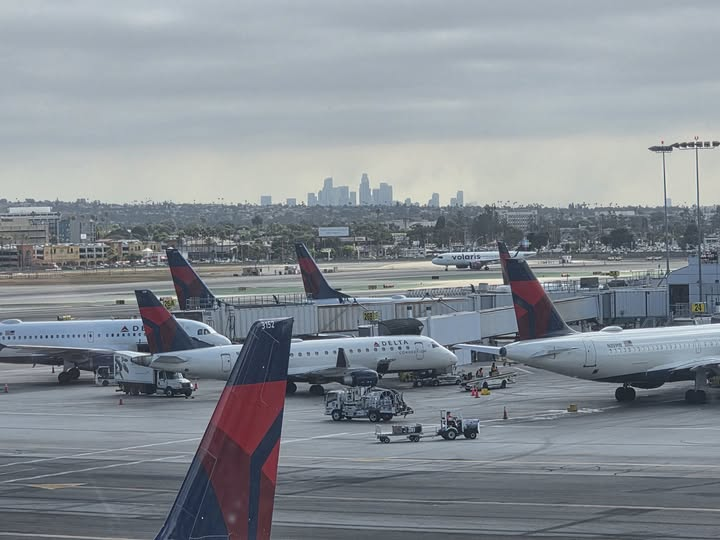
Above: LAX. 21 June 2026.
Seeking the Kimberley.
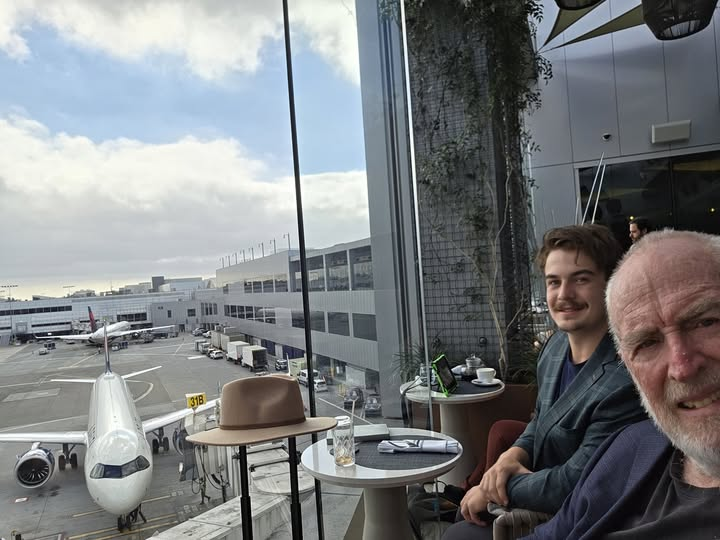
Image: Delta One Lounge.
Bishop gets the skinny from Drums on which aircraft is which. Bishop doesn't know Boeing from Airbus!
Two hours later we fly to Las Vegas. A car is there, driven by Lou's wife, to take us to Ivins.
End of Seeing the Kimberly reportage! A good trip all around!
Addendum:
Penny lived next to us on a different street, not Inkerman. Carrington I believe.
FeeBee,
Park City, UT
The street below our two houses, where we are standing talking to John Forrest and his son, is Carrington. For some reason, the address of our house was Inkerman, the street above our house, from which street there was a gateway leading to stairs descending to our house. To my recollection we never used the upper Inkerman access to the house. I didn't realize (or remember) this discontinuity until I discovered it last week. Interestingly, we, the Davis's and the Taylors, parked our cars coming up the same driveway from Carrington Street. We veered right to our garage and the Davis's veered left to their garage.
Steve
I lived in Manly beach when I was 3 years old. My parents rented a house across the road from the beach for a year. There was reasonably heavy traffic along that road. I liked to go on to the beach and down to the water. I also liked to be outside during the day. There was a flag pole in the yard on the edge of the road. My parents put a vest on me that was tied by a long rope to the flag pole. I could run around the yard and get close to the road along the beach but was restrained by the rope from heading to the beach on my own. I was always thrilled to be outside and observe Manly Beach. I did get taken across the road to the beach regularly.
Today, my parents would have been charged with neglect of me and illegal rope constraints despite my desire to be outside. I would not have the positive memories of Manly Beach.
I am glad you went to the Taranga Zoo as it is great to walk around, see animals while looking over Sydney harbor.
Thank you
The Pope,
Eufala, Alabama