Picto Diary - 19 June 2015 - Waxing Philosophical
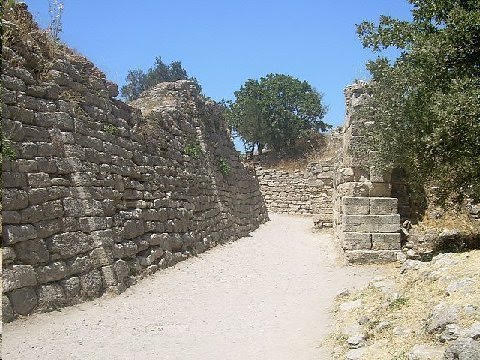
Above: Walls of Troy. File photo.
The Sapper Gallipoli Centenary Tour members, today, 19 June 2015, visited Troy.
Turkish guide Sinan gave us a good explanation of how intermittently placed six sided key stones were used to hold the walls together during earthquakes. Such a large stone can be seen in wall in image at left.
TIMDT tells me that we visited Troy in 2005 while motorcycling up the Aegean coast. I don't remember it.
I think what happened was that some of our group decided to ride past Troy to catch the ferry to the Gallipoli Peninsula from Canakkale, 15 miles further up the road from Troy. TIMDT switched from the bike to join other riders, who did not wish to take the Gallipoli diversion, in a visit to Troy.
From Wikepedia:
n Greek mythology, the Trojan War was waged against the city of Troy by the Achaeans (Greeks) after Paris of Troy tookHelen from her husband Menelaus king of Sparta. The war is one of the most important events in Greek mythology and has been narrated through many works of Greek literature, most notably through Homer's Iliad. The Iliad relates a part of the last year of the siege of Troy; the Odyssey describes the journey home of Odysseus, one of the war's heroes. Other parts of the war are described in a cycle of epic poems, which have survived through fragments. Episodes from the war provided material for Greek tragedy and other works of Greek literature, and for Roman poets including Virgil and Ovid.
The war originated from a quarrel between the goddesses Athena, Hera, and Aphrodite, after Eris, the goddess of strife and discord, gave them a golden apple, sometimes known as the Apple of Discord, marked "for the fairest". Zeus sent the goddesses to Paris, who judged that Aphrodite, as the "fairest", should receive the apple. In exchange, Aphrodite made Helen, the most beautiful of all women and wife of Menelaus, fall in love with Paris, who took her to Troy. Agamemnon, king of Mycenae and the brother of Helen's husband Menelaus, led an expedition of Achaean troops to Troy and besieged the city for ten years because of Paris' insult. After the deaths of many heroes, including the Achaeans Achilles and Ajax, and the Trojans Hector and Paris, the city fell to the ruse of the Trojan Horse. The Achaeans slaughtered the Trojans (except for some of the women and children whom they kept or sold as slaves) and desecrated the temples, thus earning the gods' wrath. Few of the Achaeans returned safely to their homes and many founded colonies in distant shores. The Romans later traced their origin to Aeneas, one of the Trojans, who was said to have led the surviving Trojans to modern-day Italy.
The ancient Greeks treated the Trojan War as an historical event which had taken place in the 13th or 12th century BC, and believed that Troy was located in modern-day Turkey near the Dardanelles. As of the mid-19th century, both the war and the city were widely believed to be non-historical. In 1868, however, the German archaeologist Heinrich Schliemannmet Frank Calvert, who convinced Schliemann that Troy was at Hissarlik and Schliemann took over Calvert's excavations on property belonging to Calvert;[1] this claim is now accepted by most scholars.[2][3] Whether there is any historical reality behind the Trojan War is an open question. Many scholars believe that there is a historical core to the tale, though this may simply mean that the Homeric stories are a fusion of various tales of sieges and expeditions by Mycenaean Greeksduring the Bronze Age. Those who believe that the stories of the Trojan War are derived from a specific historical conflict usually date it to the 12th or 11th centuries BC, often preferring the dates given by Eratosthenes, 1194–1184 BC, which roughly corresponds with archaeological evidence of a catastrophic burning of Troy VII.[4]
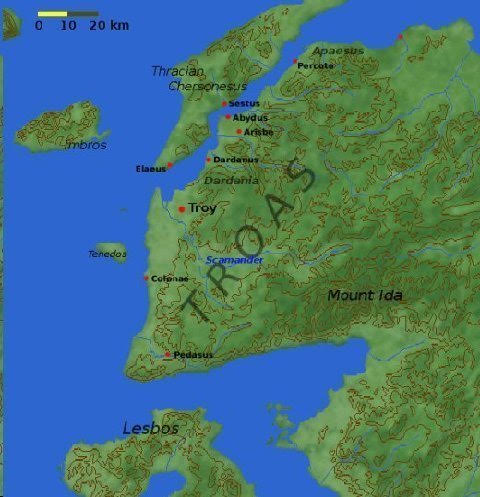
Above: Map showing location of Troy, the Dardanelles, and the Gallipoli peninsula.

The Bishop, Malcolm, and John. Post dinner conversation over rakis. Kum Hotel. Eceabat, Gallipoli Peninsula, Turkey. 19 June 2015.
Talking the vagaries of war...
Why did 2000 British soldiers dig in at Y Beach on 25 April 1915 at The Helles when they could have marched, with little Turk resistance, to their ultimate objective : Achi Baba?
Three unlikely friends.
Malcolm: Kiwi living over 40 years in Japan who restores vintage motorcycles for Japanese collectors....when he isn't managing real estate holdings in Ikebukero.
John: Retired Oz member of Parliament who grew up as Scottish orphan in Manchester, UK. Resented the classism of British culture and ultimately found a more egalitarian life and professional success as a top engineer in "the Lucky Country."
Mwah (sic): American, retired suit.

Above: Moon and star (planet?) Over the Aegean Sea in the west. Eceabat, Gallipoli peninsula, Turkey. 19 June 2015.
Looking at the waxing moon as seen by Homer, Xerxes...Alexander the Great...the Apostle Paul?
Addendum:
Group photo hat tip Sinan!
Malcolm,
Tokyo, Japan
Sunrise, not sunset, Gaba Tepe.
Malcolm
Tokyo, Japan
Whoops!
Nice to see combat engineers/sappers getting some recognition. I was a combat engineer in Vietnam we just don't have that comradery or recognition. Wrong war I guess.
I'll Tell You What,
San Angelo, TX