Picto Diary - 18 June 2015 - Watson's Pier/The Waterloo Dinner
"We assist the army to live, move and fight."
Wayne Budd,
Brigadier, Head of Corps, Royal Australian Engineers
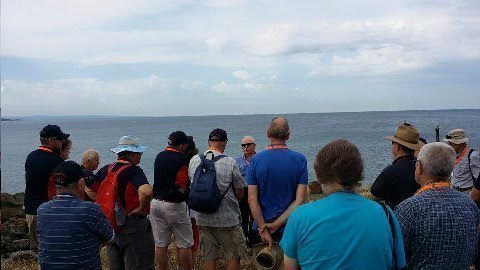
Above: Margetts instructs at Suvla Bay. Gallipoli. Turkey. 18 June 2015.
While the Sapper Centenary Gallipoli Tour will return this PM to Anzac Cove for a memorial service, this AM's visit to Suvla Bay will be the tour's last battlefield site visit under the able tutelage of Baronia Travel Service (Melbourne) battlefield guide, Rod Margetts. Before returning to the hotel, the tour will make a stop at the small town of Bigali, headquarters of Colonel Mustafa Kemal's 19th Turkish Division on the day of the Anzac landing on 25 April 2015.
On 06 August 1915, as part of the Allied August offensive, British troops were landed at night at Suvla Bay, north of Anzac Cove. They were to take high ground nearby, then, early AM on 07 August 2915, proceed south to support the August offensive ANZAC assault on Sari Bair.
The invasion force, was overseen by an incompetent field commander, Lieutenant General Sir Frederick Stopford's troops landed alright, but Stopford's effort was delayed by two days in its assault on the Sark Bair range high ground, as Stopford and his command dilly dallied. Stopford's delay gave the Turks time to bolster defenses in what was, heretofore, lightly defended ground. Stopford was a known incompetent, but, seniority concerns from other August offensive field commanders about Hamilton's less senior first choice, "forced" Hamilton to select the "senior" Stopford.
Once the British Suvla force engaged the now reinforced Turks - late..., heavy fighting occurred sporadically along a skirmish line that reached from Suvla Bay all the way, south, to the Anzac position, for the rest of the month of August. But, the Turks held the line and prevented the Suvla Allied invaders from reaching the Sari Bair in time to help secure the tentative bridgehead at Chunuk Bair first established by the Kiwi Anzacs, on 07 August 1915.
In September, a frustrated British War Council called Sector Commander Hamilton back to London and replaced him with Sir Charles Monro, a highly regarded field commander who had been fighting successfully on the Western Front. Monro, after only a day surveying all the allied concentrations in Gallipoli, determined the Allied situation was futile. Much to the consternation of Lord Kitchner, British Secretary of State for War, and the still "Gallipoli optimistic" Churchill, Monro urged that the Allied position on the Gallipoli peninsula be abandoned.
Dissenting voices re Gallipoli began to gain greater purchase in London. One faction had urged a southern Allied assault from Salonica on Central Powers concentrations to the north. Gallipoli troops could be evacuated to Egypt, recuperate, and then be sent to the "Salonica" front. It was, they said, time to cut losses and redirect the war effort elsewhere.
Estimates of Allied troop losses in a Gallipoli battlefield withdrawal ran as high as 50% percent of the force. Lord Kitchener could not conceive of a withdrawal under these circumstances. Surely, a renewed offensive, in the Spring after hunkering down for the winter, would result in the long sought occupation of the high ground and ultimate forcing of the Dardanelles straits?
Some British and French naval leaders were urging a new assault on the straits. Churchill, no longer First Lord of the Admiralty, but still a member of the War Cabinet, backed a renewed naval assault on the Dardanelles straits.
Anti Gallipoli forces in the War Cabinet - and Monro - prevailed, and Gallipoli was abandoned by the Allies in a surprisingly well executed withdrawal, with little loss of life, in December 1915 and January 1916.
Gallipoli was a brutal "learning experience" for the Anzacs. However, after recuperation in Egypt, Anzacs were sent to the Western Front where, along with their newly recruited Anzac compatriots from home, they fought with distinction for the remainder of the war.
By the time the war had ended, from an Australia population of fewer than five million, 416,809 men enlisted, of which over 60,000 (8,000 at Gallipoli) were killed and 156,000 wounded, gassed, or taken prisoner.
Via Gallipoli and later fighting on the Western Front, a new nation of Australia had come of age. No longer was Britain "home." Hence forth, Australian leaders would be the ones to decide on the disposition of Australian treasure.
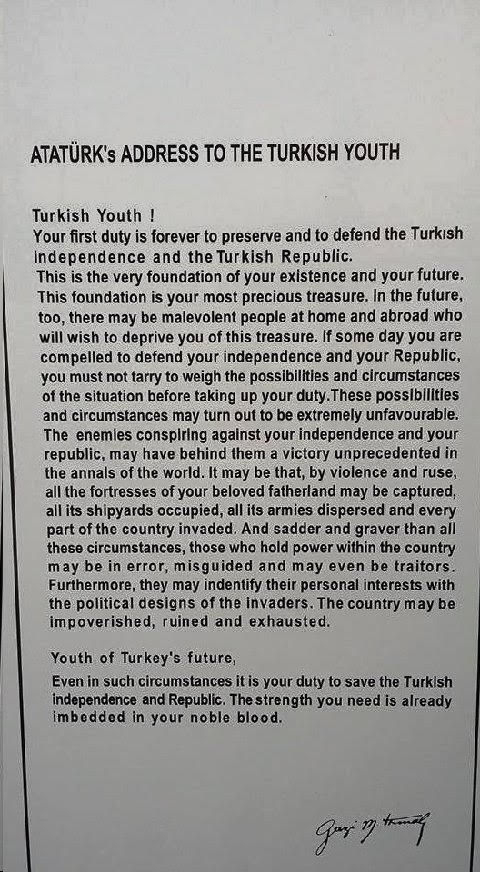
Above: Story board sign in Bigali, Gallipoli public square. 18 June 2015.
After reading the above, written by Mustafa Kemal Ataturk, it seemed to me, a word changed here and there, to have universal application... beyond just an admonition for Turkish youth.
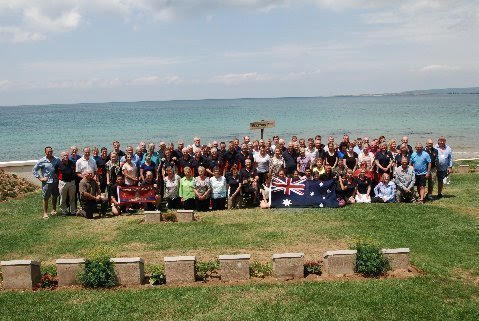
Above: Sappers Gallipoli Centenary Tour participants. Ari Burnu cemetery, Anzac Cove, Gallipoli, Turkey. 18 June 2015.
Image hat tip: Malcolm Moore
The tour, organized by Baronia Travel Center, Melbourne, was divided into three busses. Each had its own battle field guide... ours, Rod Margetts. Though they went to the same destinations, the three bus groups, on their battlefield explorations, operated more or less independently.
This image shows all three bus group participants in one image.
Can you find the interloper in the image? Easy to find.
This effort has been incredibly well organized. Busses are new and cleaned daily, inside and outside. Our bus driver is hyper competent, even if a bit speedy. Everybody shows up on time, is friendly and cordial. No whiners. Likely the military background of the participants and their keen interest in the topic of the visit impacts the seeming smooth flow of the trip.
The three star Kum hotel is extremely well located on the Aegean Sea, midway between the Helles and Anzac/Suvla battle sectors. It is the only hotel with such a fortuitous location if a Gallipoli battle field tour is your objective. There are better hotels via ferry back across the Dardanelles in Canakkale, but everyone understands that we have traded a bit of luxury for superior location functionality.
Kum hotel restaurant is good.... meals are served buffet style. Turkey has always reminded me of Italy, where it is hard to get a bad meal anyplace. And so it is at the Kum. Lots of veggies, fruit, rice, mashed potatoes, and kebabs.
Malcolm and Mwah (sic) are in the same bus as the head Sapper, Brigadier Wayne Budd. Most of the sappers or sapper alums that I have talked to - senior officers or retired senior officers on our bus - have served stints (combat, sapper support, UN assignments) all over the world, have masters degrees from some US university, or have served as instructors at US military training facilities. Sapper wives/girl friends were equal to their husbands/partners. If my Australian tour mates are representative of the broader Australian military population, Australia seems well positioned to continue being a major contributor to protecting and preserving the western way of life.
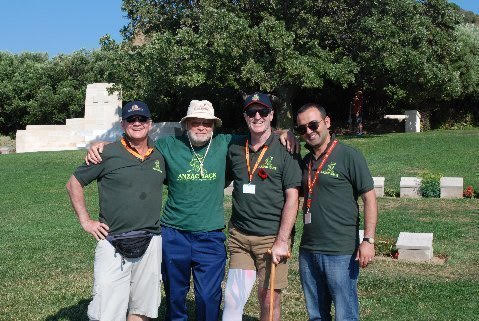
Above: Wayne Budd, Brigadier, Head of Corps, Royal Australian Engineers; Malcolm Moore, grandson of Anzac Jack, who was sapper veteran of Gallipoli landing, 25 April 1915; Doug, Kiwi private equity investor, retired Kiwi sapper, close friend of Wayne since Duntroon days; Sinan, Turkish guide for the Sapper Gallipoli Centenary Tour.
All wear Anzac Jack T's or polos.
Image hat tip: Malcolm Moore.
I think if I've learned anything about friendship, its to hang in, stay connected, fight for them, and let them fight for you. Don't walk away, don't be distracted, don't be too busy or tired, don't take them for granted. Friends are part of the glue that holds life and faith together. Powerful stuff. Jon Katz
For the duration of the tour, Doug was wheel chair bound. His friend Wayne was behind Doug's chair at each stop on the tour. Between the two of them... and with occasional assistance from other tour participants... they managed to get Doug to a lot of battlefield spots one would not ordinarily think accessible by wheel chair.
Sinan was our able Turkish guide, explaining, periodically, a Turkish point of view on the Gallipoli campaign and behind the scenes, ensuring that stuff went smoothly. In both he excelled.
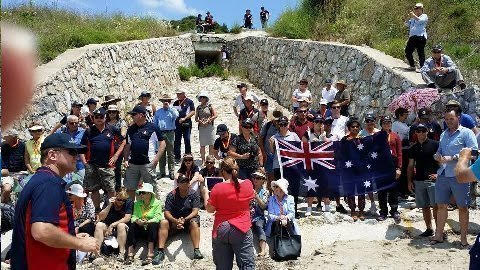
Above: Members of the Sapper Centenary Gallipoli Tour. Anzac beach, Anzac Cove, Location of Watson's Pier. Gallipoli, Turkey, 18 June 2015.
Brigadier, Sapper head of Corps, Wayne Budd, wearing official sapper polo shirt, is near, at left, as he prepares for a memorial ceremony to recognize the 100th anniversary of the completion of Watson's Pier, 18 June 1915, a special day for Australian sappers, celebrated annually, since 1924, via The Waterloo Dinner. 18 June 1815 was the date of Wellington's defeat of Napoleon at the battle of Waterloo, in Belgium.
Wayne's friend, Doug, is seen in wheel chair at the top of the culvert.
I try hard, but, I know I can't fully appreciate what this memorial service means to the sappers and sapper families attending here. I very much appreciate the hospitality shown to me as an outsider looking in to what is a sacred moment for the sappers. I had a lump in throat moment when the group sang Australia's national anthem, "Advance Australia Fair," right here at Anzac Cove.
Listen (link)... imagine you are there at Anzac Cove. Anzac Jack and the Anzac Sappers of yore... are there with you.
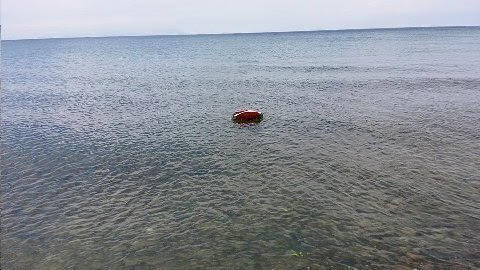
Above: Ceremonial wreath floats off the shore of Anzac Cove, Gallipoli peninsula, Aegean Sea. 18 June 2015. Commemoration by Sapper Gallipoli Centenary Tour participants of the completion of Watson's Pier, 18 June 1915, one hundred years ago today.
We are at the actual spot of Watson's Pier, where original pier post stumps can be seen by underwater divers.
Malcolm's grandfather, Anzac Jack, a Kiwi enlisted in the Australian army, was in the vanguard of the Gallipoli landing, 25 April 2015. Anzac Jack was evacuated from the battlefield afther three weeks having suffered a bullet wound to the right shoulder. Anzac Jack convalesced in Malta before returning to the fightin on the Western Front.
After the war ended, in 1918, Anzac Jack returned to New Zealand after an absence of five years.
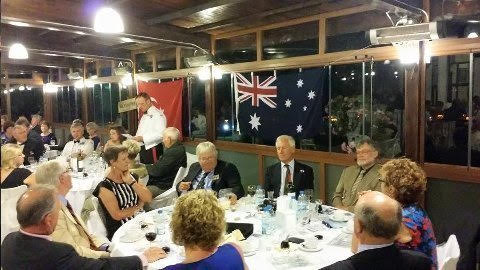
Above: Waterloo Dinner. Royal Australian Engineers (Sappers). Kum Hotel, Eceabat, Gallipoli, Turkey. 18 June 2015.
The first Waterloo Dinner was organized by Stanley Watson, Australian Sapper, designer and chief engineer of Watson's Pier. The dinner, featuring a menu with salmon as a main course, was held on Anzac beach at Anzac Cove. 18 June 1915.
The dinner was called "The Waterloo Dinner," only because of the coincidence of Wellington's victory over Napoleon at Waterloo in Belgium, 18 June 1815 being exactly one hundred years, to the day, before Watson's Pier completion and the first Waterloo Dinner.
The tradition of the Waterloo Dinner was revived after the war in 1924 and has been held annually, wherever there are Australian sappers, anyplace in the world.
In image, Wayne Budd, Brigadier, Head of Corps, Royal Australian Engineers, in dress uniform, standing at the head table, delivers the annual Waterloo Dinner address, outlining the accomplishments of the Sappers over the past year and citing the challenges for the upcoming year.
At another point on the tour, Wayne succinctly, with great, no BS, no frills, economy, described the purpose of the Royal Australian Engineers (Sappers): "We assist the army to live, move and fight." Someone who uses economic language likes this deserves to head an army corps. The same was true of Margetts, whose battle field lectures to tour goers, if transcribed, would require no editing.
Two other head tables were allocated, one to the Watson family, descendents of pier builder Stanley Watson, and the other to Malcolm Moore, grandson of Anzac Jack Moore. As Malcolm, and Mwah (sic) were the only representatives of Anzac Jack present, Malcolm invited other members of the Watson family to join him at the Anzac Jack table.
To Malcolm's right is John, orphan, immigrant to Oz from Manchester, England, where as a boy he resented the barriers to advancement for the working class man built into British culture. He received engineering training in the UK, made his way to Australia, and joined the sappers. He became chief engineer on Australia's largest power project, The Snowy River Scheme.... then a member of Parliament representing an area of New South Wales... proving Australia as a land of opportunity for anyone who works for it.
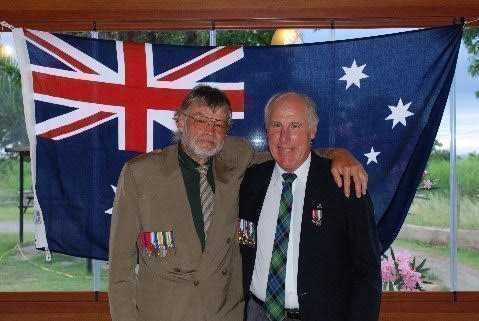
Above: Malcolm Moore, grandson of Anzac Jack, and Bill Watson, grandson of Watson's Pier builder, Stanley Watson. Waterloo Dinner. Royal Australian Engineers. Kum Hotel, Eceabat, Gallipoli Peninsula, Turkey. 18 June 2015.
Malcolm and Bill each wear their respective grandfathers' campaign medals on their right breast. Bill, wears his own medals, as an Australian army veteran, on his left breast. Malcolm and Bill wear campaign medals as protocol dictates for wearing campaign medals on civilian clothing.
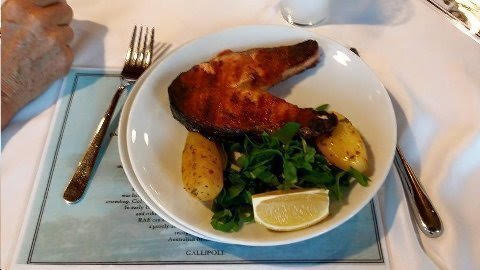
Above: Main Course. Salmon. Waterloo Dinner. Royal Australian Engineers (Sappers). Kum Hotel. Eceabat, Gallipoli Peninsula. Turkey. 18 June 2015.
In keeping with tradition....
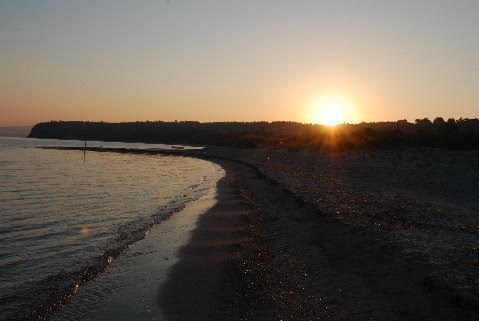
Above: Sunset. Gaba Tepe. Gallipoli Peninsula. Aegean Sea. Turkey. 18 January 2015.
Image looks northwest from beach near Kum Hotel.
Just on the other side, to the north, of the Gaba Tepe peninsula was the beach where Anzac fighters originally intended to land. Instead, they landed two kilometers further to the north on much more difficult ground: Anzac Cove.
Turkish gun positions on Gaba Tepe shelled the Anzac beach head through the duration of the eight months of fighting, 25 April 1915 to December/January 1915. Anzac raids to dislodge the Turkish guns failed.
Addendum:
Great summaries of your Turkey adventure.
I remember the Japan nostalgia book from when you visited me at the bank in Tokyo.
The days since have flown by and I have no idea as to how except we seem to living life to the fullest.
Stay well. Best
The Archbishop,
Big Sky, MT
Whatever good fortune we enjoy abetted by you. TIMDT and Mwah (sic) look forward to seeing you and L in Jackson.
cool. thanks Steve.
Brand Man,
Venice, CA
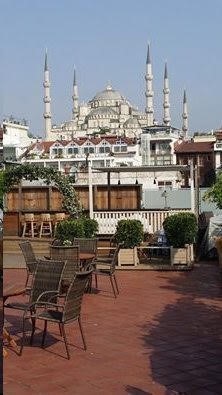
Above: The Blue Mosque. 18 June 2014.
This image was captured by Mwah (sic) from the dining patio of the Armada Hotel, Istanbul, Turkey, exactly one year ago.
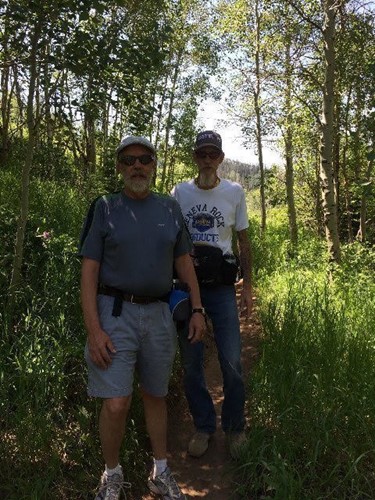
Above: Title and Lee. Brothers. Hiking PCMR. 18 June 2015.
Image by TWO3.
I think this is a place were the meaning of life could be found. 13,453 steps, 6.05 miles. Taking a summer run at PCMR.
Getting used to Vail are we, boys?!