Picto Diary - 16 June 2026 - Lacepede Islands...Ship Socialization
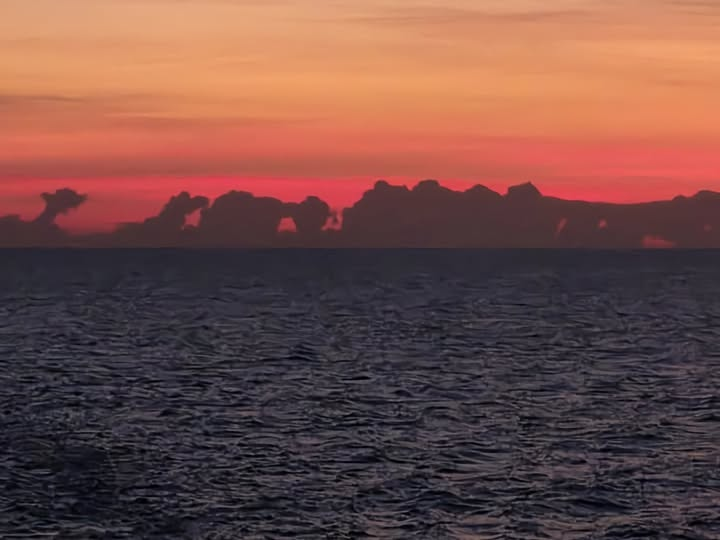
Above: Lacepede Islands. 16 June 2026.
Seeking The Kimberley
Seabourn Pursuit.
The cruise offered a succession of spectacular sunrises and sunsets. Each morning, I made a point of being among the first to breakfast at the Colonnade. I would claim a table on the outer deck, fill my plate at the buffet, and settle in to watch the sky slowly brighten as I ate.
Drums, though he would have preferred to linger in bed, always joined me within fifteen minutes. He never had to—I never asked—but he showed up faithfully, a quiet testament to his desire to be a good companion.
The above pictured dawn left me momentarily speechless. As the sky paled into morning, I stared at what looked like distant mountains rising on the horizon. Were they real, or merely clouds shaped by the light?
Breakfast itself was a comforting constant: scrambled eggs, crisp Canadian bacon, hash browns, baked beans, a grilled half-tomato, sourdough toast with butter and strawberry jam, plus coffee, orange juice, and water. A proper British breakfast, the kind that makes you wonder why genuine Canadian bacon is so hard to find back home in the supermarkets.
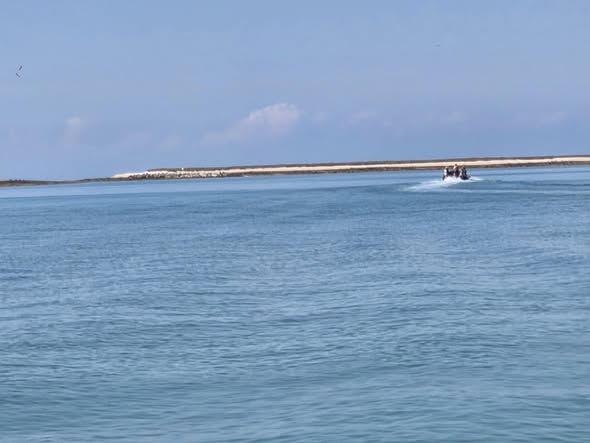
Above: Lacepede Islands. Kimberley, Australia. 16 June 2026.
Seeking The Kimberley
Seabourn Pursuit.
Grok. Designated an A-class Nature Reserve in 1970 and managed by Western Australia’s Department of Biodiversity, Conservation and Attractions, the islands are a vital breeding site. Rats were eradicated in 1986, boosting populations. They form an Important Bird Area (IBA) with one of the world’s largest brown booby colonies (up to 18,000 pairs) and significant roseate terns (up to 20,000). Other breeders include masked boobies, lesser frigatebirds, terns, noddies, oystercatchers, and more. They are also one of WA’s most important green turtle rookeries, with flatback turtles present. Surrounding waters host dolphins, manta rays, dugongs, crocodiles, and migrating humpback whales.
On this (pictured, my image) excursion we saw a large ray swimming under the zodiac, occasional turtles bobbing to the surface, and a sky full of frigate birds chasing terns to steal their food.
Above: Lacepede Islands. 16 June 2026.
Seeking The Kimberley
Seabourn Pursuit.
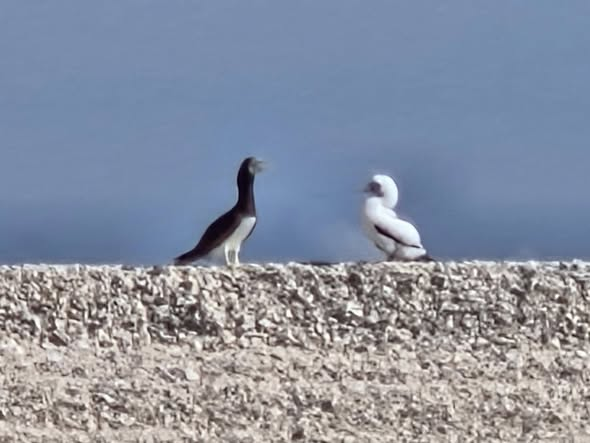
Brown Booby Mom and chick.
Above: Lacepede Islands. 16 June 2026.
Seeking The Kimberley
Seabourn Pursuit.
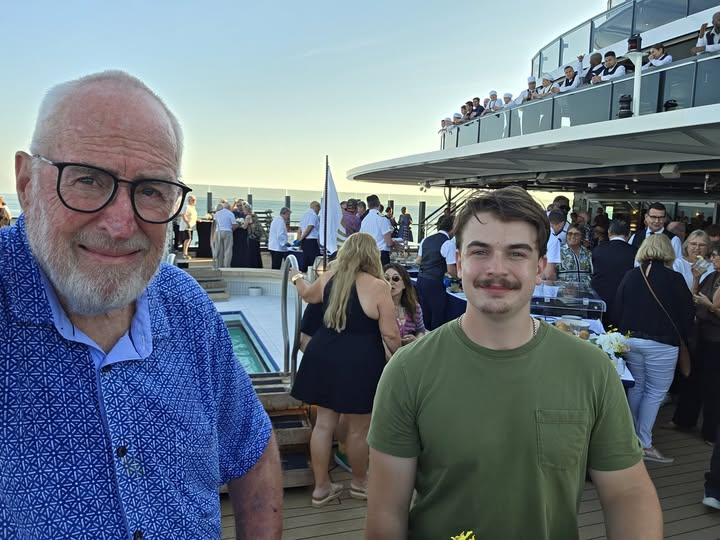
On the final night of the cruise, the Colonnade Deck pulsed with the deck party’s easy rhythm. With only two hundred passengers aboard, the relatively intimate group made casual acquaintances feel natural. One woman in a sleek black dress, from Las Vegas, approached us on the very first day. Noticing Drums, she paused and said warmly, “He looks exactly like my son.” Uncannily, her son had just graduated from the University of Utah. She pulled out her phone, showed us his photo, and asked if she could take a selfie of herself and Drums... to which request Drums graciously acquiesced.
Cruise guests were assigned a color code on their ID cards to designate their Zodiac landing groups. There were six colors in total; ours was blue. The smaller size of the blue group made it easy to form acquaintances, most notably an affable, well-traveled farming couple in their eighties from northern New South Wales. Peter and Sue. We also connected with another couple from the same region who lived in a retirement community. He was a retired Australian Army officer with thirty-five years of service; she, his second wife, was gentle and sweet, though her husband quietly confided that she was in the early stages of Alzheimer’s. Michael and Susan.
A day or two earlier, we helicoptered to Mitchell Falls with a stylish pair from Geneva—he a French commodities trader in his fifties, she a British interior designer. Later, Drums swam at the falls with two dapper Germans in their forties. We ran into them often aboard the ship afterward. They were seasoned Seabourn regulars who claimed to make money while cruising. I suspected they were social media influencers of a certain flamboyant lifestyle; they were always impeccably turned out. Like Drums and me, they wore jackets to dinner every night—where perhaps only ten percent of the men did the same. I can't be more praiseworthy of Drums' easygoing, authentic, confident and engaging manner in relating to all of these newfound acquaintances.
Above: Lacepede Islands. 16 June 2026.
Seeking The Kimberley
Seabourn Pursuit.
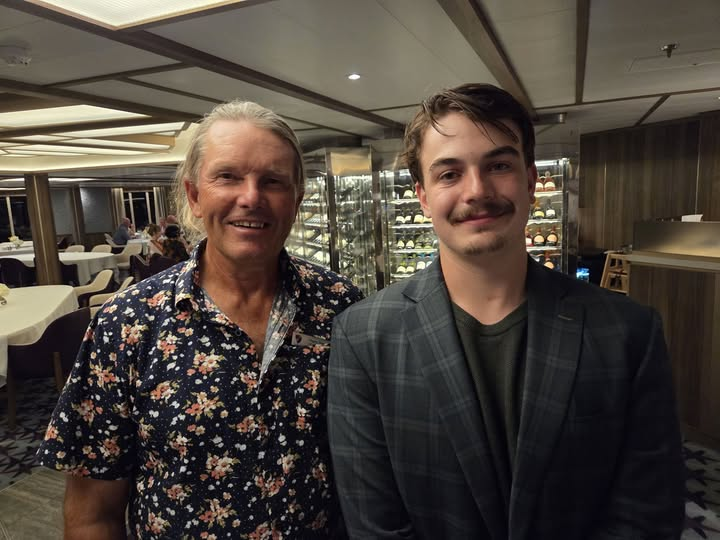
Image: Dinner host Greg from Seabourn adventure staff and Drums.
This was Greg’s final cruise with Seabourn. After thirteen years with the line, he was returning to his native South Africa to launch a dirt-bike touring business. He also hoped to lead an initiative equipping anti-poaching law enforcement teams with motorcycles for faster response in the bush.
Greg spoke candidly about the very real threats facing South African white farmers. Many were now adopting advanced technology—drones and Anduril-like systems—to help protect their land and families.
We were also invited to join cruise staff for two other dinners. One evening we dined with the ship’s South African HR officer; another night we sat with two young bridge officers, one Croatian and the other Romanian.
From the HR officer we learned that disciplinary issues arose at least once a month, usually resulting in a crew member being confined to quarters until the next port. I was particularly impressed by the two bridge officers. Both were married with young children and followed a demanding schedule: four months at sea followed by two months at home with their families. Each aspired to command his own ship one day.
Addendum:
Thanks for your notes on yours and Phin’s trip…welcome back.
'Cake,
Park City, UT