Picto Diary - 12 June 2015 - Sapperg Gallipoli Centenary Tour
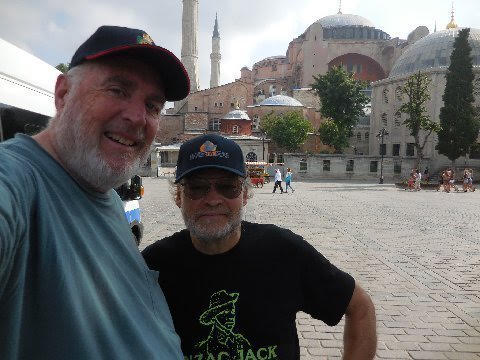
Above: The Bishop and Malcolm. Haggia Sophia in the background. Istanbul, Turkey. 12 June 2015.
The two of us are about to embark on the eight day long Sapper Gallipoli Centenary Tour, organized by The Royal Australian Engineers (Sappers). We embark for Gallipoli tomorrow, 13 June 2015.
Malcolm's grandfather is "ANZAC Jack" Moore, a WWI Gallipoli survivor whose five year, war time letters and photographs have recently been published by Malcolm's dad, ANZAC Jack's son, J. H. Moore. The Sappers invited Malcolm and his father to join the tour, managed by Baronia Travel Center in Melbourne. Malcolm's father, 90 years of age, did not feel sufficiently fit to make the long trip. On hearing of the program from Malcolm, I expressed an interest in the possibility of going along. I would complete a trip to the Isle of Man TT just before the Sapper Gallipoli started... the timing was right. Malcolm obtained Sapper Core Commander Wayne Budd's approval for me to join the Gallipoli Sapper tour as "family."
I had some background knowledge on the WWI Anzac landings in Gallipoli. TIMDT and Mwah (sic) had lived in Australia for five years (1974-1979) and Mwah (sic) knew how important Galippoli was to the Oz national psyche. Mwah (sic) has visited the Australian War Memorial Museum in Canberra to see the extensive Gallipoli exhibit, and made two, albeit short, prior visits to Gallipoli. Here was an opportunity to have a vivid look, real time... "real ground"... at one of the important conflicts of WWI at its centenary.
Mwah (sic) is indebted to Malcolm and the Sappers for allowing me along on the tour.
Gallipoli Overview
By the beginning of 1915, the war between the Allies (UK, France, Russia) and the Central Powers (Germany, Austria Hungary), WWI, had reached a stalemate along a 350 mile long line of trenches between Switzerland and Belgium, through France... the Western Front. A million allied casualties had already been suffered in the months follwoing the war's start in August, 1914.
As Russia struggled against Central Powers Germany and Austria Hungary on the eastern front, she asked for assistance from her allies, England and France: Take some of the pressure off of us. Open another front. Take the Dardanelles from the Ottomans, now aligned with the Central Powers. Take Constantinople (and the Turks out of the war). Open our warm water ports... Sevastapol, Odessa... to the world.
Allied troops were in short supply and needed on the Western Front. So, First Lord of the Admiralty, Winston Churchill, convinced the British War Council that a sea assault with no troop landing could clear the mines and neutralize the forts at "the Narrows" in the Dardanelles, and open the path for the Allies to take Constantinople. In March 1915, an allied flotilla of some 30 capital ships entered the straits. Three allied capital ships were lost to strategically placed Turkish mines and the allied flotilla retreated in a failed attempt to secure passage through the Dardanelles (Hellespont in classical Greece)
The Allies, stung by their naval failure, decided to make a troop landing on the Gallipoli peninsula, take out the forts and mines protecting the Dardanelles in order that a renewed sea assault on Constantinople be undertaken.
On 25 April 2015, under the authority of sector commander Ian Hamilton, some 70 thousand allied troops, including 25 thousand Australians and New Zealanders (Anzacs), recently requisitioned from Egypt, where they were undergoing training, invaded the Gallipoli peninsula.
Attacking Allied troops, British, who landed on the south tip of the Gallipoli peninsula - The Helles, and Anzacs at Anzac Cove, who landed on the peninsula's west side on the Aegean Sea, failed (but barely in the Anzac sector) to reach their respective, anticipated high ground objectives, Achi Baba and Chanuk Bair, respectively, within the first few days of fighting.
French troops landed on strategic ground on the Asian side of the Dardanelles with the hope of neutralizing Turk guns shooting at the five British landing sites on the tip of peninsula. Allied ships provided gun support to the landings.
After the first week of fighting, stalemate resulted at trench lines in both fighting sectors where neither neither the Turks nor the Allies were able to gain an advantage on the other.
On 09 May 1915. The Turkish 19th Division, under Mustafa Kemal (later to become Ataturk and first president of modern Turkey), mounted a massive counter attack on the Anzacs at Quinns Post on 2nd Ridge - front lines. The attack failed and resulted in 10,000 Turkish casualties with only two or three hundred Australian casualties.
On 06 August 1915, the Allies began a second offensive to reach high ground in the Sari Bair range in the Anzac sector. A Kiwi platoon got close, reaching Chunuk Bair, within sight of the straits, but, British troops, who had replaced the exhausted Kiwis, were repelled by the Turks and retreated from the high ground earlier captured by the Kiwis.
An 06 June 2015 landing of British troops north of the Anzac sector at Suvla Bay to bolster the allied assault on Chunuk Bair was also stymied in the early fighting. While the British landing at Suvla Bay carved out new Allied occupied ground, it was not successful in achieving its objective. The Suvla invaders established a trench line and enabled contact along the beach with the Anzacs. But the operation was of no help in the Allied effort to achieve high ground at Chunuk Bair.
On 28 August 1915, Allied forces attempted,unsuccessfully, in serious fighting, to secure Hill 60, an inland midpoint between the Suvla sector and the Anzac sector.
During late December of 1915 and early January 2016, the Allies evacuated their land positions at Gallipoli confirming a misbegotten effort to take Constantinople and to open Russia's warm water ports to the Mediterranean Sea.
Oz Sappers' Waterloo Dinner
The Gallipoli campaign, where eight thousand Australian soldiers and 2500 Kiwi soldiers lost their lives, looms large in the psyche of Australians. Australia's national day is Anzac Day, 25 April. An extensive commemorative centenary remembrance was held in Gallipoli on Anzac Day, 25 April, 2015. The ANZAC sappers were among the first Anzac troops to make landfall at Galllipoli during the early AM of 25 April 1915. So why are the Australian Sappers coming to Gallipoli almost two months after the official Anzac centenary celebrations in April?
The most important "Anzac day" for the Sappers is 18 June, ironically the date of Napoleon's demise at Waterloo, in 1815. It was on 17 June 1915 that the sappers completed the building of a pier in the Gallipoli landing area at Anzac Cove. Sapper Stanley Watson was chief engineer responsible for the pier. The next day, 18 June 1915, the successful sapper pier builders held a commemorative dinner on the beach to celebrate their accomplishment - Watson's pier They noted the coincidence of the date to the 100th year centenary of the battle of Waterloo and called their dinner "the Waterloo Dinner."
.
Post war, in 1924, sapper alums revived the Waterloo dinner tradition and the annual dinner has continued to this day. That this year's main Waterloo dinner is on the 100th year anniversary of the completing of Watson's Pier, and on the 200th year anniversary of Wellington's victory at Waterloo, makes this dinner a special event.... special enough to hold in Gallipoli itself. A sapper memorial service will be held at Anzac Cove, at the site of the original pier (elements of which can still be seen by underwater divers) and the dinner will be held at a hotel nearby. Other Waterloo dinners will be held where their are concentrations of Australian sappers... Kabul, Washington D.C. to name a couple.
The Sapper Gallipoli Centenary Tour is comprised of currently serving sappers, sapper veterans, spouses, descendants of Gallipoli veterans, and a few "other" like Mwah (sic), who, apart from Turkish guides, is the only non Oz/Kiwi on the tour.
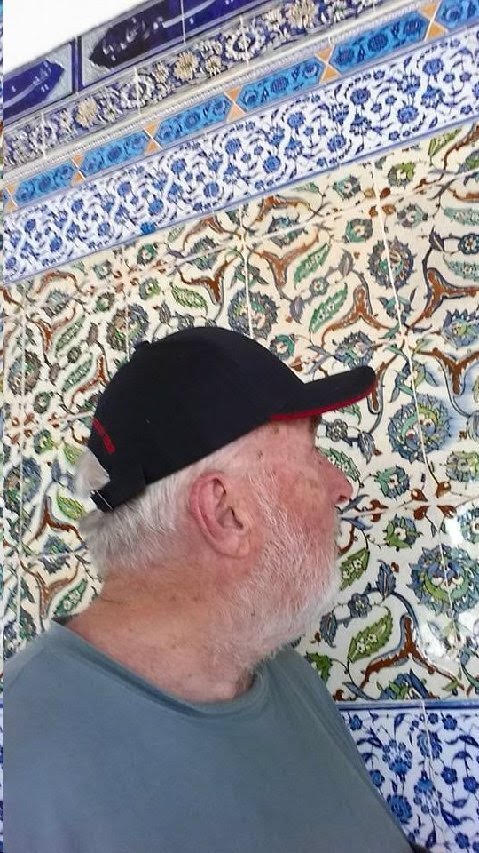
Above: The Bishop, mesmerized, gazes at the tile on the wall of the Sultan's harem. Topkapi Palace. Istanbul, Turkey. 12 June 2015.
Is it within these intricate designs, that witnessed a thousand palace intrigues over the 500 year course of the Ottoman Empire, where the Bishop will finally find the meaning of life?
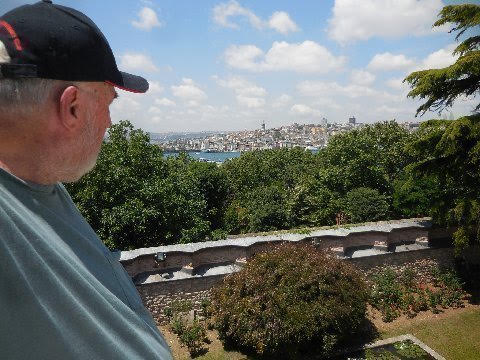
Above: The Bishop views Begolu district of Istanbul, across the Golden Horn from Topkepi Palace. Istanbul, Turkey. 12 June 2015.
TIMDT and the Bishop were in Istanbul a year ago at this time. After staying a night, we flew to Trabzon, picked up motorcycles with Lotus friends, and rode through Georgia, Armenia, Azerbaijan, and Russia for 18 days.
In September of 2014, TIMDT and Mwah (sic) returned to Istanbul, where, among others we enjoyed a delightful dinner at Tugra, Curagan Palace Kempinski Hotel with 1%, Comic Mom, Oz, and Bridge.
This is The Bishop's third visit to Istanbul in the last 12 months, and fifth visit, overall.
In 1964 The Bishop boarded a train in Istanbul bound for Sofia, Bulgaria.
In 2005 The Bishop and TIMDT motorcycled around western Turkey... including, Istanbul, Safranbolu, Cappadocia, Konya, Antalia, Bodrum, Ephesus, and Gallipoli.
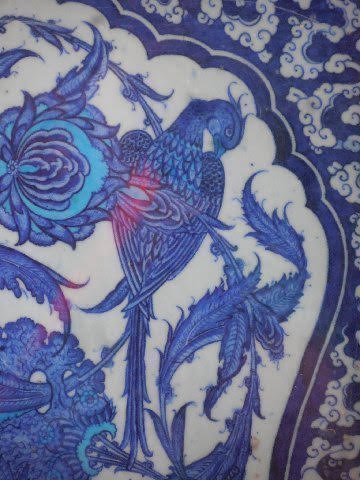
Above: Phoenix bird in tile at Topkepi Palace. Istanbul, Turkey. 12 June 2015.
Out of ashes comes a rebirth. A symbol of civilizations waning and waxing over the course of Anatolian history. The more things change... the more things stay the same. Who's next?
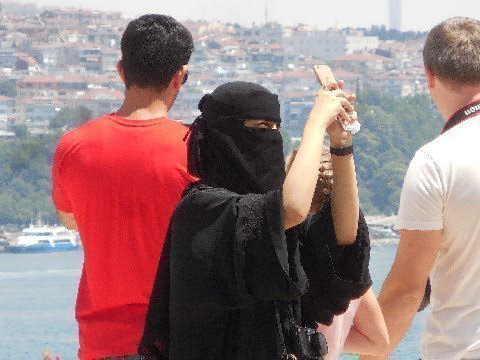
Above: Hijab clad... person (probably a woman) with cell phone/camera. Topkepi Palace. Istanbul, Turkey. 12 June 2015.
The contrast between deep religious tradition in the dress and the casual use of high technology seems dichotomous. Just sayin'.....