"Nothing Like It In the World" by Stephen E. Ambrose (Second Reading, second book report)
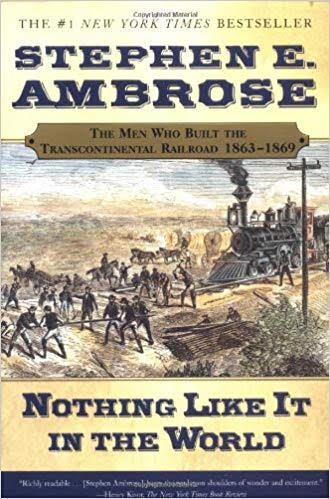
Above: "Nothing Like It In The World." - Stephen E. Ambrose - 382 Pates.
Leland Stanford, President of the Central Pacific Railroad, was highly resistant to associate Charles Crocker's recommendation that Chinese workers be hired as railroad workers. Stanford finally gave in, and railroad executives were well rewarded as the Chinese workers demonstrated remarkable resilience while toiling through harsh working conditions, including extreme temperatures and while fulfilling, skillfully, dangerous tasks like dynamiting rock.
I completed reading this book in August 2025. It was my second reading of the book. My first reading was in 2019. Here is a link to my review of that first reading six years ago. Two reviews in one!!!
"Nothing Like it in the World" by Stephen E. Ambrose | Stephen DeWitt Taylor
I love overland travel... by car, van, or motorcycle. I never travel anywhere overland in the US without trying to be aware of the history, formative events, geography and geology of the area in which I travel. "Nothing Like it in the World" provides great historical background for anyone living near the transcontinental railway track in Utah. To wit:
Park City, UT is a propitious place to live if you are interested in the story of the transcontinental railroad in the United States. Promontory Point, near the northeastern shore of the Great Salt Lake is 142 miles distant. There, on 10 May 1869, the Golden Spike was hammered through a base plate to anchor the final rail to a sleeper to complete the transcontinental railroad. Ogden, Utah, 68 miles away from Park City, UT, became the official meeting point of the Union Pacific Railroad, coming from the east, starting in Omaha, Nebraska, (830 miles distant) and of the Central Pacific Railroad, coming from the West, starting in Sacramento, California (540 miles distant). Echo, Utah is the nearest point of the transcontinental railroad to Park City at 29 miles.
During the course of reading this book I visited all three of the aforementioned Utah locations along the transcontinental railroad, still, to this day, a principal east west railway line connecting the Atlantic and Pacific oceans. Promontory Point today is a National Monument with a visitor's center and replicas of the two actual locomotives that met, cow catcher to cow catcher, on 10 May 1869 to celebrate the opening of the transcontinental railroad. Ogden is home to a stellar railway museum. Echo, which once was a railroad construction town with a population of three thousand people, has a restored, historic church of the period and a number of story boards along the track line outlining pertinent vignettes about the transcontinental railroad.
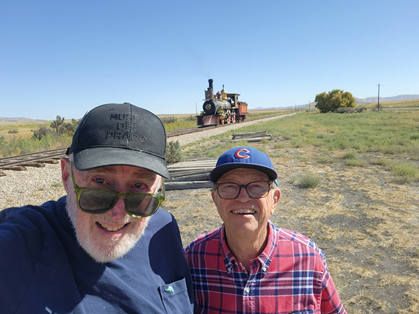
Above: Promontory Point, UT. 18 August 2025.
Mwah (sic) and friend 'Cake. Replica Union Pacific Locomotive 119 in the background. 'Cake and I had read "Nothing Like it in the World" for a book club and made an excursion on this day to see, firsthand, some of the historic points of the railroad near Park City.
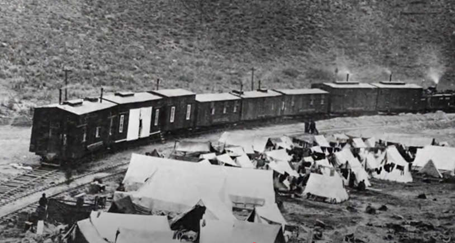
Above: Echo, UT. Transcontinental Railway construction. 1868.
I drive, or motorcycle, frequently along I-80 from Evanston, WY to Ogden, UT. Distance 80 miles. Along that route the transcontinental railroad track is frequently visible. It is hard to travel any of that distance without seeing a Union Pacific train. There is a shooting range at Echo just opposite the tracks. Many times, when I am shooting, I sight a train coming. I pause shooting and walk towards the track to wave at the engineer in the lead locomotive. Most times, I get a wave and a toot in return. I make it a point to wait for the entire train to pass. I like to count the locomotives. At Echo, if the train is east bound, it has to climb a 1.14 grade, the Wasatch Grade, to Evanston, Wyoming thirty-five miles up the road. If the eastbound train is long and fully loaded, I'll count as many as seven locomotives push/pulling the load. Usual configuration for seven locomotives is four in the lead, two in the middle, and one bringing up the rear. A down grade, west bound train, fully loaded might only have three locomotives. Some relatively lightly loaded short trains only have two locomotives in the lead. Often, when sighting the trains, my mind's eye tries to envision what this location would have looked like in 1868, one hundred fifty-seven years ago (see above image). I also think how much progress has occurred in the years since as I compare the steam driven locomotives of 1868 with the massive diesels of today.
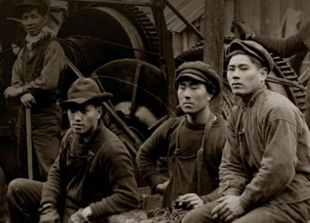
Above: Three of 15,000 Chinese workers on the Central Pacific Railroad.
Chinese workers played a crucial role in the construction of the Transcontinental Railroad in the 1860s, contributing significantly to a project that connected the eastern and western United States. The Chinese immigrants undertook grueling labor to build about 700 miles of railroad track across the Sierra Nevada mountain range, across the Nevada desert and into the Wasatch Range, in Utah. Leland Stanford, President of the Central Pacific Railroad, was highly resistant to associate Charles Crocker's recommendation that Chinese workers be hired as railroad workers. Stanford finally gave in, and railroad executives were well rewarded as the Chinese workers demonstrated remarkable resilience while toiling through harsh working conditions, including extreme temperatures and while fulfilling, skillfully, dangerous tasks like dynamiting rock.
2019 saw the 150th anniversary of the construction of the Transcontinental Railroad. At the sesquicentennial celebration of the completion of the transcontinental railway at Promontory Point, US Secretary of Transportation, Elaine Chow, of Chinese heritage, gave a speech celebrating the contribution of Chinese workers. Until Chow's talk, the role of Chinese workers to the success of the venture had been much overlooked in written accounts, photographs, commemorations and celebrations of the historic event.
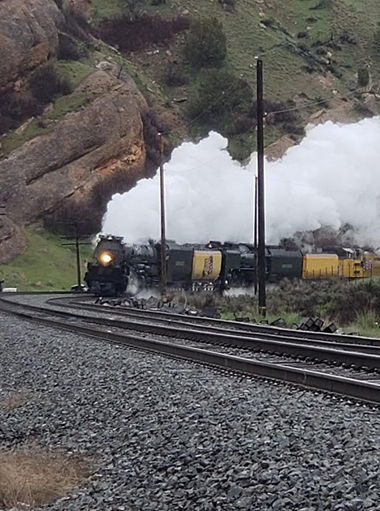
Above: Echo, UT. Transcontinental Railroad Tracks. 08 May 2019.
Big Boy locomotive #4014: a restoration by Union Pacific of its largest steam locomotive along the transcontinental railway which pulled freight before the introduction of the diesel locomotives in the 1940's and 1950's. Image, looking east, uphill, includes the red-rock cliffs on the north side of Echo Canyon. Echo Canyon is replete with important history. Before the transcontinental railroad, the canyon was a principle east west corridor for French fur trappers in the 1820's; American explorers such as Jim Bridger and John C. Fremont in the 1840's; The Donner Party (1846); the Mormon pioneers (1847); the 49ers, 1849; the Pony Express (1860-1861); the Lincoln Highway, 1913; and, Interstate 80, completed in 1986.
Summary of "Nothing Like it in the World."
Ambrose's book vividly chronicles the audacious construction of America's first transcontinental railroad, a monumental engineering triumph that linked the nation's coasts and created a unified continent amid the Civil War's chaos. Ambrose celebrates the visionaries, financiers, construction managers and laborers who were responsible. The book emphasizes human grit over dry technical facts.
President Abraham Lincoln, a fervent railroad advocate from his Illinois railroading days, champions the Pacific Railway Act of 1862, granting massive land subsidies and loans to two rival companies: the Union Pacific (UP), building westward from Omaha, Nebraska, and the Central Pacific (CP), pushing eastward from Sacramento, California. This legislation pits the firms in a high-stakes race, where speed trumps safety, fueling innovation but also peril. Ambrose spotlights Lincoln's strategic foresight: the railroad would knit the West to the East, transport troops swiftly, and spur economic booms in trade and settlement, slashing cross-country journeys from perilous months-long wagon treks to mere days.
At the helm, UP's Thomas "Doc" Durant, a cunning financier, manipulates stocks and politics to fund the venture, while CP's "Big Four"—Leland Stanford, Collis Huntington, Mark Hopkins, and Charles Crocker—pool Sacramento merchant savvy with ruthless lobbying in Washington.
Engineers like Grenville Dodge (UP) and Theodore Judah (CP) brave blizzards, floods, and plains Indian resistance to survey routes through unforgiving terrain. Construction managers like Thomas Crocker (CP) and the Casement brothers (UP) manage the building of tunnels, fills, and bridges that were unprecedented in all railways building theretofore. The UP conquers the flat Great Plains, dodging buffalo herds and Sioux warriors, but the CP's ascent into the Sierra Nevada proves hellish: workers dynamite sheer granite cliffs, burrow 1,700-foot tunnels amid avalanches, and toil through winters where temperatures plummet to -30°F, all while navigating unstable explosives that claim countless lives.
Ambrose's narrative heart beats in the unsung toilers: 10,000 Irish immigrants and Civil War veterans for the UP, enduring cholera outbreaks and brutal bosses; and 15,000 Chinese recruits for the CP, derided as "Celestials" yet excelling with ingenuity—hanging baskets over chasms to drill and blast, hand-building miles of track daily. These men, paid meager wages and housed in tent slums, face starvation, scalping raids, and corporate greed, yet their backbreaking labor—laying 2,000 miles of iron—embodies Ambrose's theme of ordinary heroism. Scandals simmer: bribery scandals like the Crédit Mobilier affair taint leaders, but momentum surges as tracks converge in Utah's arid Promontory Summit.
Brigham Young was a key player in the construction of the transcontinental railroad. He supplied Mormon labor for the Union Pacific. Young lobbied for the route of the railroad to include Salt Lake City. Dodge and Durant, however, chose a route down Weber Canyon to Ogden, forty miles north of Salt Lake City. Shortly after the completion of the transcontinental railroad, Young built a rail spur from Salt Lake City to Ogden. Memorable from the book are the accounts of Young trying to get his workers paid. Eventually, Durant paid up, but Young's patience was stretched to the limit many times before payment was made.
On May 10, 1869, amid cheers and champagne toasts, CP's Stanford and UP's Dodge swing ceremonial hammers, driving the golden spike that unites the rails with a telegraph click heard nationwide: "Done!" Ambrose portrays this as America's defining feat—rivaling the pyramids in scale—propelling industrialization, westward migration, and cultural fusion, though at the cost of exploited workers and displaced tribes.
A few years back I visited Promontory Point National Monument. There in the bookstore, I asked a ranger what book would best enable me to understand the story of the transcontinental railway. She recommended: "Empire Express," by David Hayward Bain. She noted that Ambrose's book, a best seller, was better known, but it included many factual inaccuracies and invented quotes. I have a copy of "Empire Express," but I haven't read it yet. Too many books... too little time. I opted to reread Ambrose because of his book's fast reading gripping prose. "Nothing Like It in the World" a great tribute to American ambition.
The book pairs well with "Path Between the Seas," by David McCollough, the story of the construction of the Panama Canal, another rollicking salute to the, still unique, and still alive, I believe, American spirit of enterprise and innovation.
"The Path Between the Seas" by David McCollough | Stephen DeWitt Taylor
Recommend! Even reading the book two times within six years is worthwhile!