"Joseph Smith: The Rise and Fall of an American Prophet" by John G. Turner.
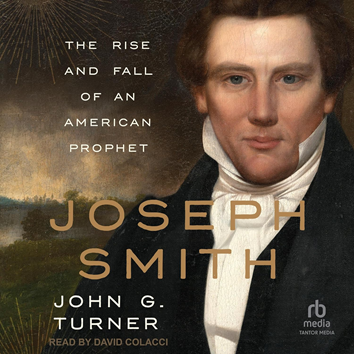
I completed reading the above book today, 08 August 2026. "Joseph Smith: The Rise and Fall of an American Prophet" by John G. Turner. 464 pages.
Turner presents Smith neither as pure prophet nor pure fraud. He sees him as a religious entrepreneur of unusual talent—charismatic, imaginative, restless, and often reckless.
I have read the two other seminal biographies of Joseph Smith... linked following:
By way of "six degrees of Kevin Bacon:" During the 1950's my mom was best friends with Barbara Smith, Fawn Brodie's sister. I was a childhood friend of Olivia and Kenny, offspring of Oliver and Barbara Smith. Richard Bushman was Bishop of our LDS student ward while I was studying at Harvard Business School, 1979 to 1971.
The following is a Grok assisted narrative. The product, however, is mine and reflects my sentiments were I as good as Grok in putting them down. I did a few edits of the Grok version. Following the Grok assisted review are some of my personal observations coming about from reading the book.
"Joseph Smith - The Rise and Fall of an American Prophet" is the first major scholarly biography of Mormonism’s founder to draw fully on the completed Joseph Smith Papers Project. Turner, a non-Latter-day Saint historian at George Mason University and author of the acclaimed "Brigham Young: Pioneer Prophet," offers a clear-eyed, fast-moving portrait of one of the most extraordinary and contested figures in American religious history.
Born in 1805 to a struggling Vermont family and raised amid the spiritual ferment of the Second Great Awakening, Joseph Smith Jr. claimed a vision of God the Father and Jesus Christ at age fourteen. Further angelic visitations, he said, led him to golden plates buried in a New York hillside. From these he produced the Book of Mormon (1830), a new scripture that became the foundation of a rapidly expanding religious movement.
Over the next fourteen years Smith founded a religion, built cities, erected temples, introduced outré doctrines of eternal progression and plural marriage, organized a private militia, ran for president of the United States, and married contemporaneously more than thirty women. His career ended violently in 1844 when a mob killed him in a Carthage, Illinois, jail.
Turner presents Smith neither as pure prophet nor pure fraud. He sees him as a religious entrepreneur of unusual talent—charismatic, imaginative, restless, and often reckless. “To fix Joseph Smith’s character in a single dimension—fraud, fanatic, prophet, tyrant,” Turner writes, “is to miss the unstable brilliance of his life. The contradictions were the point.” Smith sold books, land, and merchandise; he dictated revelations that spoke to deep anxieties about salvation, miracles, and the afterlife; he gathered followers into tight communities that both inspired devotion and provoked fierce opposition.
Turner does not believe the golden plates existed and regards the Book of Mormon as Smith’s own composition—an audacious literary achievement that reveals remarkable biblical fluency and narrative ambition. Yet he takes Smith’s religious experiences seriously as they were lived by him and his followers, and he declines to reduce the prophet’s career to simple deception.
The book’s great strength is its narrative drive and economy. At roughly 400 pages of text, it is tighter and more accessible than Richard Bushman’s magisterial "Rough Stone Rolling (2005)" while remaining more measured and better sourced than Fawn Brodie’s classic skeptical biography "No Man Knows My History (1945)."
Turner makes excellent use of newly available diaries, sermon transcripts, and church records. He is particularly strong on Smith’s personality—his humor, hospitality, rough speech, and appetite for risk—and on the escalating tensions of the Nauvoo years, when polygamy, theocratic politics, and personal vendettas created an atmosphere of crisis that culminated in martyrdom.
Critics, especially Latter-day Saint reviewers, have noted limitations. Some find Turner too quick to dismiss the historicity and theological depth of the Book of Mormon. Others argue that he occasionally states uncertain details of plural marriage with excessive confidence.
The book also spends less time than Bushman on the broader cultural and intellectual context of early nineteenth-century America. These are fair observations, yet they do not diminish the book’s overall achievement. "Joseph Smith" is neither a work of faith promotion nor of debunking. It is a serious, readable historical biography that treats its subject as a complex human being whose vision and flaws together produced one of the most successful new religions of the modern era. For general readers and scholars alike, Turner has provided an outstanding one-volume introduction to the rise and fall of an American prophet. Highly recommended.
Personal Thoughts
It appears that conventional wisdom about Joseph Smith has gone far beyond "how could such a stupid, poorly educated boy" produce something as complex and theologically deep as the Book of Mormon? ".. a trope oft used and pushed a century ago. Turner cites Joseph's audacity... his risk-taking nature... his self-confidence... his charisma, his biblical knowledge. Think some combination of Forrest Gump, Napoleon, Elon Musk, Buckminster Fuller, Nikola Tesla and Donald Trump.
More than most biographies, the book flows... readable... page turner etc. Many biographies are turgid and are read more out of duty than enjoyability. However, reading Turner is like binge watching a streaming video that you like. While reading the book, because of the smooth flow of the narrative, I felt that I got to know Joseph Smith as a man than ever before. Accordingly, I asked Grok to characterize Joseph as portrayed by Turner in a paragraph:
Composite description of Joseph Smith’s persona, drawn from John G. Turner’s research and portrayal in Joseph Smith: The Rise and Fall of an American Prophet: Joseph Smith emerges in Turner’s account as a larger-than-life figure of restless energy and unstable brilliance—an audacious, charismatic, and relentlessly dynamic religious entrepreneur whose contradictions were essential to his power. Rough-spoken and mirthful, he prized kindness and hospitality over propriety, yet he could turn sharply coercive or furious when challenged. Optimistic and self-confident, he continually reinvented himself and his movement, always advancing a grander plan than the last, whether revising scripture, inventing rituals, founding cities, or plunging into polygamy and politics. He thrived on drama, adventure, and danger, growing more reckless after setbacks and, in his final years, displaying traits of megalomania in his obsession with power, disregard for risk, and taste for pageantry. Compelling and magnetic to followers, he was also deeply flawed—financially improvident, personally complicated, and ultimately impossible to contain within any single category of prophet, innovator, or scoundrel.
As I read Turner’s book, I couldn’t help reflecting on the sharp contrast between the youthful, charismatic, chaotic, self-confident, and outspoken Joseph Smith—who presided over a heavily indebted church and a persecuted, often disputatious people—and today’s LDS leadership: a carefully spoken gerontocracy guiding a huge, well-organized, stable, bureaucratic, and hyper-wealthy church in a far different culture (half of today's Church members live outside of the US) than existed in Joseph's time. If one is wont to say the proof of the Church's truth is in the pudding, there is a strong case to be made for Joseph Smith's claims, however they came about.