"Joseph Smith - The Architect of Mormonism - A Topical Biography" by Ganesh Cherian
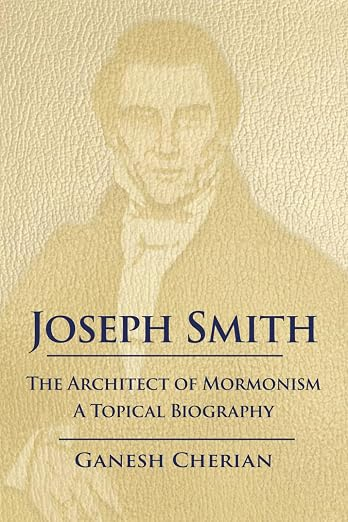
Above: "Joseph Smith - The Architect of Mormonism - A Topical Biography. 586 pages. I completed reading this book today.
In short, Cherian’s work presents Joseph Smith as a brilliant, charismatic, and deeply human architect whose early visionary product—the Book of Mormon—set ideals that the subsequent institutional religion both built upon and substantially altered under the pressures of reality. This portrayal is offered as a lens on the “messy, miraculous alchemy of faith” and on how religions commonly evolve from founding texts and charismatic founders.
Attempts, such as Cherian's, to explain the origins of the Book of Mormon continue apace. Could the Book of Mormon really have resulted from the inspired discovery of golden plates by the seventeen-year-old Joseph Smith in upstate New York in 1823? Was Joseph Smith a genius? How could a young man from a poor family put forward such a complex narrative? Did Smith plagiarize using other sources? Was the source of the Book of Mormon the direct divine as claimed by the Mormon Church, however fantastic that sounds? There have been so many books which have attempted to explain Book of Mormon origins.
Following links are my reviews of four books I recently (within the last five years) read about Joseph Smith and the origin of the Book of Mormon. The authors of each book attempts to explain the Book of Mormon’s origins within the broader context of its seemingly fantastical origin story. Note: Richard Bushman, noted LDS scholar, was the Bishop of my LDS ward when I was a student in Boston, Massachusetts, 1970 to 1971.
In short, Bushman works within a framework open to the miraculous transcription narrative claimed by the LDS Church as the best historical fit; Brodie sees conscious composition and fraud rooted in treasure seeking and contemporary books like "View of the Hebrews;" and Park frames The Book of Mormon as an emergent text within the vibrant, magical, and speculative religious culture of the burned-over district as part of a larger American religious history.
What about Cherian's book? The central claim of Cherian's book, reviewed here, is that the Book of Mormon reflects the worldview, experiences, and aspirations of the young Joseph Smith—shaped by poverty, family dynamics, 19th-century American settler culture, contemporary ideas about Native Americans, prevailing theologies, personal prejudices, and folk-magic traditions—while later revelations and practices often departed from or inverted those early ideals under the pressures of leadership, financial crises, persecution, community-building, and personal evolution.
Cherian treats Joseph as the primary (and sole) author of the Book of Mormon in a naturalistic sense, with the text functioning as a product of its time that was later reshaped by lived experience. The work is presented as both biography and an examination of how religious ideas transform and distort under real-world stress, with implications for understanding the origins of many faiths.
The structure of the book is unconventional for a biography. The book is organized topically into five sections containing forty-five chapters. These include:
- 19th-century settler worldviews and American history/expansionist ideas.
- Contemporary understandings of Indigenous Native Americans (including conversion hopes, “white and delightsome” language, and related missionary priorities).
- 19th-century theology and its evolution.
- Joseph’s personal prejudices and socio-cultural views.
- Folk magic and related cultural practices.
- Aspects of Joseph’s own beliefs and ideologies.
Each topic generally follows a consistent pattern: outline relevant early-19th-century cultural or intellectual context (and sometimes Joseph’s or his family’s specific circumstances); quote extensively from the Book of Mormon (often with key phrases highlighted); compare those passages to later teachings, revelations, and practices; identify “pivot points” where doctrine or emphasis shifted; and supply timelines tracking the progression. Historical events (such as the destruction of the Nauvoo Expositor and Joseph’s subsequent arrest and death) are sometimes repeated across chapters so that individual topics can stand alone as a reference-style topical guide.
Cherian traces Joseph’s trajectory from impoverished upstate New York roots through the production of the Book of Mormon and the rapid, turbulent growth of the movement to Nauvoo.
Early Book of Mormon themes emphasize egalitarianism, warnings against kings and hierarchical power, limited or conditional salvation ideas, anti-secret-combination rhetoric, and particular views of Native peoples and America’s role. These are set against later developments: the rise of a hierarchical priesthood structure, the introduction of temple ordinances and baptism for the dead, shifts toward more expansive/universalist conceptions of salvation (degrees of glory), evolving teachings on the Godhead, the Word of Wisdom (contextualized against contemporary temperance movements and early inconsistent observance), changing positions on slavery under political pressure, speaking in tongues, and the introduction of plural marriage and other Nauvoo innovations.
The book portrays these changes as responses to concrete pressures—financial failures (e.g., Kirtland), expulsions and violence in Missouri, the demands of governing a growing and often fractious community in Nauvoo, and Joseph’s own changing status and circumstances—rather than seamless continuous revelation. A recurring motif is “a tale of two Josephs”: the younger idealist reflected in the 1829 text versus the more pragmatic (and sometimes contradictory) leader of the early 1840s. Cherian links specific Book of Mormon passages and narrative features to Joseph’s environment and oral/compositional practices of the era, arguing that the text’s internal evidence supports sole authorship by him.
Written from the perspective of an active member seeking greater historical accuracy and institutional accountability, the book is neither a traditional faith-promoting hagiography nor a pure debunking.
In short, Cherian’s work presents Joseph Smith as a brilliant, charismatic, and deeply human architect whose early visionary product—the Book of Mormon—set ideals that the subsequent institutional religion both built upon and substantially altered under the pressures of reality. This portrayal is offered as a lens on the “messy, miraculous alchemy of faith” and on how religions commonly evolve from founding texts and charismatic founders.
Cherian implies that, notwithstanding the radical difference between the Church’s claimed origin story and his own analysis, neither Joseph Smith’s contribution nor the "truth" of the Mormon Church is thereby rendered any less valid.