"How to Rule the World" by Theo Baker
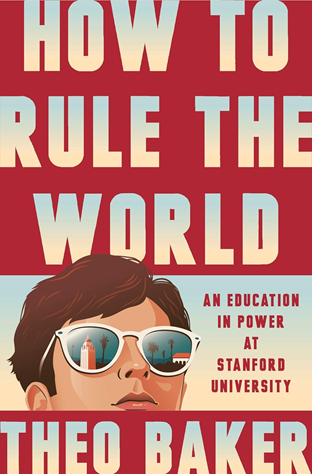
"How to Rule the World," by Theo Baker — 302 pages
I finished the book today.
"How to Rule the World" is a hybrid of investigative journalism, campus ethnography, and coming-of-age memoir. Written by a Stanford undergraduate who arrived as a 17-year-old computer-science freshman in fall 2022, it recounts how he joined The Stanford Daily, uncovered research-misconduct questions around university president Marc Tessier-Lavigne, and helped force the president’s resignation—while also documenting the secretive networks that groom elite students for Silicon Valley power. Baker later won a George Polk Award, becoming the youngest recipient ever. The book became a New York Times bestseller.
Baker came to Stanford intending to code and join the tech ecosystem. He quickly encountered two overlapping worlds. One was “Stanford inside Stanford”: invite-only gatherings, venture-capital dinners, mansion parties, slush funds, and a secretive class literally titled “How to Rule the World,” taught by a Silicon Valley CEO who promised hidden frameworks for extracting value—knowledge once reserved for “the literal children of billionaires.” Baker contrasts this with more established entrepreneurship classes that lament a lost “moral compass.” He also reported on campus life, including the administration’s “War on Fun” (a sharp drop in registered parties) and a high-school graduate who had impersonated a Stanford student and lived in dorms for years.
The book’s core is Baker’s freshman-year investigation of Tessier-Lavigne, a celebrated neuroscientist and former Genentech executive. A tip led Baker to PubPeer comments dating to 2015 about possible image manipulation in papers listing the president as co-author. Image-forensics expert Elisabeth Bik identified serious problems in multiple papers. Baker’s first story (November 2022) prompted Stanford’s board to open an investigation; he then reported a conflict of interest involving a committee member with a large investment in a Tessier-Lavigne-linked company.
A key breakthrough involved Genentech sources who said an internal review had found fabricated data in Tessier-Lavigne’s prominent 2009 Nature paper on a proposed Alzheimer’s pathway; Tessier-Lavigne had been urged to retract it but instead published later papers that quietly walked back the claims. Legal pressure from a major Silicon Valley firm followed. Baker published despite warnings. An independent panel later found “apparent manipulation of research data” in several papers, an unusual frequency of problems in the lab, and a failure to correct the record over two decades.
Tessier-Lavigne resigned in 2023, requested retractions or corrections, and later received a large payout, bought a mansion in Atherton, and co-founded an AI drug-discovery company that raised $1 billion. Baker notes that an investor in that new venture later approached him about funding. Interwoven is Baker’s personal story: impostor syndrome in a demanding CS class, running a major hackathon while publishing, collapse from exhaustion, family deaths (including two grandfathers and a family friend by suicide), a breakup, and a private opioid overdose from which he recovered with Narcan.
Baker frames Stanford’s entanglement with Silicon Valley as a Faustian bargain that produced both extraordinary success and a culture of impunity. “It is precisely because I love Stanford,” he writes, “that I wish it to be better.” The book argues that access and power at the top of tech and elite academia often flow through opaque networks rather than transparent merit, and that institutions protect their own even when scientific integrity is at stake. Reviewers have compared it to Liar’s Poker, All the President’s Men, and One L—a propulsive, sometimes terrifying portrait of a “dweebocracy” that sets agendas for the planet. Some critics found the memoir elements less fully realized than the reporting. Tessier-Lavigne has publicly disputed key allegations about fabrication and cover-up. The book is widely praised as a vivid, sourced account of how a teenage reporter took on an institution and what that institution teaches its most ambitious students about ruling the world.
From Baker’s coda: “But too often the integration of the university and the tech world has proven exploitative and tolerant of misdeeds. Stanford’s most singular attribute is also its gravest flaw. ”Baker emphasizes the symbiotic relationship between Stanford and neighboring Silicon Valley—or, more broadly, the “tech world.”
In addition to this book, two others I have read and reviewed illustrate Stanford-adjacent tech scandals.
"Bad Blood," by John Carreyrou. Bad Blood (2018) is the investigative account of Theranos, the Silicon Valley blood-testing startup founded by Elizabeth Holmes. Holmes promised a revolutionary device that could run dozens of tests from a finger-prick drop of blood; the technology never worked as advertised. The book details how she and COO Sunny Balwani used secrecy, intimidation, fake demonstrations, and high-profile board members (including Henry Kissinger and James Mattis) to raise hundreds of millions, sign deals with Walgreens, and delay exposure. Carreyrou, a Wall Street Journal reporter, reconstructs the whistleblowers, lab failures, regulatory deception, and eventual collapse that led to Holmes’s fraud conviction. It is a cautionary tale of hype, charisma, and the costs of believing a visionary too completely.
Stanford connection. Holmes enrolled at Stanford as a chemical-engineering student in 2002 and dropped out after her freshman year (around 2003–2004) to found Theranos, using her tuition money as seed funding. She worked in Stanford labs and received early encouragement from chemical-engineering professor Channing Robertson, who became a technical advisor and one of the company’s first board members. Stanford medicine professor Phyllis Gardner rejected Holmes’s initial wearable-patch idea as scientifically unworkable. Later, Stanford professor John Ioannidis publicly criticized Theranos in 2015 for its lack of peer-reviewed evidence (“stealth research”). Several prominent Stanford-affiliated figures served on Theranos’s board, most notably former Secretary of State George Shultz (a Hoover Institution fellow), whose grandson Tyler Shultz later became a key whistleblower after working at the company. Other Stanford alumni or affiliates, such as William Perry, also joined the board. Holmes later cited a reported sexual assault at a Stanford fraternity house in 2003 as influencing her decision to leave school and focus on the company.
"Going Infinite," by Michael Lewis. Going Infinite (2023) chronicles the meteoric rise and sudden collapse of Sam Bankman-Fried, the eccentric math prodigy and effective altruist who built a cryptocurrency empire through Alameda Research and the FTX exchange, amassing tens of billions before FTX imploded in November 2022 amid a liquidity crisis, missing customer funds, and allegations of fraud. Lewis, who had unusual access, explores SBF’s quirky personality, chaotic operations, and whether the disaster stemmed more from incompetence than deliberate crime.
Stanford connection. Bankman-Fried did not attend Stanford (he went to MIT), but he was born there in 1992 to longtime Stanford Law professors Joseph Bankman and Barbara Fried and grew up on campus; that elite academic halo later helped him raise money and credibility for FTX. His father took leave to advise FTX, allegedly received a large transfer from the company, and steered more than $5.5 million in FTX-linked gifts to Stanford—funds the university said it would return after the bankruptcy estate sued the parents for clawbacks (they denied wrongdoing and were not charged). After SBF’s arrest he was held on house arrest at his parents’ campus-area home on a $250 million bond co-signed by former Stanford Law dean Larry Kramer and scientist Andreas Paepcke; Stanford Law professor David Mills was among his lawyers. He was convicted in 2023 and sentenced in 2024 to 25 years and more than $11 billion in forfeiture, leaving Stanford tied to his story through family, prestige, donations, and legal aftermath rather than as his alma mater.
Notwithstanding Stanford's ties to scandal, Baker still has hope for Stanford: “There is so much good here, and many people here really do change the world for the better. It is precisely because I love Stanford that I wish it to be better.”
For Baker, Hoover Institution director Condoleezza (Condi) Rice—former Stanford provost and U.S. secretary of state in the George W. Bush administration—is part of that “so much good.” Rice tells him: “If you’re going to have a big research enterprise, and you’re going to have a big commercialization arm, and if you’re going to encourage people to take risk, you will have some bad actors.” Baker replies: “Perhaps it’s just that I’m young, as Rice pointed out, but I have a less fatalistic view. I think you can inculcate innovation without enabling fraud. If Stanford is going to claim credit for its success stories, it must also shoulder responsibility for its failures.”
In the book, Baker, not holding back admiration, describes Condi Rice appearing before the Stanford Faculty Senate amid faculty demands to scrutinize or distance the university from the Hoover Institution. Some professors wanted action against Hoover figures they associated with election-denial narratives and the January 6 Capitol riot (including later debates about board members such as Rupert Murdoch and Rebekah Mercer). Rice, as Hoover’s director, firmly rejected calls that would amount to firing or silencing fellows and overseers. She framed the effort as an attack on academic freedom and viewpoint diversity, noted Hoover’s relative political balance compared with the heavily Democratic faculty, and warned that targeting Hoover’s board would require applying the same standard to every university advisory body. The Senate ultimately declined an independent review committee and instead tasked Rice and the provost with increasing collaboration between Hoover and the rest of campus.
Full disclosure: I am a proud member of the Board of Overseers of Stanford’s Hoover Institution—read: Hoover donor. I have spent a good deal of time on the Stanford campus over the last ten years attending Hoover retreats. Using Baker's terminology, I can personally attest that Hoover Institution very much fits within "so much good about Stanford."
Summation. Theo Baker arrived at Stanford at 17 as a coder drawn to Silicon Valley’s promise, then almost immediately turned reporter for The Stanford Daily and began probing the university president’s scientific record. Within months he uncovered a pattern of image manipulation and questionable data in papers associated with Marc Tessier-Lavigne spanning two decades. The story, pursued with unusual tenacity for a freshman facing institutional pushback, lawyers, and PR teams, triggered a formal investigation that ended with the president’s resignation. How to Rule the World is both the chronicle of that investigation and a wider, often satirical portrait of “Stanford inside Stanford”—the secret seminars, VC talent-scouting, and ethical shortcuts that train future rulers of tech. The book’s page-turning quality comes from Baker’s dual vantage: an insider close enough to see the machinery of elite formation, yet outsider enough, as a teenage journalist, to treat its contradictions as news rather than destiny.
Highly recommend.