Earth. Ticking time bomb. - 25 November 2025
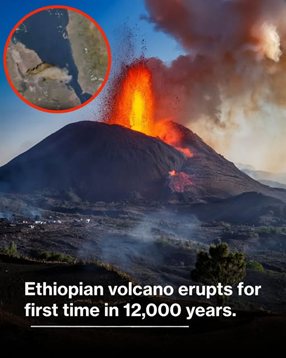
Above: Hayli Gubbi, Ethiopia, volcanic eruption 23 November 2025.
There are no conspiracies. But, also, there are no coincidences.
Only nine days ago I posted my blog, The Case for Mars, The Case for Mars | Stephen DeWitt Taylor, where I noted earth's fragility and cheer led Elon Musk in his pursuit to secure the future of human consciousness by establishing a permanent earth settlement on Mars... hedging bets on humanity's destruction, as it were.
In The Case for Mars, I rehearsed earth's five previous extinctions over the last 500 million years and posited that there would be another one... tomorrow... 50K years...100K years... but extinction event there would be and hence the exigency of not letting that extinction event wipe-out mankind. I provided background on the five previous extinctions, most of them volcanic in origin. I then posited locations where the next volcanic induced extinction could occur. Here quoted from The Case for Mars:
Africa's Grand Rift Valley widens by seven millimeters a year. This progressive separation will result in the eventual splitting apart of the African continent, and like the Siberian cataclysm, will result in at least a thousand years of life-destroying atmospheric disturbance. When? Tomorrow or in100K years.
Location of Hayli Gubbi, which erupted two days ago, after a 12K year dormancy? Africa's Grand Rift Valley. It may be another 10K years before Hayli Gubbi erupts again... or... it could be in a year, with other rift volcanos joining in the cataclysm... the start of... the sixth extinction. If nothing else, Hayli Gubbi should be a wakeup call for all humans to appreciate mankind's fragile state of existence and the imperative for our species survival and continued progress measured in geologic time and space time.
Following is Science Acumens post on Hayli Gubbi's eruption.
Science Acumen's Post 24 November at 9:13 AM ·
JUST IN: In the scorching expanse of Ethiopia's Afar region, where the Earth's crust fractures like brittle glass, the Hayli Gubbi volcano shattered millennia of silence on November 23, 2025.
Perched about 500 kilometers northeast of Addis Ababa, near the Eritrean border, this modest 500-meter shield volcano—long presumed dormant—unleashed an explosive fury unseen in the Holocene epoch, which dawned roughly 12,000 years ago at the close of the last Ice Age.
Satellite imagery from NASA's MODIS and advisories from the Toulouse Volcanic Ash Advisory Centre captured the spectacle: a colossal plume of ash and sulfur dioxide rocketing skyward to 14 kilometers, dwarfing the horizon and drifting eastward across the Red Sea toward Yemen, Oman, and as far as India and northern Pakistan.
Hayli Gubbi slumbers in the Afar Rift, a tectonic crucible where the African and Arabian plates wrench apart, birthing new seafloor in one of Earth's most volatile zones.
Neighbors like the perpetually simmering Erta Ale, with its eternal lava lake, underscore the area's restless geology, yet this eruption marks a rare awakening for Hayli Gubbi, with no prior Holocene activity etched in geological records, according to the Smithsonian Institution's Global Volcanism Program.
Explosions began around 8:30 a.m. UTC, persisting for hours and blanketing the remote Danakil Depression in a hazy shroud. Local herders, eking out lives amid extreme heat exceeding 50°C, watched in awe and trepidation. Official Mohammed Seid reported no immediate casualties, but the ashfall threatens livestock forage and water sources, potentially unraveling fragile pastoral economies.
Aviation authorities issued alerts, diverting flights—including an IndiGo route to Abu Dhabi—as the plume menaced airspace. Volcanologists like Michigan Tech's Simon Carn hailed the event as a "geological surprise," detected solely through orbital sentinels due to the terrain's inaccessibility.
As the ash dissipates, scientists anticipate monitoring for renewed tremors, pondering whether this heralds a brief flare or the stirrings of deeper unrest. In a world of accelerating climate pressures, such eruptions remind us of nature's untamed pulse, where ancient forces defy human timelines and reshape distant skies.

Above: Bishop motorcycling (Honda Africa Twin) Ethiopia, 2009. Africa Grand Rift Valley ground zero.