Can the LDS resume membership growth in the US? - 16 April 2026
I noted with interest the below linked piece on the decline of LDS Church membership in the US (worldwide, the LDS Church continues to grow in membership):
Latest from Mormon Land: LDS membership drops for first time in US.; apostle updates divorce remarks
I am not surprised that LDS membership numbers in the US has peaked. The decline in LDS US membership mirrors, though lags, the national trend of declining Christian church membership in the US. Consider the following chart:
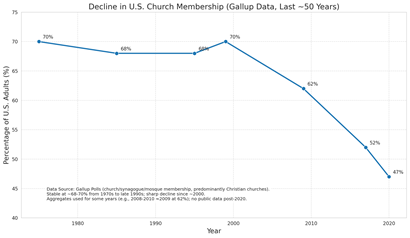
The chart above shows the percentage of U.S. adults who report belonging to a church, synagogue, or mosque over roughly the last 50 years (1975–2020). Gallup has tracked this measure since 1937, when it stood at 73%. It remained high and stable (70% or above through 1976, averaging around 68% through the 1970s–1990s) before a steady and accelerating decline beginning around the turn of the century.
So, the LDS US membership declines, though lagging national trends. Why?
One consideration: C. Peter Wagner (church-growth expert) warned decades ago that prioritizing the “cultural mandate” (social justice/compassion) over the “evangelistic mandate” (gospel proclamation and conversion) leads to “a decline both in membership and in social strength.”
Is the LDS church overly focused on a social/cultural mandate compared to its emphasis on the "evangelistic mandate?"
The LDS "evangelistic mandate" is strong. The success of the LDS missionary effort (evangelistic mandate) is well rehearsed. Worldwide, the Church continues to grow, mostly, though, through missionary efforts outside of the US.
However, does the decline in US LDS Church membership correlate to evidence that the LDS Church has bent to accommodate cultural trends that advance social justice, LBGTQ, or feminist principles?
Grok: ...there is evidence of the LDS Church engaging contemporary racial-justice language and making modest procedural updates (especially around 2019–2020), which some interpret as accommodation to US cultural shifts. However, these are framed [by the Church] as consistent with eternal principles rather than capitulation, and the Church has actively resisted or reversed moves on sexuality and gender that would parallel the more sweeping doctrinal revisions seen in many mainline Protestant churches. The pattern is selective responsiveness on race within a broader commitment to unchanging doctrine on family and identity.
The LDS Church seems to have done a better job than mainline Protestantism in keeping its focus on its evangelical mandate. Still (at least per Grok) the Church has selectively bent to accommodate social justice pressures coming from the broader culture.
The current rise in interest in religion of US Gen Z is due to their realization that living in today's progressive culture where there are few behavioral guard rails does not satisfy. This Gen Z awakening provides an opportunity for the LDS Church, through its successful evangelizing programs, and a rock-solid evangelical message, to focus on the Gen Z awakening to resume US membership growth. Accordingly, the LDS Church should consider doubling down on its evangelical message and bending less to accommodate prevailing, ephemeral, social trends. Targeting Gen Z using the excellent LDS Proclamation on the Family, with double down emphasis on restoration of the time-tested, but fraying, patriarchal order is a good place to start. Methinks LDS membership will resume growth under such a Gen Z targeted program.