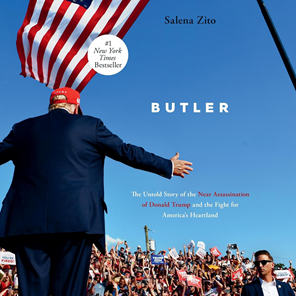
Above: "Butler," by Selina Zito, 256 pages.
I completed reading "Butler," today. The book was recommended by a friend who grew up in the Ohio country east of Cleveland (East Palestine) and west of Butler Pennsylvania.
Beyond the shooting itself, "Butler" is fundamentally about “place.” Zito argues that national media and coastal political elites have long misunderstood or dismissed communities like Butler County—mixtures of farmland, small industry, suburbs, and working-class towns—whose values, rootedness, and economic concerns ultimately decide elections.
Salena Zito’s Butler is a firsthand journalistic account of the July 13, 2024, assassination attempt on Donald Trump at a campaign rally in Butler, Pennsylvania, combined with a broader examination of why places like Butler—and the American heartland more generally—proved decisive in the 2024 presidential election.
Zito, a longtime political reporter for the Washington Examiner and a lifelong resident of western Pennsylvania with deep family roots in Butler County dating to the 1750s, was standing only a few feet from the stage when the shots were fired.
The book opens with a striking historical parallel: in 1753, a young George Washington narrowly survived an assassination attempt by a French-aligned guide in the same county. More than 270 years later, Trump survived a bullet that grazed his ear after he turned his head at a critical moment to look at a chart—an impulsive gesture that Zito and Trump himself later attributed, in part, to divine intervention or sheer chance.
At a book-club event in Park City a couple of years ago, we were discussing "Washington’s Crossing" by David Hackett Fischer. "Washington's Crossing" by David Hackett Fischer | Stephen DeWitt Taylor I drew the same parallel Zito did. I marveled that, but for the near-fatal bullets directed at both Washington and Trump, neither man might ever have become president. I mused about what U.S. history would have looked like had either been assassinated. One book club member replied, “Trump was never grazed by a bullet.” Well, that was that. Trump Derangement Syndrome (TDS) has a way of shutting down a lot of potentially interesting discussions.
Zito provides a vivid, moment-by-moment reconstruction of the Butler chaos in 2024: the gunshots, Trump’s reaction, the Secret Service response, the death of spectator Corey Comperatore, and the wounding of others. She was tackled to the ground by a staffer for her own safety and continued reporting throughout the aftermath, including multiple phone conversations with Trump in the hours and days that followed.
Beyond the shooting itself, Butler is fundamentally about “place.” Zito argues that national media and coastal political elites have long misunderstood or dismissed communities like Butler County—mixtures of farmland, small industry, suburbs, and working-class towns—whose values, rootedness, and economic concerns ultimately decide elections. Zito weaves in interviews with local residents, rally attendees, law enforcement, Trump campaign figures (including JD Vance), and even Elon Musk to illustrate a political realignment: working-class voters shifting toward Republicans while Democrats became associated with elite institutions.
The book traces how the near assassination, combined with other 2024 events, reinforced Trump’s image of resilience and strengthened his connection to these voters, contributing to his victory. Zito’s access is extensive—she had spoken with Trump just before the rally and maintained contact afterward—lending the narrative an intimate, on-the-ground quality.
Critics have noted Zito's evident sympathy for Trump and her critique of mainstream media failures, while supporters praise her as one of the few reporters who consistently covers the people and places that actually drive electoral outcomes. In roughly 250 pages, Butler functions both as a dramatic eyewitness chronicle of a defining moment in modern American politics and as a longer meditation on cultural and geographic divides. It underscores Zito’s central thesis: to understand national elections, one must understand places like Butler.
I read Zito's 2018 book, "The Great Revolt: Inside the Populist Coalition Reshaping American Politics (2018), co-authored with Republican strategist Brad Todd. "The Great Revolt" by Salena Zito and Brad Todd | Stephen DeWitt Taylor Salena Zito drew on extensive on-the-ground interviews with more than 300 Trump voters across ten swing counties in the Midwest “Blue Wall” states (Pennsylvania, Ohio, Michigan, Wisconsin, and Iowa) plus a large custom survey to argue that Donald Trump’s 2016 victory was not a fluke or mere protest vote but the emergence of a durable populist coalition of working-class, localist, and culturally rooted Americans who rejected both parties’ elites, globalization, and coastal cosmopolitanism in favor of pragmatism, economic nationalism, and respect for their communities. Its meaning and lasting import lie in reframing the “Trump voter” beyond simplistic stereotypes (angry, rural, racist), identifying distinct voter archetypes, and demonstrating a fundamental realignment that has continued to reshape American politics long after 2016 by highlighting how overlooked heartland places and values—not coastal media narratives—decide national elections.