2015 - Gallipoli
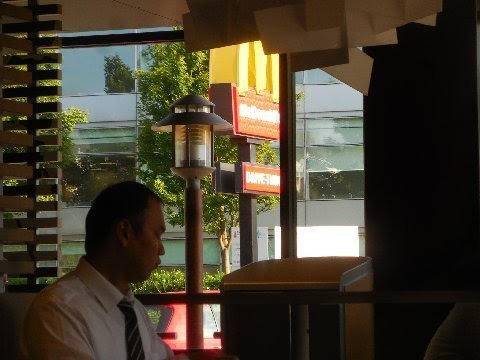
Above: Customer at McDonaldls. Heathrow, UK. 10 June 2015.
Overnight in Heathrow at the end of the Isle of Man trip before flying to Istanbul, Turkey tomorrow morning.
I stopped at McDonalds in Heathrow's hotel area for a cup of coffee and to check email after a long walk.
I noted in news,, yesterday, that McDonalds had hired Robert Gibbs with the objective of making McDonalds "a more progressive burger company."
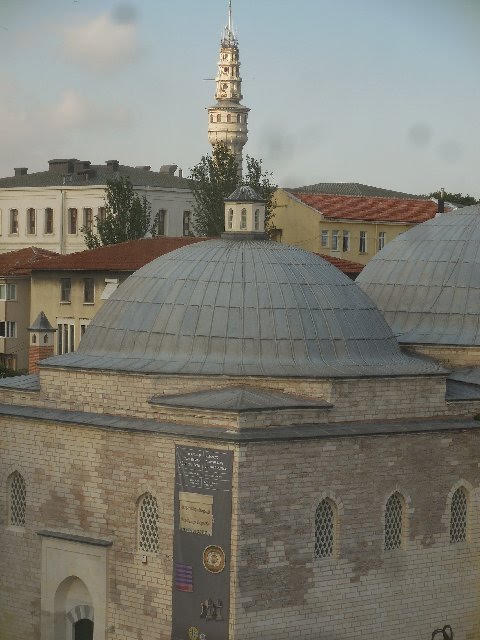
Above: Mosque. Old City, close to Sultanahmet. Istanbul, Turkey. 11 June 2015.
Listening to the call to prayer from my hotel room window. Kent Hotel.
"The sweetest sound I know is the Muslim call to prayer." Barack Hussein Obama
This is my third trip to Istanbul in the last 12 months and the fifth trip since I retired in 1998.
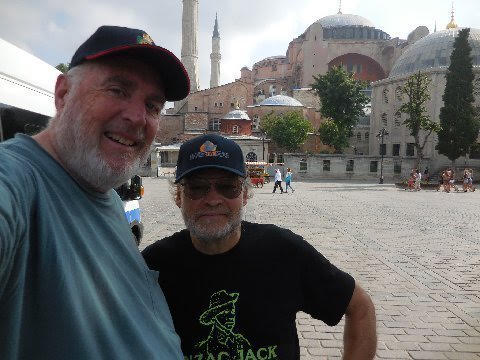
Above: The Bishop and Malcolm. Haggia Sophia in the background. Istanbul, Turkey. 12 June 2015.
The two of us are about to embark on the eight day long Sapper Gallipoli Centenary Tour, organized by The Royal Australian Engineers (Sappers). We embark for Gallipoli tomorrow, 13 June 2015.
Malcolm's grandfather is "ANZAC Jack" Moore, a WWI Gallipoli survivor whose five year, war time letters and photographs have recently been published by Malcolm's dad, ANZAC Jack's son, J. H. Moore. The Sappers invited Malcolm and his father to join the tour, managed by Baronia Travel Center in Melbourne. Malcolm's father, 90 years of age, did not feel sufficiently fit to make the long trip. On hearing of the program from Malcolm, I expressed an interest in the possibility of going along. I would complete a trip to the Isle of Man TT just before the Sapper Gallipoli started... the timing was right. Malcolm obtained Sapper Core Commander Wayne Budd's approval for me to join the Gallipoli Sapper tour as "family."
I had some background knowledge on the WWI Anzac landings in Gallipoli. TIMDT and Mwah (sic) had lived in Australia for five years (1974-1979) and Mwah (sic) knew how important Galippoli was to the Oz national psyche. Mwah (sic) has visited the Australian War Memorial Museum in Canberra to see the extensive Gallipoli exhibit, and made two, albeit short, prior visits to Gallipoli. Here was an opportunity to have a vivid look, real time... "real ground"... at one of the important conflicts of WWI at its centenary.
Mwah (sic) is indebted to Malcolm and the Sappers for allowing me along on the tour.
Gallipoli Overview
By the beginning of 1915, the war between the Allies (UK, France, Russia) and the Central Powers (Germany, Austria Hungary), WWI, had reached a stalemate along a 350 mile long line of trenches between Switzerland and Belgium, through France... the Western Front. A million allied casualties had already been suffered in the months follwoing the war's start in August, 1914.
As Russia struggled against Central Powers Germany and Austria Hungary on the eastern front, she asked for assistance from her allies, England and France: Take some of the pressure off of us. Open another front. Take the Dardanelles from the Ottomans, now aligned with the Central Powers. Take Constantinople (and the Turks out of the war). Open our warm water ports... Sevastapol, Odessa... to the world.
Allied troops were in short supply and needed on the Western Front. So, First Lord of the Admiralty, Winston Churchill, convinced the British War Council that a sea assault with no troop landing could clear the mines and neutralize the forts at "the Narrows" in the Dardanelles, and open the path for the Allies to take Constantinople. In March 1915, an allied flotilla of some 30 capital ships entered the straits. Three allied capital ships were lost to strategically placed Turkish mines and the allied flotilla retreated in a failed attempt to secure passage through the Dardanelles (Hellespont in classical Greece)
The Allies, stung by their naval failure, decided to make a troop landing on the Gallipoli peninsula, take out the forts and mines protecting the Dardanelles in order that a renewed sea assault on Constantinople be undertaken.
On 25 April 2015, under the authority of sector commander Ian Hamilton, some 70 thousand allied troops, including 25 thousand Australians and New Zealanders (Anzacs), recently requisitioned from Egypt, where they were undergoing training, invaded the Gallipoli peninsula.
Attacking Allied troops, British, who landed on the south tip of the Gallipoli peninsula - The Helles, and Anzacs at Anzac Cove, who landed on the peninsula's west side on the Aegean Sea, failed (but barely in the Anzac sector) to reach their respective, anticipated high ground objectives, Achi Baba and Chanuk Bair, respectively, within the first few days of fighting.
French troops landed on strategic ground on the Asian side of the Dardanelles with the hope of neutralizing Turk guns shooting at the five British landing sites on the tip of peninsula. Allied ships provided gun support to the landings.
After the first week of fighting, stalemate resulted at trench lines in both fighting sectors where neither neither the Turks nor the Allies were able to gain an advantage on the other.
On 09 May 1915. The Turkish 19th Division, under Mustafa Kemal (later to become Ataturk and first president of modern Turkey), mounted a massive counter attack on the Anzacs at Quinns Post on 2nd Ridge - front lines. The attack failed and resulted in 10,000 Turkish casualties with only two or three hundred Australian casualties.
On 06 August 1915, the Allies began a second offensive to reach high ground in the Sari Bair range in the Anzac sector. A Kiwi platoon got close, reaching Chunuk Bair, within sight of the straits, but, British troops, who had replaced the exhausted Kiwis, were repelled by the Turks and retreated from the high ground earlier captured by the Kiwis.
An 06 June 2015 landing of British troops north of the Anzac sector at Suvla Bay to bolster the allied assault on Chunuk Bair was also stymied in the early fighting. While the British landing at Suvla Bay carved out new Allied occupied ground, it was not successful in achieving its objective. The Suvla invaders established a trench line and enabled contact along the beach with the Anzacs. But the operation was of no help in the Allied effort to achieve high ground at Chunuk Bair.
On 28 August 1915, Allied forces attempted,unsuccessfully, in serious fighting, to secure Hill 60, an inland midpoint between the Suvla sector and the Anzac sector.
During late December of 1915 and early January 2016, the Allies evacuated their land positions at Gallipoli confirming a misbegotten effort to take Constantinople and to open Russia's warm water ports to the Mediterranean Sea.
Oz Sappers' Waterloo Dinner
The Gallipoli campaign, where eight thousand Australian soldiers and 2500 Kiwi soldiers lost their lives, looms large in the psyche of Australians. Australia's national day is Anzac Day, 25 April. An extensive commemorative centenary remembrance was held in Gallipoli on Anzac Day, 25 April, 2015. The ANZAC sappers were among the first Anzac troops to make landfall at Galllipoli during the early AM of 25 April 1915. So why are the Australian Sappers coming to Gallipoli almost two months after the official Anzac centenary celebrations in April?
The most important "Anzac day" for the Sappers is 18 June, ironically the date of Napoleon's demise at Waterloo, in 1815. It was on 17 June 1915 that the sappers completed the building of a pier in the Gallipoli landing area at Anzac Cove. Sapper Stanley Watson was chief engineer responsible for the pier. The next day, 18 June 1915, the successful sapper pier builders held a commemorative dinner on the beach to celebrate their accomplishment - Watson's pier They noted the coincidence of the date to the 100th year centenary of the battle of Waterloo and called their dinner "the Waterloo Dinner."
.
Post war, in 1924, sapper alums revived the Waterloo dinner tradition and the annual dinner has continued to this day. That this year's main Waterloo dinner is on the 100th year anniversary of the completing of Watson's Pier, and on the 200th year anniversary of Wellington's victory at Waterloo, makes this dinner a special event.... special enough to hold in Gallipoli itself. A sapper memorial service will be held at Anzac Cove, at the site of the original pier (elements of which can still be seen by underwater divers) and the dinner will be held at a hotel nearby. Other Waterloo dinners will be held where their are concentrations of Australian sappers... Kabul, Washington D.C. to name a couple.
The Sapper Gallipoli Centenary Tour is comprised of currently serving sappers, sapper veterans, spouses, descendants of Gallipoli veterans, and a few "other" like Mwah (sic), who, apart from Turkish guides, is the only non Oz/Kiwi on the tour.
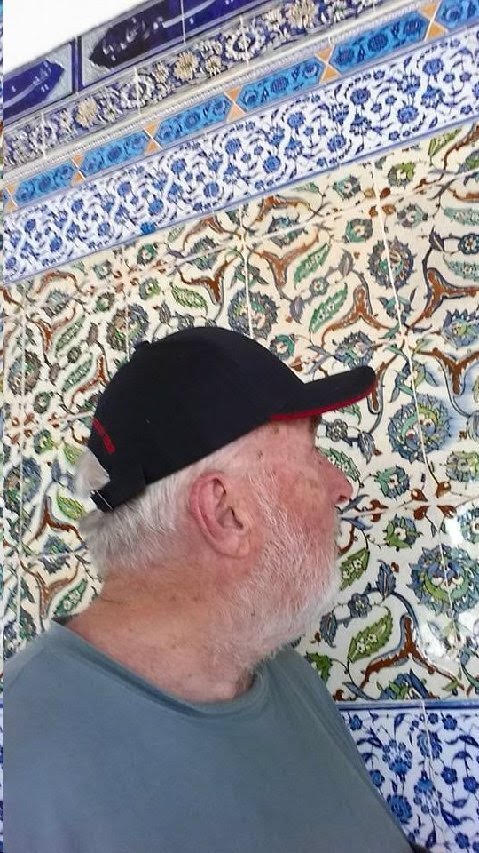
Above: The Bishop, mesmerized, gazes at the tile on the wall of the Sultan's harem. Topkapi Palace. Istanbul, Turkey. 12 June 2015.
Is it within these intricate designs, that witnessed a thousand palace intrigues over the 500 year course of the Ottoman Empire, where the Bishop will finally find the meaning of life?
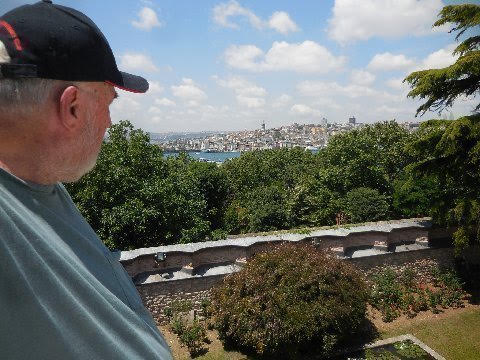
Above: The Bishop views Begolu district of Istanbul, across the Golden Horn from Topkepi Palace. Istanbul, Turkey. 12 June 2015.
TIMDT and the Bishop were in Istanbul a year ago at this time. After staying a night, we flew to Trabzon, picked up motorcycles with Lotus friends, and rode through Georgia, Armenia, Azerbaijan, and Russia for 18 days.
In September of 2014, TIMDT and Mwah (sic) returned to Istanbul, where, among others we enjoyed a delightful dinner at Tugra, Curagan Palace Kempinski Hotel with 1%, Comic Mom, Oz, and Bridge.
This is The Bishop's third visit to Istanbul in the last 12 months, and fifth visit, overall.
In 1964 The Bishop boarded a train in Istanbul bound for Sofia, Bulgaria.
In 2005 The Bishop and TIMDT motorcycled around western Turkey... including, Istanbul, Safranbolu, Cappadocia, Konya, Antalia, Bodrum, Ephesus, and Gallipoli.
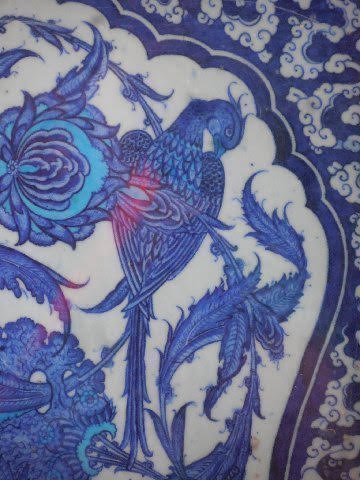
Above: Phoenix bird in tile at Topkepi Palace. Istanbul, Turkey. 12 June 2015.
Out of ashes comes a rebirth. A symbol of civilizations waning and waxing over the course of Anatolian history. The more things change... the more things stay the same. Who's next?
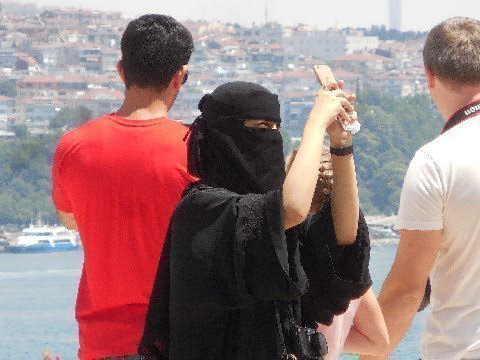
Above: Hijab clad... person (probably a woman) with cell phone/camera. Topkepi Palace. Istanbul, Turkey. 12 June 2015.
The contrast between deep religious tradition in the dress and the casual use of high technology seems dichotomous. Just sayin'.....
"Essentially the great question remains: Who will hold Constantinople?"
Napoleon
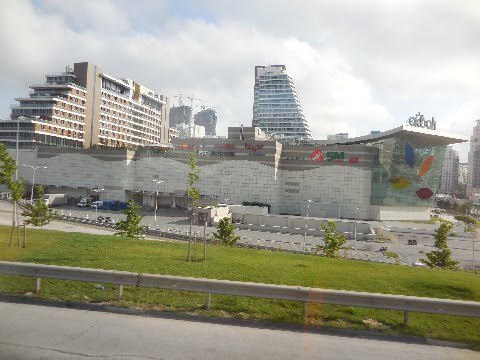
Above: Buildings along highway from Istanbul going west along north coast of Sea of Mamara. Istanbul, Turkey. 13 June 2015.
Scenes of such new construction and growth are not isolated in Istanbul.... or Turkey, for that matter. Last year we noted much new sea side construction from Trabzon, along the Black Sea coast, into Georgia.
One gets the impression of vibrancy and progress in Turkey.
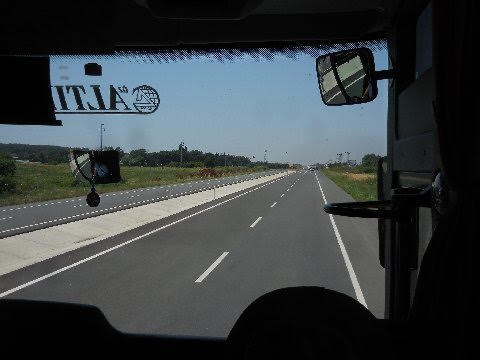
Above: Highway heading south onto Gallipoli Peninsula. 13 June 2015.
I motorcycled this highway coming the opposite direction as shown, from the south, 10 years ago. Then, this section, now four lanes, was a well constructed two lane highway.
Again... progress... not stasis. In sharp contrast to what I saw in Cuba two years ago.
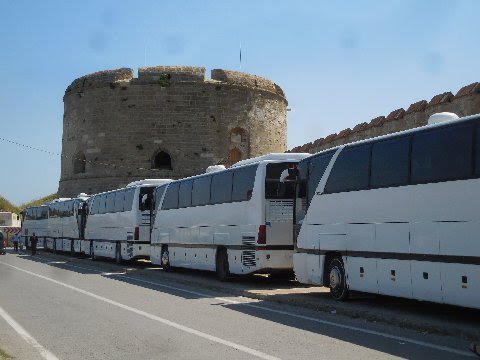
Above: Tour busses parked near Kilitbahir Castle fort located at Kilid Bahr on west side of Dardanelles "Narrows," the narrowest spot on the Dardanelles. 13 June 2015. Near Eceabat, Turkey.
The two sides of the Dardanelles Narrows are only a mile a part. The sister Narrows fort on the eastern (Asian) side is located in Canakkale.
Similar Ottoman era forts were also located at the European and Asian entrance points to the Dardanelles.
Any would-be invader by sea to Istanbul would have to get through the heavy Turkish guns found at these forts.
Turkish Tourist Busses
I'd like to have the tour bus concession for Turkey. All of the manufacturers make what seems like the same model bus, and most of the tour busses are white like the ones seen here. Our bus was a well appointed Mercedes Benz.
There are no jalopy tourist busses. The Turkish government licenses only tourist busses that are less than five years old.
The Sappers Gallipoli Centenary Tour with over one hundred participants fills up three of these busses. Each bus has an Anzac battlefield guide - in our case, a retired Australian infantry Colonel, and a Turkish guide. The three groups operate independently of one another.
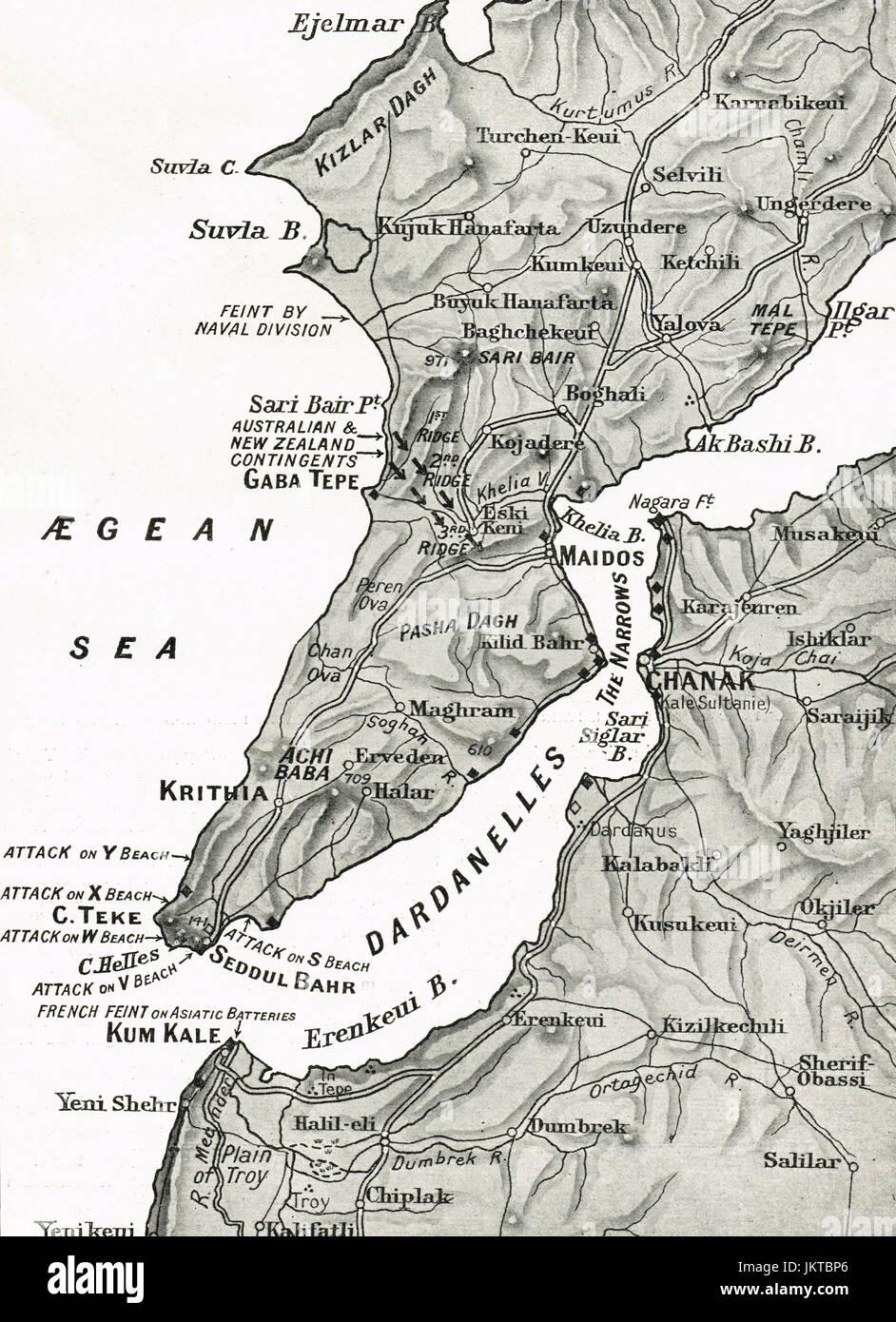
Above: Map of Gallipoli peninsula and The Dardanelles.
Note "The Narrows."
In March 1915, during World War I (1914-18), British and French forces launched an ill-fated naval attack on Turkish forces in the Dardanelles in northwestern Turkey, hoping to take control of the strategically vital strait separating Europe from Asia. The failure of the campaign at the Dardanelles, along with the campaign that followed later that year in Gallipoli, resulted in heavy casualties and was a serious blow to the reputation of the Allied war command, including that of Winston Churchill, the British first lord of the admiralty, who had long been a proponent of an aggressive naval assault against Turkey at the Dardanelles. (History Channel)
An invader from the sea, trying to get to Constantinople, would not only have to get past the guns at forts guarding the entrance and The Narrows of the Dardanelles, but also an extensive mine field.
"Britannia Rules the Waves" took a hiatus in the Allied March 1915 campaign to force the Narrows. The defeat broke a 200 year old string of British naval victories.
The Ottoman empire at the time was called "the sick man of Europe." The Turks had lost a war in 1912 in the Balkans. They were losing influences in far flung reaches where they had been dominant for 400 years... Egypt, the Levant, and the Caucasus. British war planners... arrogant in hindsight.... thought capturing the Dardanelles and pushing on to Constantinople would be a push over.
The March 18 naval victory was a shot in the arm for the Turks. National esprit de corps took an upswing, troops were amassed to meet an expected land assault on
Gallipoli, and "self confidence" of leaders was bolstered to an extent that they initiated an ill conceived genocidal campaign against their minority Armenian population whom they believed to be sympathetic with the allies. The border between Armenia and Turkey remains closed to this day. Armenians seethe to this day, 100 years later.
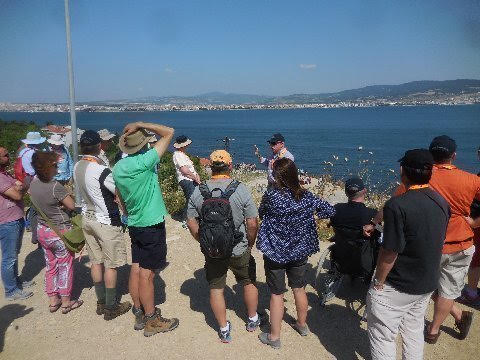
Above: Sapper Gallipoli Centenary tour goers from Bus One, our bus, listen to Rod Margetts, battlefield tour guide, explain the 18 March 1915 failed attempt by the allies to "force the Narrows." Kilitbahir Castle fort. Near Eceabat, Turkey. 13 June 2015.
Beyond are the Narrows of the Dardanelles, and the city of Canakkale on the Asian side.
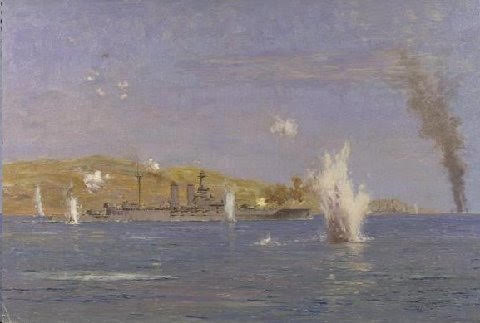
Above: Artists rendition of The Queen Elizabeth, England's newest battle ship, trying to force the Narrows on 18 March 1915. The Queen Elizabeth and the allied flotilla turned back after three capital ships were lost to newly placed mines in locations not anticipated by the Allies.
Over the previous six weeks, the British had tried to eliminate Dardanelles mines using private fishing boats brought from England. The process had worked for them in the English channel... but, there, there was no one shooting at them from forts and gun emplacements. The Dardanelles fishing boat captains had no problem trying to get rid of the mines... a relatively easy job... but, they said they didn't sign up for being shot at.
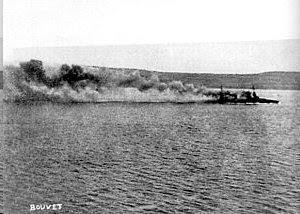
Above: French battleship Bouvet sinking after hitting a mine in the Dardanelles.
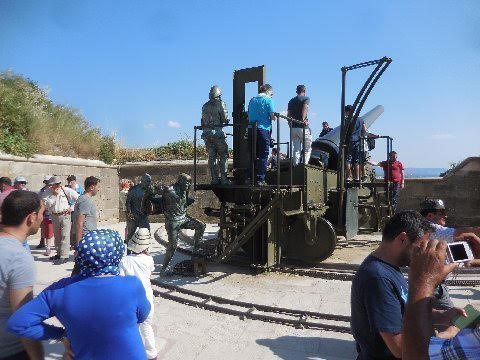
Above: Turkish gun emplacement at European side Dardanelles Turkish fort. 13 June 2015.
Malcolm is standing on platform - blue shirt.
The statue at "7:00 o'clock" from Malcom, at the base of the gun steps, is a representation of Seyit Ali Cabuk, carrying an artillery shell on his back. He is usually called Corporal Seyit. He is famous for having carried three live shells, otherwise seemingly impossible for one man to accomplish, to an artillery piece during the Allied attempt to force the Dardanelles on 18 March 2015.
As the story goes, most of the soldiers manning the fort gun seen here were killed by Allied shelling from battleships entering the Dardanelles. The rail cart and rail system used to transport shells from the nearby magazine to the gun were also destroyed. Corporal Seyit, seeing an Allied battleship making its way up the strait, took it on himself to bring shells to the gun, and knock out the ship. Or.... so the story goes.
A country needs uplifting examples of heroism to bolster and sustain national pride. Corporal Seyit, whether he truly single handedly took out an Allied battle ship or not, seems to have penetrated deeply into the Turkish psyche in this regard. We watched Turk tourists reverently touch the statue of Corporal Seyit. Some were crying.
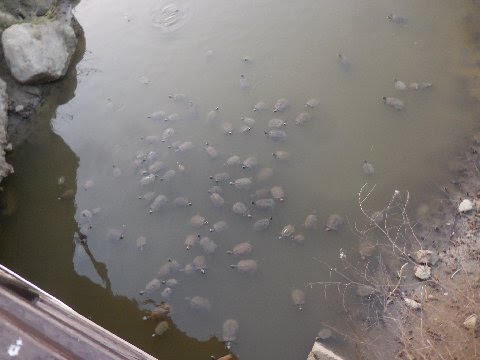
Above: Turtles waiting for a feed. Kum Hotel, Eceabat, Turkey. 13 June 2015.
Addendum:
very cool. thanks Steve.
Brand Man,
Venice, CA
Taylor, a closet Muslim?
Privateer,
Hancock, ME
great Steve.
thanks.
(for me, english spoken in parts of england are the most difficult to understand :)
Brand Man,
Venice, CA
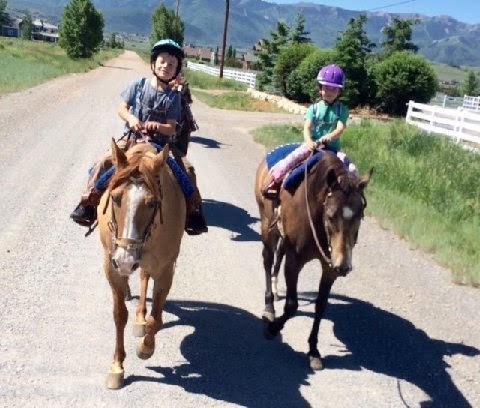
Above: Drums and Mynduveroan on trail ride.
Image by FeeBee.
U forgot Ataturk's famous line.....I am in Kanab; jealous as usual.
Comic Mom,
Kanab, UT
Well... I haven't got to that yet!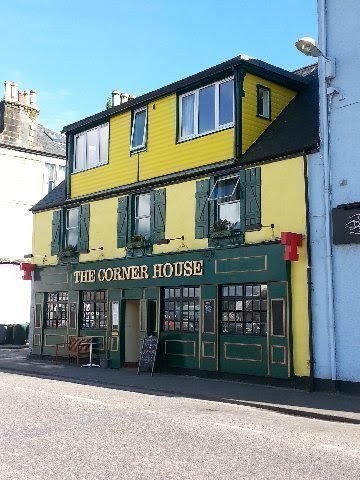
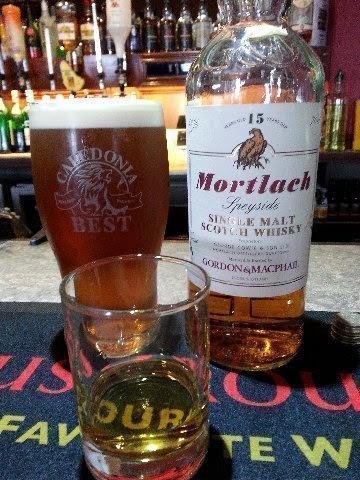
Above: An Imperial pint of Caledonia Best Bitter and a dram of 15 yr. old Mortlach Single Malt from Speyside in the Highlands.
All for £7.10 or roughly $11.70 in the Corner House in Tarbert, Scotland.
Exceptional!
Keith, Riding somewhere in Scotland.
Steve,
Thanks for sharing this very intriguing story.
Was a pleasure getting to know you.
Keep the stories coming.
Lynn,
Boise, ID
Thought you might enjoy these...
Keith, Riding somewhere in Scotland
Steve, I am sure the elusive meaning could possibly be found in an IoM side hack doing triple digits with one returning to primate roots as a monkey.
Jay, San Angelo, TX
Good on ya, mate! Pls give our best to ANZAC Jack’s grandson!!!
Morgan, Chicago, IL
Really enjoying the Isle of Man TT through your picto diary also on velocity TV. Also I don't think enlightenment/meaning of life can be found in the bank or money. I hope to say hello to you in Park city sometime next month. Keep up the excellent reporting we all enjoy.
Jay, San Angelo, TX
Keep me posted on your schedule. Love to see you.
E – none of these.
Being as bereft of any sense of judgment as you are, you are inevitably going to be looking in the wrong place.
It’s too bad that you don’t grasp this, because you are basically a very nice and decent person.
Jack Aroon, Mahwah, NJ
The night came on and found us fairly well dug in. During the night the Turks made determined efforts to drive us, as we had driven them in the morning but their efforts were useless for their nerve failed every time when they reached close quarters to that line of steel. Their wild rushes gave us our opportunity to revenge our heavy losses during the day. In the morning we had the satisfaction of seeing the result of our work, but among those dead Turks lay many of our own mates. The position now presented before us was that we were entrenched on one side of a gully and the Turks on the other at a distance of from 30 yards in some places, jp to 300 at others and along a front of over 1 1/2 miles with the gully in between full of dead Turks.
"Anzac Jack" Moore
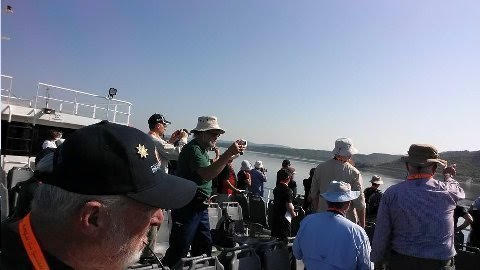
Above: Sappers (Royal Australian Engineers) and The Bishop at left wearing cap. Survey Anzac cove from the water. Aegean Sea, Gallipoli Peninsula Turkey. 14 June 2014.
Between 25 April 1915 and 01 May 1915 25 thousand Anzac troops landed on this beach. The story of the Anzacs and their participation in the Gallipoli campaign is one of the most heralded stories of World War I.
Objective? Assist in a multi force Allies effort headed by British General, Ian Hamilton, to take the Gallipoli peninsula from the Turks who were allied with the Central Powers (Germany, Austria/Hungary). Anzac occupation of the heights (Sari Bair range) two miles beyond the beach would enable (or so military strategists felt) troops to reach the other side of the 7 mile wide peninsula to take out Turkish forts and gun emplacements guarding the Dardanelles Narrows.
With the The Narrows neutralized, the allied fleet, which had failed on its own, five weeks previously, 19 March 1915, to "force the Narrows," could sail unimpeded through the Dardanelles and into the Sea of Mamara to "take" Constantinopole and the Bosphorus. Turkey would be "out of the war." Russia's warm water ports of Sevastapol and Odessa would be opened enabling reliable allied supply lines to Russia. A stronger Russia on the Eastern Front would help break the stalemate of killing along the Western Front.... or so the hypothesis went.
The effort ultimately failed. Eight months later, in December 1915, Anzacs (and other allied troops in other beach head locations on the peninsula, were evacuated. Anzacs suffered 28,150 casualties (8709 dead and 19,441 wounded). Total allied casualties were 141,029 (44,092 dead and 96,937 wounded. Turkish casualties were 251,309 (86,692 dead and 164,617 wounded).
Gallipoli became a defining moment for Australians and set the course for Australian self determination. Australia remained in the British Commonwealth... but decisions going forward as to the use of Australian troops would be made by Australians and not British. The diggers, (the name for Australian troops derived from their Gallipoli experience) went on to play a distinguished and important role in the trenches of the Western Front. A nation, with no history of warfare participation, came of age in WWI.
Gallipoli set up a whole set of "woulda, coulda, shoulda" introspections.
One:
After the March 18, 1915 sea battle fiasco at the Dardanelles five weeks before the landing, Churchill, First Lord of the Admiralty wanted to attack again, the next day. British Admiral on the spot, De Robeck, stung after having lost three capital ships, temporized. The War Council decided to hold... to amass an invasion force (including the 25,000 Anzac troops stationed in Egypt), and mount a joint sea land effort to force the Dardanelles in April, five weeks later
Only later, post war, did the Turks admit that they fully expected the Allies to succeed in their sea assault. The Turks had expended virtually all their ammunition and Constantinople had prepared to destroy assets that might be valuable to the Allies. Likely, had Churchill's advice to attack the second day been followed, Constantinople would have been in allied hands, and the misbegotten invasion would have never taken place.
And another:
The Anzacs landed two kilometers further north, on the difficult ground at Anzac Cove, rather than at the intended location of easier ground Gaba Tepe.
The Gallipoli invasion was the largest troop landing in war time. No one had ever attempted a landing on this scale. With little moonlight, young, inexperienced pinnace pilots, towing troop laden boats missed their objective.
Had the landing taken place on "easier ground" the likelihood of reaching high ground on the Sari Bair range would have increased, guaranteeing invasion success.... or so goes the second guessing.
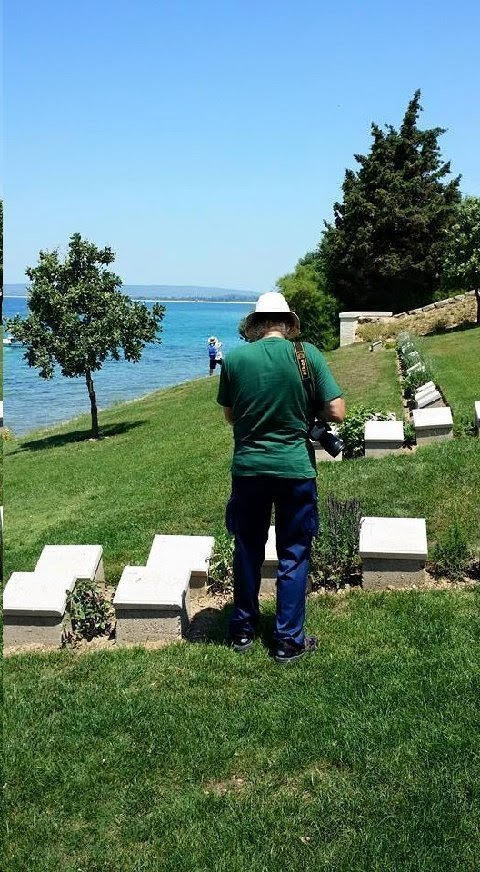
Above: Malcolm reflects at an Australian soldier grave stone. Beach Cemetery. Anzac Cove. Aegean Sea. Gallipoli peninsula. 14 June 2015.
Malcolm's grandfather, Anzac Jack, participated in the first landing at Anzac Cove. Anzac Jack, no doubt, knew many of the soldiers who lost their lives on the initial assault to the beach, some of whom are buried here.
There are a number of cemeteries around the Gallipoli peninsula. Post war authorities decided that the fallen soldiers should be buried near the battles and skirmishes where they actually died.
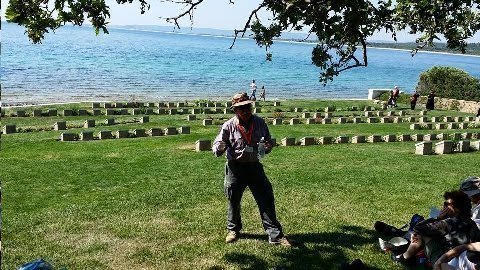
Above: Rod Margetts, battlefield guide. Ari Burnu Cemetery, Anzac Cove Aegean Sea. Gallipoli peninsula. Turkey. 14 June 2015.
Here Rod describes the misbegotten Anzac beach landing. Wrong beach and questionable decisions after the landing ultimately stymied the mission's success. Anzac and Turkish troops ended up facing off against one another in a trench war stalemate roughly a mile inland from the beach... half way to the Sari Bair high points needed to (or so it was felt) ultimately take the Dardanelles in a combined land and sea effort.
So far, our tour is an exceedingly well organized effort. Magetts is a 30 year, retired infantry Colonel, from the Australian Army. He served in Vietnam, commanded combat efforts in Iraq and Afghanistan, and spent three years at Centcom Tampa... obviously a highly regarded Australian military officer.
Margetts is an amateur historian... his knowledge of the Gallipoli Battlefield is prodigious. He has a stentorian, military voice... easy to hear... sense of humor, and he does not waste one word in his communication.
It is easy to see how, as a military leader himself, he can empathize with the young Anzacs, bringing their stories vividly to life as we stand here on the beach where they fought.
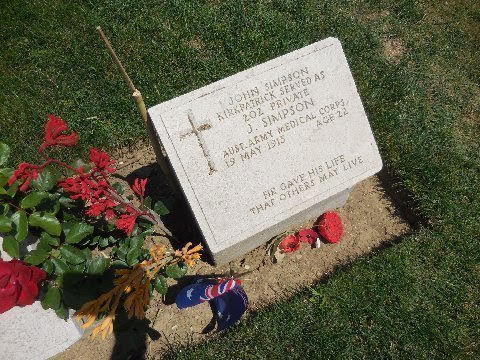
Above: Headstone of John Simpson Kirkpatrick. Ari Burnu Cemetary. Gallipoli, Turkey. 14 June 2015.
John Simpson, as he became known, is the reciprocal of Turkish Corporal Seyit. Both Seyit and Simpson enabled military and political leaders to buoy their home populations with uplifting and patriotic stories... "positive" war stories with which everyone could identify.
Simpson was a stretcher bearer with the Anzac corps. After landing at Anzac cove on 25 April 1915, Simpson began to use donkeys to provide first aid and carry wonded soldiers to the beach, for evacuation. Simpson and the donkeys continued this work for three and a half weeks, often under fire, until he was killed. Simpson and his donkey are a part of the Anzac legend.
Rod Margetts hastens to tell us that there were many, equally heroic stretcher bearers, many of whom performed their work for the entire eight months of the Gallipoli campaign.
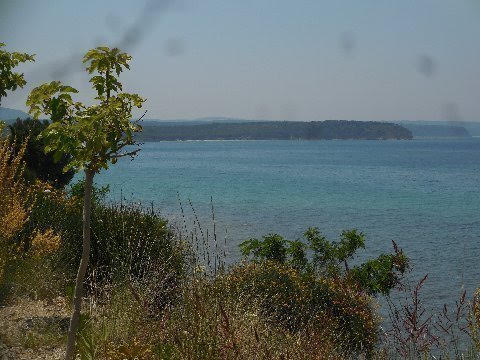
Above: Gaba Tepe peninsula, as seen from Ari Burnu, Anzac Cove. Gallipoli Peninsula, Turkey. 14 June 2015.
The beaches this side of the peninsula are about two kilometers away from where this image is being captured. These are the original intended beaches for the Anzac landing..., and the terrain opposite these beaches is not as difficult as the steep and gnarled, cliff and ravine terrain above Anzac Cove.
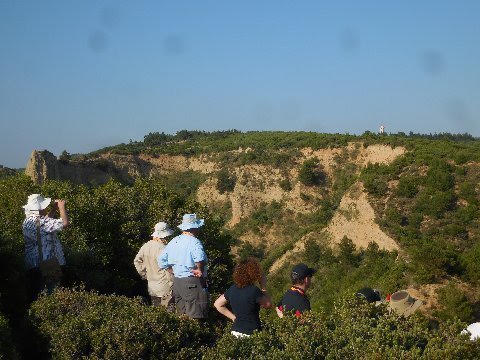
Above Sapper Tour members contemplate the gnarled ravines, cliffs and steeps that had to be negotiated by Anzacs. Gallipoli, Turkey. 14 June 2015.
Image is captured from Plugge's Plateau a key high point held for eight months by Anzac troops. In the distance is 2nd Ridge. The Lone Pine Cemetery monument can be seen atop the ridge. A large portion of the front line trenches were along 2nd ridge. It can be seen that the Anzacs made a good deal of progress inland, but a view from the top of 2nd ridge would show that the Anzacs were still a long way off from the objective high ground on Sari Bair.
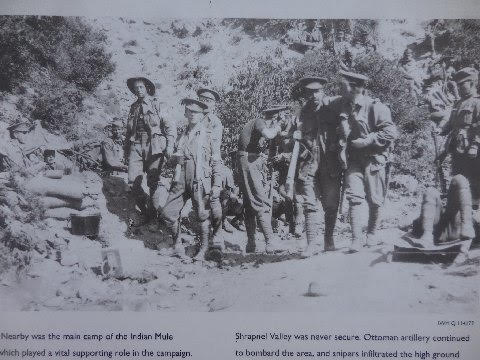
Above: Image of Anzac Troops on story board at Quinn's Post. Gallipoli, Turkey, 14 June 2015.
Quinn's post was a key trench position along the front line at 2nd ridge.

http://m.ba-bamail.com/View.aspx?emailid=16013&source=mobile_share
Aunt Joyce,
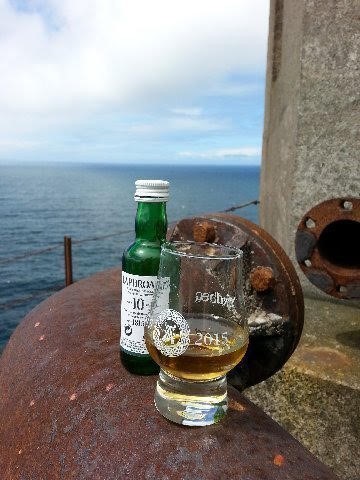
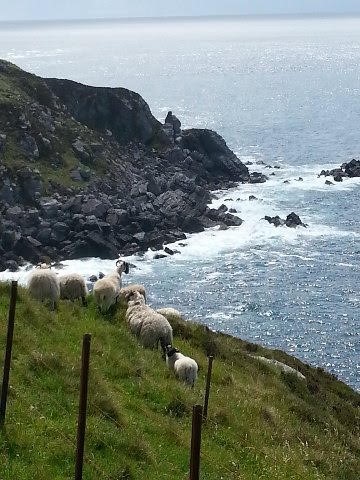
Keith, Somewhere in Scotland
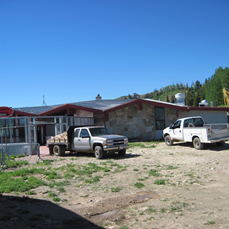
Top of Mother Lode lift. Behind the Demo Shack is the top of the old King Con terminus, bull wheel, auxiliary motor. New tower footings at top are already in place.
View of bottom of Silver Lode lift taken from top of Prospector Face. It appears that the new Snow Hut will be large. Not in photo, but they have cut a swath of trees out for the Canyon Gondola. Work is also underway at the top of Pine Cone ridge for the Gondola, giving a clear indication where the lift will be located.
TWO3,
I was on a motorcycle tour and just finished it last night to return to Istanbul. Steve, I am sorry I could not see you while you were in Istanbul. Sounds like you are on a wonderful tour even though your mode of transportation is not motorcycles.
Kaz, Istanbul, Turkey
Re the meaning of life, Steve, I think you figured it out a while ago. Seems you certainly are living it. Claire and I head for a three week tour (our first time there) of Turkey in September. We are doing this one with 'Road Scholar' - the folks who used to be known as Elderhostel. Nice to have the level of pre-input you are providing. Hope to talk to you before then about this part of the world. Thanks for the info and pix!
Poughkeepsie, NY
One gets the impression of vibrancy and progress in Turkey.
Who’s Going to Save Turkey’s Economy?
The Turkish economy is in dire straits. But its leadership is showing no interest in serious reform.